




University College London: A Masterpiece of Academic Architecture
It stands as a physical argument for knowledge itself, a city of learning built from stone and ambition. This is not a single style but a conversation across centuries, where neoclassical gravity meets modernist light. The campus forms an intellectual map, its evolving architecture charting the very history of progressive thought. To walk its quadrangles is to move through a living timeline of educational ideals, each facade a chapter in a bold experiment.
The Historical Vision: UCL’s Foundational Architecture
The founders sought a new kind of temple, one dedicated not to divinity but to human reason and secular inquiry. Their architecture deliberately rejected the Gothic cloisters of Oxford and Cambridge, which spoke of ecclesiastical tradition. Instead, they chose the clean lines and democratic ideals of Greek revivalism, borrowed from the ancient world’s cradle of philosophy. This was a built manifesto, declaring that education should be open, rational, and accessible. The very stones were laid to challenge the established order of British society.
The Radical Spirit of 1826: A University Without Walls

This institution was conceived as a deliberate breach in the walls of privilege that surrounded higher learning. It admitted students regardless of religion and focused on practical, modern knowledge alongside the classics. Architecturally, this spirit meant creating open, accessible spaces rather than closed monastic courtyards. The university was to be integrated into the fabric of London itself, a part of the city’s bustling intellectual and commercial life. Its radicalism was not just in its curriculum but in its very relationship to the world outside.
William Wilkins and the Original Neo-Classical Quadrangle

Wilkins provided the dignified face for a revolutionary idea, wrapping radical intent in a cloak of respectable classicism. His grand portico, inspired by the Temple of Hephaestus in Athens, immediately conferred legitimacy and gravitas. The quadrangle created an ordered world of contemplation, a serene counterpoint to the chaotic city. Yet this classical shell contained a profoundly modern core, a deliberate and potent architectural irony. It established a formal language of enlightenment that subsequent architects would both respect and reinterpret.
Expanding the Vision: The Bloomsbury Campus Takes Shape

The 20th century saw the original quadrangle become the heart of a growing academic district, a true campus woven into Bloomsbury. Each new building, from the brutalist concrete of the Institute of Education to the sleek curves of the Student Centre, added a new voice to the dialogue. The expansion was less about uniform style and more about creating a dynamic ecosystem of spaces for collaboration and discovery. This organic growth turned the university into a microcosm of architectural history, where every era left its confident mark.
Post-War Reconstruction and Modernist Interventions

The aftermath of war demanded an architecture of optimism, clarity, and forward-looking function. Modernist buildings like the Chadwick Building embraced glass, steel, and open plans to express transparency and progress. These structures spoke a new language of light, efficiency, and social purpose, breaking with historical imitation. They asserted that the university’s mission was ever-evolving, not preserved in stone. This period wove threads of bold modernity into the fabric, proving the campus could honor its past without being imprisoned by it.
Architectural Anatomy: Deconstructing the UCL Campus
The campus is not a singular statement but a curated collection of architectural philosophies. Each building is a chapter in a visual debate about knowledge, power, and civic identity. Walking its grounds is to trace the intellectual history of the institution itself, made manifest in stone, concrete, and glass. This anatomical study reveals how contrasting styles create a dynamic whole greater than the sum of its parts.
The Iconic Portico: Symbolism and the Greek Revival Facade

This grand colonnade is a deliberate transplant of Athenian democracy onto London soil. It frames the university not as a secluded cloister but as a public institution open to the city and the world. The facade communicates stability, rationality, and a direct lineage to classical ideals of truth and beauty. It is a permanent manifesto, declaring that education is the new civic religion.
The Cruciform Library: A Study in Light and Volume
Its form is a geometric paradox, a cross shape designed to flood the interior with natural illumination from four directions. This creates a serene, almost sacred atmosphere for study, where light itself becomes an architectural material. The soaring central dome is not just a roof but a spatial experience, compressing and then releasing volume to dramatic effect. It transforms the act of reading into a ritual performed under a canopy of knowledge.
The Flaxman Gallery: Neoclassical Interior as a “Temple of Art”
This long, top-lit hall is a sanctuary for plaster casts, treating them with the reverence of original sculptures. The austere geometry and solemn rhythm of the space elevate academic study to a form of contemplation. It is a frozen moment of 19th-century pedagogy, where art history was learned through direct encounter with idealized forms. The gallery itself becomes the primary exhibit, a perfect vessel for its contents.
Contrast and Dialogue: Brutalist Gems like the Institute of Education
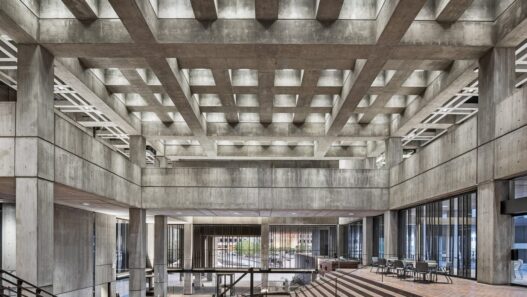
These concrete forms introduce a raw, tectonic honesty to the classical conversation. Their bold massing and textured surfaces speak a language of modernism, functionality, and social progress. Placed in proximity to Portland stone, they create a vital tension between tradition and radical change. This dialogue insists that a living campus must continually question its own architectural legacy.
Green Spaces and Urban Fabric: The Integration of Gordon and Malet Streets
The squares and gardens are the connective tissue that binds disparate architectural eras into a coherent precinct. They provide breathing room, allowing monumental facades to be viewed and understood from a distance. This careful stitching of built form and landscape turns a collection of buildings into a genuine neighborhood. It acknowledges that the space between structures is as critical to the experience as the structures themselves.
Philosophy in Stone: The Architecture of Knowledge and Access
A library or archive built of stone is a fortress for thought, declaring permanence in a world of fleeting information. Its weight and solidity embody the gravity of collected human understanding, suggesting that truth is not light but something to be sought and safeguarded. This material choice transforms access into a ritual, where crossing the threshold feels like entering a secular cathedral dedicated to the intellect. The architecture itself becomes a philosophical argument, asserting that knowledge deserves a permanent, dignified vessel.
Designing for Democratic Education: Open Courts and Public Spaces
The open courtyard at the heart of a campus is a spatial manifesto for a democratic society. It is a shared ground without a prescribed purpose, inviting chance encounters and unscripted debate between students of all disciplines. This design rejects the closed corridor and the isolated classroom, favoring transparency and fluid movement that mirrors the free exchange of ideas. By prioritizing these communal voids, the architecture cultivates the civic identity of the individual, reminding them they are part of a collective project larger than themselves.
The “Laboratory of Learning”: How Layout Influences Pedagogy
The traditional lecture hall, with its fixed rows facing a single authority, architecturally reinforces a one way transmission of facts. In contrast, a cluster of flexible studios arranged around a shared resource hub tells a different story about knowledge. This layout suggests that learning is an active, collaborative, and experimental process, much like a laboratory. The architecture becomes a silent teacher, encouraging exploration, peer interaction, and the understanding that expertise is often built laterally, not handed down from a podium.
Material Narratives: Stone, Iron, and Glass as Ethical Statements
In the 19th century, the pairing of robust iron frames with vast sheets of glass created the great train sheds and market halls. This was not merely an engineering feat but a moral one, using transparency and light to counter the opacity of industrial power. The honest expression of structure and the admission of daylight spoke to new social ideals of openness and health. These materials together wrote a narrative of progress, suggesting that a better society could be built literally from a framework of truth and clarity.
Adaptive Reuse: Breathing New Life into Historic Structures
Adaptive reuse is a dialogue between epochs, where the past is not erased but invited into the present. It recognizes that the embodied energy and cultural memory within old walls are resources more valuable than empty land. This process layers new stories upon old brick and timber, creating a rich palimpsest that deepens our connection to place. It is an architecture of humility and imagination, proving that sustainability is not just about materials but about honoring the narrative continuum of human habitation.
Dök Mimarlık sitesinden daha fazla şey keşfedin
Subscribe to get the latest posts sent to your email.