
Salk Institute for Biological Studies San Diego
The Shared Vision of Louis Kahn and Jonas Salk
This building begins with a relationship: Jonas Salk wanted an institute that could attract top-tier minds, and Louis Kahn wanted a form that could confer dignity upon those minds. Salk pushed for open, adaptable, and long-lasting laboratories and clearly articulated this goal: “Make a place worthy of Picasso’s visit.” The result was a research campus where architecture is not merely decoration for science, but a partner that shapes how curiosity is felt every day.
Design Purpose: A Shelter for Science
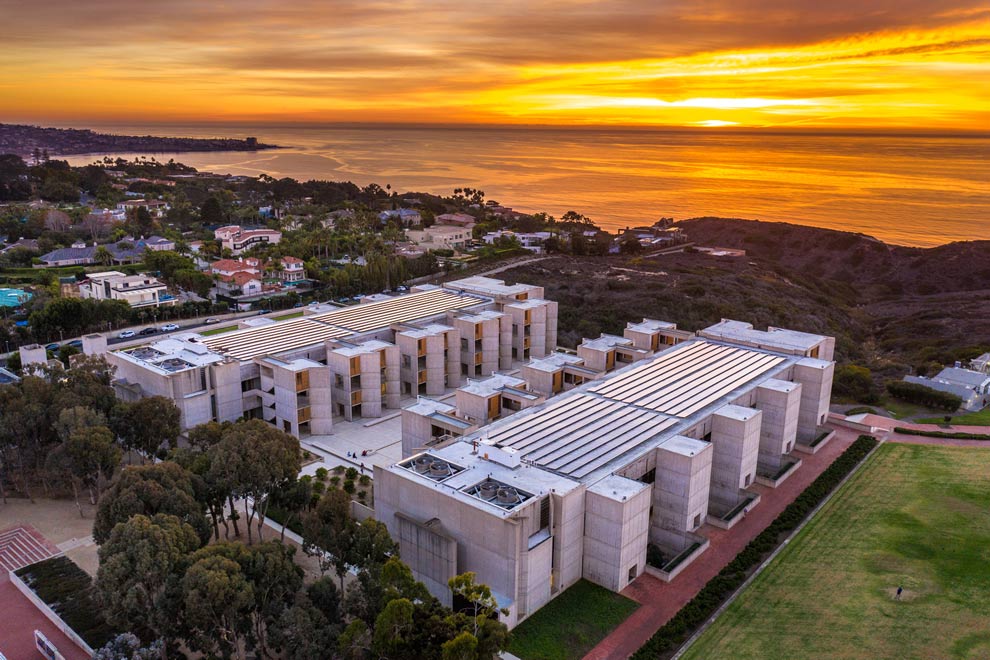
Kahn designed this place like a modern monastery: two disciplined wings define a central courtyard, holding the community inward while drawing the eye outward toward the horizon. The large courtyard opens at one end to the Pacific and at the other to a grove, transforming the arrival point into a gradual transition from landscape to thought. Even the courtyard’s emptiness is deliberate and reinforced by the idea of a stone “square” that becomes a facade facing the sky.
The Role of Light, Silence, and Order in the Concept
Kahn flooded the laboratories with daylight using large glass walls, and when the floors had to be lowered below ground level due to height restrictions, he solved this problem with large light wells that draw sunlight deep into the building. Silence comes from simplicity: concrete, teak wood, travertine, and meticulous details that prevent visual noise allow the mind to hear its own thoughts. In the courtyard, a narrow water channel defines the axis and directs the entire composition towards the ocean, transforming “order” into something you can walk through.
The Balance Between Monumentality and Human Scale
While the mass presents a monumental appearance, daily life is scaled with choices such as work towers and office spaces that offer individuals a tranquil environment conducive to reflection. Kahn’s hierarchy of “served” and “serving” spaces is not merely theoretical here: the plumbing and structure are deliberately placed to keep the laboratories open, flexible, and socially accessible. Between the large plaza and the small workroom, the institute offers a rare promise: science can be both social and internal, and architecture can accommodate both without forcing a compromise.
Importance, Structure, and Spatial Experience
The Use of Concrete and Teak Wood as Functional Aesthetics
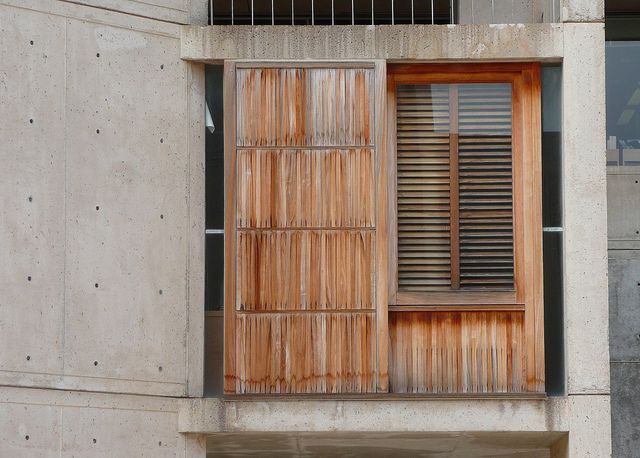
The concrete in Salk is not a “cladding”; it is the essence of the building and has been deliberately left raw, so that the space is perceived as constructed rather than stylized. Teak wood is used in areas subject to touch, weather conditions, and heavy daily use: window walls, shutters, and work tower openings. While performing their actual functions in the sun and sea air, they soften the building’s rigidity. The color palette is deliberately limited, so that light, grain, and small variations in surface texture serve as decoration, giving the building a simple yet strangely warm feel.
The Courtyard as the Central Spatial Axis
The courtyard is the institute’s tranquil heart: two identical blocks enclose a void that becomes a shared space. The narrow water channel known as the “River of Life” cuts through the travertine and draws your gaze directly to the Pacific, harmonizing the walk. Kahn and Salk linked this line to the Alhambra and a larger idea: exploration flowing from focused rooms to an open sea of knowledge.
Structural Innovations in Laboratory Block Design
Kahn viewed laboratories as clean, flexible, and easily adaptable “service” areas, so he moved the ducts and pipes to special service floors above the laboratory floors. To make this possible, the structure uses Vierendeel truss beams designed in collaboration with August Komendant and spreads out over a wide area to free the laboratory floors from internal columns. The result is both practical and philosophical: because the support systems are both accessible and architecturally understandable, it is a research building that can evolve without the need to constantly reinvent itself.
Circulation Patterns and the Rhythm of Repetition
The movement in Salk is arranged like music: repeated projections, repeated towers, repeated windows, until you begin to feel the building’s order without thinking about it. The stair towers emphasize the long wings, providing vertical circulation while also housing auxiliary and support rooms, so that the “how” of the building is always close to the “where.” Because the plan is mirrored, your sense of direction becomes instinctive, and your daily walk to the lab bench begins to feel like a ritual that prepares your mind for work.

The Integration of Nature, Horizon, and Ocean Views
The Salk doesn’t just stand beside the ocean; it incorporates the ocean into the architecture as a final wall of distance and light. The water channel becomes a final point toward which you can aim the horizon, so that the courtyard is not merely a space to pass through but a tool for seeing. Even if the mist obscures the view, the building continues to point the way, reminding us that science is built upon both what is real and what remains hidden.
Cultural Significance and Influence on Modern Architecture
The Role of the Institute in Shaping Research Environments
The Salk Institute helped transform its research building into more than just a machine for experiments: it became a social and intellectual living space. The laboratory floors were designed to be open and adaptable; the structure and services were arranged to allow the “workspace” to change without compromising the building’s clarity. This concept quietly reshaped expectations for scientific workspaces, embodying flexibility and collaboration not only as administrative values but also as architectural ones.
The Global Architectural Impact and Legacy of Kahn’s Design
Salk has become a reference point worldwide for a specific type of modern monument: serious, calm, and emotionally precise, proving that minimal form can still convey meaning. It is often included among Kahn’s defining works and serves as a touchstone for architects who consider structure as expression and silence as atmosphere. Its influence manifests not as imitation but rather as permission: to create buildings that feel timeless without adopting a generic appearance.
Salk Institute in Academic and Professional Discourse
Classes and journals extensively discuss how Salk, engineering, program, and spatial order can converge into a unified concept. Academics revisit this topic to examine Kahn’s hierarchy of “serving and served” and demonstrate how technical decisions can create a sense of unity. Its popularity endures because it can be taught at many levels, from detail and structure to ethics and institutional identity.
Conservation Efforts and Contemporary Restoration Challenges
Preserving Salk is challenging because its most iconic elements are also its most vulnerable: the window-wall assemblies made of teak wood, which have been exposed to salty air, sun, and maintenance errors for decades. The Getty Conservation Institute and Salk developed a research-focused approach that informed the construction work carried out in 2016-2017, preventing a complete renovation and framing it not as cosmetic repair but as the preservation of modern architecture. The ongoing challenge is the modernist paradox: you must upgrade systems and meet evolving performance expectations without disrupting the building’s original “silence,” because its cultural value lies as much in its constraints as in its materials.
Discover more from Dök Architecture
Subscribe to get the latest posts sent to your email.