
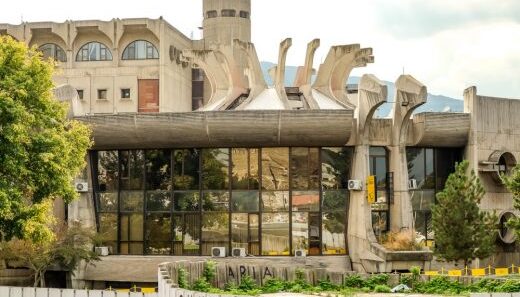
Skopje, North Macedonia
This city is a living archive of 20th-century urban ambitions, frozen in concrete and now transforming into a new identity. Its center stands as a monumental testament to a specific era, tasked with embodying the collective power of architecture and forward momentum. Today, these once rigid forms are being re-evaluated not as cold relics, but as a unique legacy of resilience. The rebirth of these forms reflects a city reconciling its traumatic past with a future that seeks meaning within its distinctive landscape.
1963 Earthquake and Brutalist Planning
A single catastrophe wiped away centuries of urban fabric in minutes, creating a terrifying tabula rasa. This destruction brought a paradoxical gift: a rare opportunity to build an entirely new capital from scratch. The choice of Brutalism was both practical and profoundly symbolic; raw concrete reflected the need for permanence. This architectural language became a direct physical response to trauma—a deliberate turn away from fragile history toward a solid, unified future.
A City in Ruins: The Catalyst for Radical Reconstruction
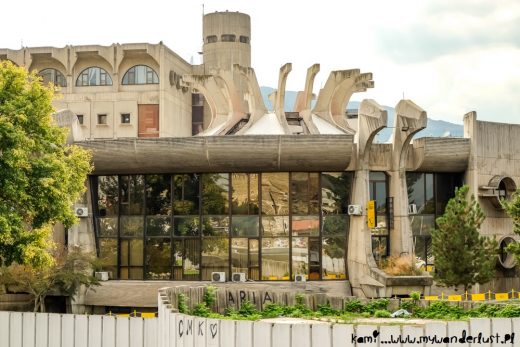
The rubble was not merely physical debris, but the shattered image of a community. From this loss emerged a powerful, collective resolve not just to restore, but to reimagine. The ruins, by erasing old property lines and historical disputes, opened space for a radical social and architectural experiment. This blank canvas demanded a vision bold enough to match the scale of the disaster, rendering the thought of a conservative rebuild impossible.
Kenzo Tange’s Master Plan: A Vision for a Modernist Capital

A Japanese architect proposed a grand metaphor: a “City Gate” connected to “City Walls” encircled the urban core like a modern fortress. His plan divided the city into distinct functional zones, bringing rational order to chaotic spaces. This was the vision for Skopje as a symbol of international modernism, prioritizing movement, order, and civic symbolism over traditional urban intimacy. The master plan provided an authoritative framework—a conceptual skeleton upon which the physical structure would be built.
International Solidarity: Architects Respond to the Call

The United Nations’ call transformed a national disaster into a global architectural project, becoming a rare example of professional collaboration. Leading figures from Poland, Japan, the United States, and other countries brought their diverse ideologies to a common table. This cooperation endowed the city with a diverse yet harmonious architectural dialogue, turning Skopje into a unique museum of late modernist thought. Their involvement signified that the city’s rebirth held not only local but also universal human significance.
Concrete as a Symbol of Durability and Progress
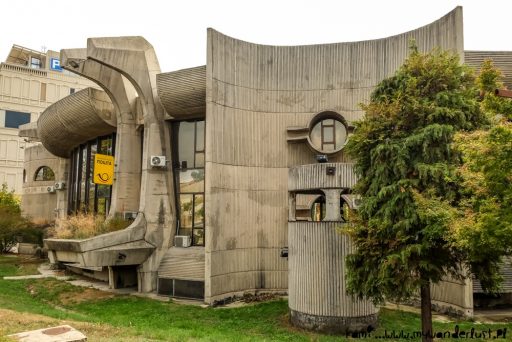
The immense mass and permanence of the material served as a psychological shield against future instability, a literal fortification. Its monolithic presence aimed to reflect the unshakable confidence and progressive ideals of the socialist state. Every board-formed surface and geometric volume narrated a collective future shaped from a common, enduring substance. In Skopje, concrete transcended its physical function, becoming the enduring character of the city itself—a harsh poetry of survival.
Iconic Structures: The Pillars of the Concrete Cityscape
These are iconic structures that define the visual and emotional silhouette of a city. As pillars of collective memory, they give physical form to a place’s aspirations and era. Their majestic presence transforms anonymous spaces into recognizable districts with unique character. Living among them means engaging in a daily dialogue with history and scale.
Macedonian Opera and Ballet: Janko Konstantinov’s Sculpture Masterpiece
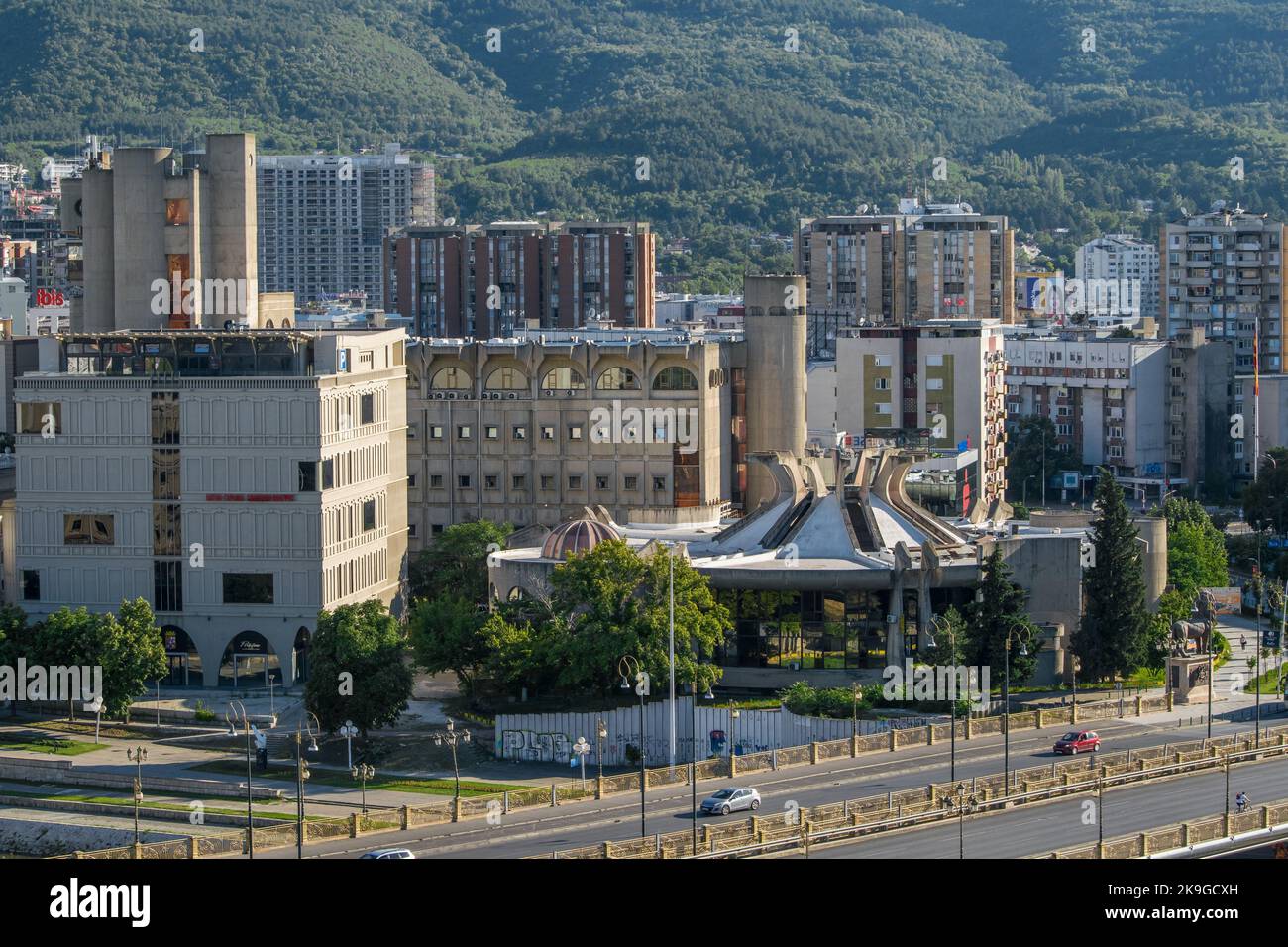
This building is an architectural structure like frozen music; a composition of sweeping curves and dramatic protrusions. It rejects a rigid grid framework to express the fluidity and emotion of performance. Its concrete forms create a sense of perpetual motion, as if the structure is performing a pirouette against the sky. This transforms it from merely an arts venue into a monumental sculpture that performs for the city every day.
Central Post Administration (PTT): The Fortress of Communication
Standing as an icon of connection, this structure evokes strength and permanence with its heavy, layered facade. The design transforms the concept of an ancient fortress into a modern citadel for letters and packages. This architectural weight signifies the great importance of the messages and goods within. In an era dominated by fleeting digital signals, it remains a structure that physically affirms the significance of human relationships.
City Walls Residential Blocks: Monumental Residences
These are not merely apartment buildings, but cliff-like, expansive formations that redefine the urban skyline. They embody the collectivist ideal of housing as a grand, unifying structure for the community. Their repetitive, fortress-like facades create a strong sense of place and shared identity for thousands of people. They transform daily life into a lived experience within a modern monument.
Goce Delchev Student Dormitory: Geometric Brutalism
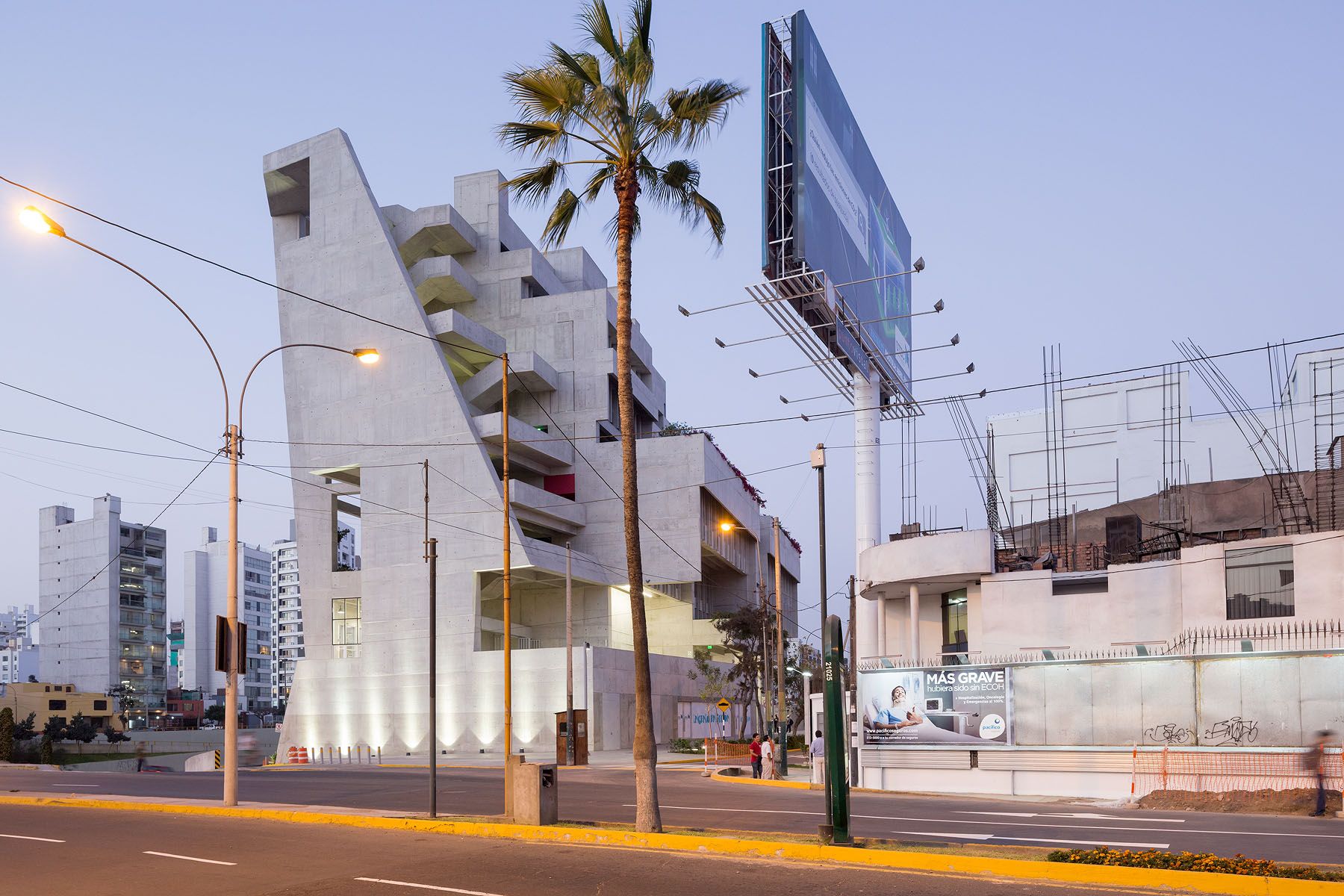
This structure is a modest experiment in pure form, where function is expressed through a powerful geometric puzzle. Interlocking concrete volumes create a dynamic interplay between shadow and solid, light and mass. The architecture, stripped of distracting decorative elements, speaks the language of rational order and collective living. It emerges as an educational work in its own right, offering lessons on space, structure, and community.
Telecommunications Center: A Futuristic Iconic Structure
A sentinel from another time, a vision of the future permanently cast in concrete. Its soaring tower and sculptural base resemble a launchpad or a giant receiving dish. This form physically manifests the invisible networks of sound and data that connect a society. It reflects the optimistic, technological fascination of its era and forever aims its architectural signal toward tomorrow.
Legacy and Reassessment: Brutalism in the 21st Century
Once described as cold and oppressive, these concrete structures are now receiving serious respect. This reappraisal is not merely nostalgia, but an acknowledgment of their radical honesty in an era dominated by digital facades. These buildings stand as monuments to a collective faith in a future shaped by raw materials and geometric strength—a specific postwar optimism. Today, they offer a tactile counterpoint to our smoothed‑out virtual worlds, their weight and permanence evoking an almost radical sensation. Their legacy is being rewritten through the
Protection or destruction: The ongoing debate
This conflict is a struggle over a city’s memory, its physical assets, and its soul. One side sees decaying concrete as a disaster, an obstacle to progress and economic vitality. The other views demolition as a loss of cultural memory, erasing the physical chapters of a shared urban story. The debate is rarely just about architecture; it is about who decides what historical values to preserve. Each threatened building becomes a litmus test for how we value the recent past. Preservation advocates for adaptation, championing
Architectural Tourism: Exploring Skopje’s Concrete Heritage
Visitors no longer come just for ancient ruins or Baroque squares; they are seeking the simple poetry of a city rebuilt in concrete. Skopje offers a pilgrimage to a unique moment in urban history following the 1963 earthquake. Tourists explore a built manifesto of modernist idealism, where all public functions were redesigned with bold, sculptural forms. This is a form of time-travel tourism to the ambitious and complex era of Yugoslav socialism. This journey transforms perception, turning what might seem harsh into
Urban Planning Lessons: What Does Skopje Teach Us Today?
Skopje’s post-earthquake plan was a grand experiment in creating a city from scratch. This plan demonstrates the power of a unified vision, where landscape, infrastructure, and architecture were designed as a single interconnected system. The lesson drawn from this is an ambitious approach that shows how a city can be deliberately designed as a symbol of recovery and modern identity. This approach stands in stark contrast to today’s often fragmented and market-driven development. However, it also offers cautionary tales regarding scale and human proximity
Emotional Landscape: Public Perception of Brutalist Spaces
These buildings evoke a far more complex range of emotions than simple like or dislike. They can be intimidating, their massive scale making one feel small. Yet they can also inspire awe through their structural boldness and timeless, geological presence. This emotional duality lies at the heart of their power; they are an architecture that refuses to be background, demanding a reaction. Public perception is shifting from seeing them as forbidding fortresses to appreciating their protective, sheltering qualities. The raw concrete, weathering and staining over
Discover more from Dök Architecture
Subscribe to get the latest posts sent to your email.