
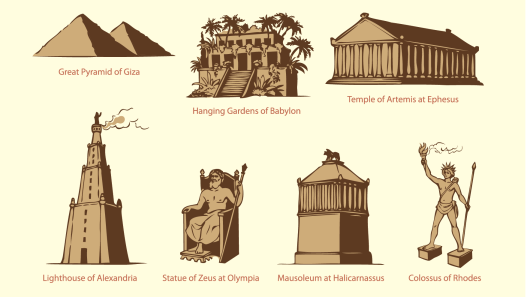

The Seven Wonders have survived to the present day because they solved symbolic and technical problems on a continental scale. They were not a random list of large structures, but a carefully selected series of tourist sites that Hellenistic-era travelers agreed were worth crossing the seas to see. The most frequently cited lists originate from a compiler known as Antipater of Sidon and later as Philo of Byzantium. Their selections helped canonize what was considered a worldwide achievement.

What makes them functional is the combination of civil narrative and meticulous craftsmanship: engineering that transforms political goals into visible form. Like diverting a river to irrigate plants on a terraced mountain or piling limestone into the world’s tallest structure of its time, these works made power readable as a place. The Great Pyramid of Giza, the only ancient wonder still standing, continues to prove this point every day on the Giza Plateau.
Their other worlds are also important. Texts, coins, and later archaeology kept the memory of most wonders alive, while debates sharpened others. The Hanging Gardens remain controversial, with convincing arguments suggesting they may have been in Nineveh rather than Babylon, reminding us that even legends can be replaced by new evidence.
The Foundations of Excellence: Context and Vision
Classical lists arose from mobility and comparisons. After Alexander’s campaigns opened routes between Greece, Egypt, and Mesopotamia, Greek travelers wrote about extraordinary “theamata” worth seeing. This practice functioned like an early travel guide, reducing a vast world to seven reference points.
Seven was not merely a number. For Greek writers cataloging the wonders of the Mediterranean and the Near East, it symbolized the unity of this region—a land interconnected by trade winds, pilgrimage routes, and imperial networks. These wonders, by mapping this network stretching from the Nile to the Aegean and Western Asia, cemented the idea of the oikoumene—a world made of stone, bronze, and memory.
Historical and Cultural Motivations
Marvels met cultural needs through architectural forms. In Olympia, a massive statue of gold and ivory created by Phidias transformed the athletic festival grounds into a meeting place with the god Zeus, inseparably linking piety and prestige. Ancient writers’ descriptions emphasize the statue’s awe-inspiring size within the cella, which was so large that when Zeus stood up, it would have lifted the temple’s roof. This was a spatial trick that made divinity feel close.
The Temple of Artemis in Ephesus was a symbol of an urban civil religion. Built by the Lydian king Croesus and rebuilt after an arson attack, the Artemision’s forest of columns and rich sculptural program transformed the port’s wealth into the ceremonial gateway of a cosmopolitan city. According to some sources, the temple, consisting of 127 columns, framed ceremonies, sacrificial rites, and trade with a single architectural language.

In Egypt, the Great Pyramid concentrated royal theology into geology. Aligned with the four cardinal directions, the pyramid made the kingdom permanent and visible for days from afar along the Nile River. As the only ancient wonder still standing today, it continues to convey the Old Kingdom’s knowledge of leveling, its logistical skills in quarrying, and the organizational capacity of a state to the present day.

Patronage, Power, and Prestige
Each marvel is also a record of who paid for it. Artemisia II commissioned the Mausoleum at Halicarnassus for Mausolus, ruler of Caria, and hired renowned architects and sculptors to blend Greek classicism with local dynastic ambition. Mausolus became synonymous with all great tombs, proving that the special sorrow of funerary architecture could be transformed into public prestige.

In Alexandria, the Ptolemies built a lighthouse that served as both a maritime infrastructure and a political billboard. At least 100 meters high, this structure, which rose in geometric layers, symbolized technological superiority at the threshold of Egypt’s most important port. Arab sources and modern archaeology emphasize the extraordinary height of this structure and its engineering marvel of fire and mirror signal lamps.
In Ephesus, Croesus’ donation to the Artemision had engraved Lydian supremacy on durable marble. The patronage here was urban strategy temples that brought together festivals, markets, and legal ceremonies. These temples reinforced power by attracting pilgrims and merchants who enriched the city that housed the temple.
Geographical and Symbolic Location
It was a settlement policy. Pharos protected a channel and transformed a marvel, Alexandria, into a security device connecting the Aegean and Eastern Mediterranean. Its location made its approach to sailors understandable, and its silhouette made the authority of the Ptolemaic dynasty clear to everyone.
Artemision was located at the intersection of land and sea trade in Ionia, while the Mausoleum occupied a strategic promontory city overlooking the Aegean routes. Olympia’s cult center was located in the interior of the Peloponnese, yet it attracted a pan-Hellenic crowd, proving that a wonder could exist in the interior if its symbolism spread sufficiently. Together, this set reads like a map of the encounter zones between Egypt, Lydia, Caria, and Babylon with Greece.
Even the most debated location, the Hanging Gardens, makes geographical sense if, in the traditional interpretation, they were located in the imperial capitals of Babylon or Nineveh, as reconstructed by Stephanie Dalley for the Assyrian king Sennacherib. Both were river cities capable of supporting the hydraulic systems necessary for a terraced green mountain. Historical uncertainty points to how place, text, and technology intersect in the reconstruction of lost works.
Heritage in Collective Memory
Transmission kept the canon alive. Ancient poems and periegetic texts circulated explanations long after earthquakes and wars had destroyed the originals. Later, antiquarians and encyclopedists fixed the list, and modern reference works still begin with Antipater and the spurious Philo corpus when explaining what a wonder is.
Archaeology continues to constantly renew this story. In Alexandria, underwater teams documented and even salvaged massive blocks believed to belong to the lighthouse. These blocks serve as the source for digital reconstructions that present the pieces to the public, renewing Pharos’ role as a navigational aid, this time over time rather than over water.
The canon also invites comparison. Although new lists of wonders have emerged to express a global, contemporary scope, they all indirectly compare themselves to the old list’s blend of courage, craftsmanship, and narrative power. The resilience of this template serves as proof of why the Seven Wonders can be read as distinctly grand, positioned, and constructed forms.
Structural Creativity and Material Mastery
Selection and Procurement of Materials
Stones selected for their purpose. Egyptian builders combined locally abundant limestone, used for load-bearing or visible sections, with select imported stones. At Giza, the core of the Great Pyramid is made of local nummulitic limestone, its passages and original white casing are made of fine Tura limestone transported from the Nile River, and the King’s Chamber is clad and roofed with Aswan granite, selected for its durability under pressure and bending loads. This palette balanced logistics, workability, and performance.
Materials with symbolic significance. Greek and Hellenistic patrons chose “ostentatious” stones and metals that symbolized power. The Temple of Artemis at Ephesus was renowned as one of the oldest large temples made of marble, symbolizing wealth on the Ionian coast. The Mausoleum at Halicarnassus was made of polished marble and topped with a massive marble quadriga. The Statue of Zeus at Olympia was ivory-covered over a gold-plated wooden skeleton; this was a prestigious technique known as chryselephantine. Each choice carried both technical and symbolic meaning.

Structural allies: water, mortar, and waterproofing. When dense planting or water features were required, engineers preferred to use bituminous binders and processed stone. The Assyrian aqueduct built by Sennacherib in Jerwan to irrigate his palace gardens used cut limestone in a monumental elevated channel that predated Roman civil structures. Its durability under continuous flow stemmed partly from the material and partly from the precise stonework.
Load Paths, Geometry, and Stability
Pure compression geometries. Pyramids reduce almost everything to compression. The stacked layers of the Great Pyramid transfer gravitational loads directly to the rock foundation; above the King’s Chamber, five granite “relief” blocks redirect the thrust force from the flat roof, which would otherwise crack under excessive load. This mechanism is a masterful example of altering the load path without changing the building’s external appearance.
Improved columns and lintels against danger. Greek marble temples transferred the loads of the roof and entablature to wide foundations through dense rows of columns. Hidden iron clamps and dowels covered with lead connected the blocks to each other, distributing shear forces and creating a ductile interface capable of dissipating energy under impact. This detail, widely documented on the Acropolis, is one reason why large temples could withstand repeated tremors long enough to be repaired.
Hybrid shells and stepped mass. Hellenistic designers shaped the mass for stability. The stepped Pharos at Alexandria was likely composed of square, octagonal, and then circular layers, tapering in height to keep weight and the risk of capsizing low while signaling across the open sea. The mausoleum’s high podium, columned block, and pyramid-shaped roof created a heavy base, a sturdier core, and a light crown that looked like a work of art but was a solid piece of engineering.
Innovative Tools and Techniques (e.g., ramps, scaffolding)
Friction management and low-tech physics. Quarry scenes and physics experiments converge on the same trick: wetting the sand. Laboratory studies show that a small amount of water hardens desert sand and reduces sled drag force by half. This aligns with ancient depictions of the water carrier wetting the path in Djehutihotep’s transport scene. It is a modest method applied with an engineering mindset.
Ramps, cranes, and controlled elevators. The Egyptians used earthen ramps in various forms. A 4,500-year-old ramp discovered at Hatnub, featuring side stairs and post holes, demonstrates a complex transport system that used ropes and wooden pulleys to haul blocks up steep slopes. From the late 6th century BC onwards, Lewis holes and lifting projections bearing traces of crane work can be seen on stones in the Greek world. This indicates a transition from a system using ramps to a lifting and precise placement system.
Large statues, large staging. Bronze giants such as the Colossus of Rhodes were almost certainly shell structures mounted plate by plate around a framed core, using wide wooden scaffolding and earthen ramps for access. This approach minimized unsupported weight during erection and allowed for gradual riveting and bracing at height. The monument’s subsequent collapse during an earthquake demonstrated both the ambition of this technique and the limitations of early seismic detailing.
Adaptation to Local Conditions (earthquakes, soil, wind)
Select the ground, then shape the ground. The Giza plateau provided suitable limestone bedrock that could be cut, leveled, and bonded to the lowest layers, thereby eliminating the problem of uneven settlement at the source. At Ephesus, ancient writers claimed that designers chose marshy land and used sacrificial beds containing coal and wool to cushion shocks. Whether the whole story is true or not, it records a clear design mindset: soil is a structural material and must be engineered.
Seismic realism in the Greek world. The clamp and lead system used in marble architecture provided controlled sliding and energy distribution at joints. In cases where seismic activity exceeded what detailing could withstand, collapse models explain the rest. The Temple of Zeus at Olympia exhibited column “domino” falls consistent with powerful tremors, while the Colossus of Rhodes and, centuries later, the Lighthouse of Alexandria were destroyed or fatally damaged by major earthquakes exceeding their capacity.
Wind and water as performance criteria. For coastal towers, conical mass and floor transitions responded to wind gusts and salt-laden air. Arab and medieval records describe repairs at Pharos and joints bound with lead, showing that conscious strategies were applied to keep joints tight and watertight on a promontory battered by waves. In Mesopotamia, the aqueducts and elevated channels near Nineveh reflect a different hazard calculation: high and durable water conveyance over floodplains to sustain the great gardens later praised by classical writers as a wonder of the world.
Why does it work? Throughout the Seven Wonders, form is never considered separate from function. Stone, metal, wood, and bitumen are used where their properties make structural sense. Geometry carries loads along the shortest paths. Details anticipate movement, shock, moisture, and time. The result is durability measured over centuries, and when failure occurs, it is usually due to forces that builders have yet to learn to control.
Design for Human Experience and Ritual
Axiality, Process Paths, and Orientations
What is axiality?
Axiality is the use of a clear imaginary line to organize space and direct attention. In sacred and civil architecture, this line frames a series of thresholds that increase focus and meaning as it progresses from the profane to the privileged space. Historic temple complexes such as Karnak express this with long east-west and north-south axes that anchor the readable ritual route through their pylons, courtyards, and halls.
Parade as choreography
The parade route is not merely a path used to reach a destination. It is a slow scenario for bodies and senses. The ancient festival routes at Karnak, surrounded by sphinxes and dotted with bark temples, separated the sacred procession from the everyday city while also providing purposeful stopping points. In early modern Rome, papal planners made processions possible on an urban scale by aligning the city’s obelisks and churches, allowing distant landmarks to converge on the ceremonial route.
Orientation and cosmology
Orientation gives symbolic weight to directions. In many Christian traditions, the apse faces east, so that prayer aligns with the sunrise and cosmic time is incorporated into the plan. The word orientation derives from this turning towards the east. Ritual directionality has also supported the alignments of other cultures, from the star or sun orientations of Egyptian complexes to the calibrated geometry of Islamic places of worship, each encoding a worldview in the plan.
Why is this experience important?
Axial clarity, walking speed, and directional symbolism transform movement into a narrative. Walking becomes an act of reading space, anticipating landscapes and thresholds that give meaning to the destination. This is the origin of the architectural promenade, which modernists later theorized by treating the path and perspective as primary design tools.
Monumentality, Scale, and Proportion
Monumentality is not about size, but quality. Monumentality expresses a sense of permanence. It is the feeling that a form could not be any other way, that it holds cultural memory and resists time. While mid-century theorists defined monuments as collective symbols, Louis Kahn defined monumentality as a spiritual weight seen in works ranging from the Parthenon to modern institutions. Scale contributes to this, but its deeper meaning lies in cultural meaning and formal inevitability.
Proportion as a human measure
Among traditions, proportion connects bodies and buildings. Vitruvius, relating temple design to symmetry and eurhythmy, argued that the parts and the whole should be harmonious, like the limbs of a body. Le Corbusier’s Modulor reintroduced the human scale system in the 20th century, combining metric and imperial units with an idealized standing figure and the golden ratio to achieve visual harmony between rooms, fixtures, and facades.
Scale as a social signal. Scale adjusts how power or sincerity is perceived. A hypostyle hall with columns larger than trees inspires awe, while a low monastery body compresses into a quiet focal point. Monumental scale can be used to express civic ideals or belief systems, but it is proportion and detail that make large spaces human and legible.
Light, Shadow, and Visual Sequences
Light as a material
Light is not a neutral medium. It expresses mass, reveals texture, and creates an emotional key. Louis Kahn’s Kimbell Art Museum treats light as the theme of the building: narrow skylights above cycloidal vaults feed reflectors that bathe the concrete in a soft, silvery glow. The result is an atmosphere that changes with the sky while maintaining a tranquil continuity for the art.
Shadow and contrast
Shadow gives form contour and lends a sense of depth and mystery to interior spaces. Le Corbusier’s Ronchamp collects light with deep wall openings and tower-like light scoops, so that beams of light and pools of light filter over white surfaces, intensifying the silence and devotion. In Ando’s Light Church, a cross-shaped cut in the concrete transforms daylight into a symbol, turning emptiness into presence.
Sequences of sight and movement
Architecture can be read as a storyboard. Le Corbusier’s architectural promenade and Gordon Cullen’s serial vision both name a deliberate sequence of views and reveal the views that emerge during the walk. The eye encounters screens, turns, horizons, and framed views, linking time to space and allowing the building itself to tell its story.
Acoustics, Spatial Drama, and Atmosphere
Acoustic architecture
Spaces speak through reverberation, echo, and absorption. Acoustic architecture specialists explain how materials and geometries shape the persistence of sound, directing orientation and mood as precisely as light. At Hagia Sophia, decay times measured at over 10 seconds transform the space into one enveloped by hymns, merging music and sound level into a single liturgical instrument.
Spatial drama beyond spectacle
Drama emerges when scale, light, and sound come together. Carlo Scarpa’s Brion Sanctuary brings together water, steps, and framed views, ensuring that each turn commands attention and silence. The sequence is ceremonial without being theatrical, creating intimacy through carefully designed thresholds and material resonance.
The atmosphere as a total space
The atmosphere is the perceived whole created by light, temperature, texture, sound, and smell. Peter Zumthor argues that the quality of architecture lies in this synthesis, where materials and details are tailored to create a specific mood rather than a general brightness. Atmosphere is what people remember when they leave; it is the trace that transforms a space into an experience.
Why is this ritual important?
Rituals are tied to repeatable emotions. Axes direct the body, proportions balance perception, light regulates attention, and acoustics intensify time. Together, they create a reliable emotional scenario that communities can live through for generations. Therefore, these elements recur everywhere, from Egyptian temples to Gothic choir stalls and modern chapels.
Durability, Degradation, and Reconstruction Over Time
Causes of Structural Failures (natural, human-induced, seismic)
Natural deterioration mechanisms
Moisture passes through porous materials and carries salts that crystallize within the pores, causing the fabric to separate, leading to contour loss and crumbling. Some salts alter their hydration states, which significantly increases damage during wetting and drying cycles. Freezing and thawing in saturated masonry has a similar effect, expanding within the pores and cracking units and joints. These are some of the main ways in which stone and mortar deteriorate. A warming climate can intensify these risks by altering moisture regimes, increasing storm frequency, and changing freeze-thaw patterns, thereby accelerating the deterioration of stone, brick, and mortar.
Human and operational factors
Fire, conflict, and long-term neglect can weaken structures and damage coatings, while well-intentioned but incompatible repairs can trap moisture or introduce fragile materials. The International Heritage Fire Guide explicitly aims to prevent fires, as post-fire rescue efforts are complex, costly, and often result in irreversible losses. Routine maintenance and repairs using compatible methods remain the most effective first line of defense for historic structures.
Seismic and geotechnical effects
Earthquakes generate lateral loads and cyclic demands that unreinforced walls cannot distribute effectively, leading to out-of-plane wall failures, arch and vault cracks, and falling parapets. The seismic rehabilitation guide for historic buildings emphasizes respect for heritage values while enhancing life safety. In some soils, shaking can trigger liquefaction, causing a temporary loss of bearing capacity as pore water pressure increases, which can lead to building collapse even if the superstructure remains relatively intact.
Archaeological Reconstruction Studies
Anastilosis and its limits
Anastilosis is the reconstruction of a ruin using its original parts, with new materials being structurally inconspicuous and clearly identifiable. This doctrine was formalized in the Venice Charter and continues to be a cornerstone for minimal, evidence-based reconstruction. At the Acropolis, in programs that began in the late 20th century, parts of the Parthenon damaged by historical explosions and earthquakes were repositioned using anastylosis and meticulous documentation methods, and replaced parts were marked.
From city-scale reconstruction to symbolic monuments
After World War II, Warsaw’s Old Town district was rebuilt using archival drawings and photographs as sources. This extensive work was later recognized by the World Heritage Committee as a symbol of resilience due to its cultural significance. The Frauenkirche in Dresden followed a different but similar path decades later: Thousands of cataloged stones were reincorporated into a new structure, and their dark patina, deliberately legible in the new masonry, was used to tell the story of loss and renewal.
Digital and reconstructive reconstructions
When physical reconstruction is not feasible or uncertain, digital visualization provides meticulously documented hypotheses. The London Charter establishes principles for intellectual transparency, source citations, and the clear expression of uncertainty in computer-based reconstructions, with the aim of informing research and public understanding, without pretending to be real.
Material Restoration and Stabilization Techniques
Wall protection: compatible materials and salt control
Re-pointing with lime-rich mortar appropriate to the original improves weather resistance and vapor exchange, but hard and dense replacements can cause adjacent units to deteriorate. Where salts cause decay, poulticing removes ions from the pore network, and consolidation of the stone with carefully selected ethyl silicates can restore surface adhesion when the substrate and tests require it. The injection of lime-based mortars can reattach delaminated plaster or fill voids in brittle masonry, but this is only possible with laboratory characterization and on-site testing.
Structural stabilization: connections, reversible reinforcement, and isolation
Historical metal tie rods and modern internal anchors connect walls and limit thrust; their use is well documented in historical masonry practices. In specific cases, fiber-reinforced polymer wraps and strips can provide capacity increases when designed to be removable so that the intervention does not become a permanent and visually dominant layer. At the building scale, foundation isolation, as seen in the San Francisco City Hall, has limited invasive reinforcement of the historic fabric while enabling important public monuments to meet seismic performance goals.

Wood and metals: preservation and restoration
Traditional scraping and Dutchman repairs preserve the original wood; in areas where decay is localized, epoxy consolidation and fillers are carefully applied to stabilize the fibers. For metals, corrosion management and compatible replacement preserve the original alloys and profiles, and by following conservation standards for rehabilitation, new work is made distinguishable yet compatible.
Interpretation Options and Hypotheses in the Conservation Area
Originality and values as decision frameworks
The Venice Charter established a modern foundation for conservation ethics by emphasizing minimal intervention and the distinctiveness of new interventions. The Nara Document redefined authenticity to account for different cultural contexts and knowledge systems. The Burra Charter operationalized a values-based approach, requiring teams to determine why a place is important before deciding how to act and to document decisions within the context of that place’s significance.
Rebuilding, memory, and public duty
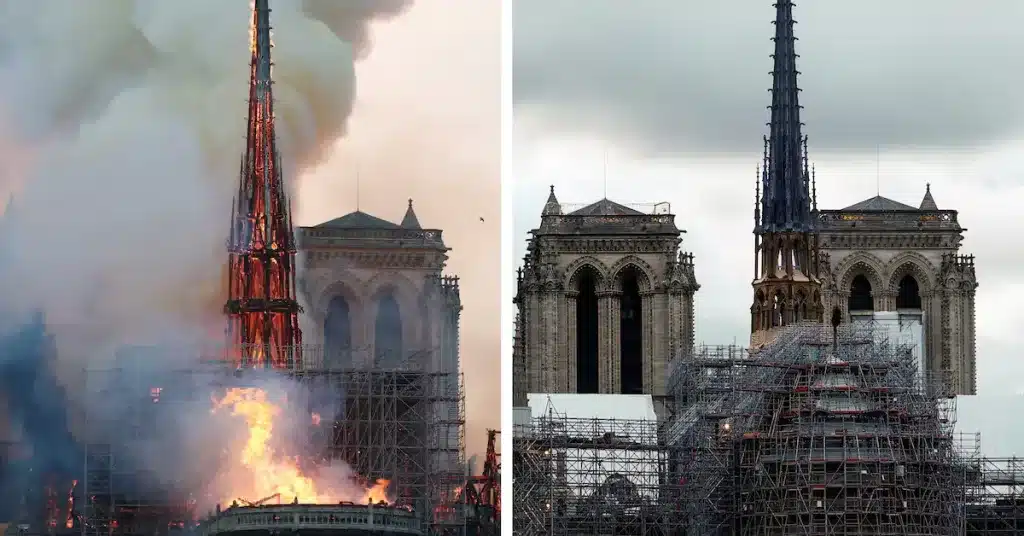
Rebuilding is not a default situation; key guidance documents treat it as an exceptional circumstance and evaluate it based on solid evidence, social meanings, and clear interpretations. However, in some cases, it becomes an appropriate response to trauma. Warsaw’s Old Town district was included on the list precisely because its reconstruction embodies the continuity of identity. Following the 2019 fire, Notre-Dame de Paris progressed with the reconstruction of its tower and roof in historical fidelity and reopened in December 2024. This choice struck a balance between academic debate and national consensus and was documented in public resources and news reports.

Show what is known and what is speculated
Clarity is essential when it comes to speculation. The London Charter requires that the sources and uncertainties of digital or physical reconstructions be explained, so that visitors and academics can distinguish evidence from hypotheses. This principle is consistent with the long-standing requirement that additions be as legible and reversible as possible.
Lessons for Heirs, Influence, and Modern Architects
Transferring knowledge of ancient structures to later periods
Through texts and printing
Much of the technical and compositional knowledge of the ancient world was passed on to later architects through books. Vitruvius’s work De architectura was rediscovered in 1414 and became the fundamental text of Renaissance theory. Alberti’s work De re aedificatoria reshaped Vitruvius’s ideas for a humanist age, while the rise of printing and the richly illustrated treatises of Serlio, Palladio, and Vignola standardized concepts of order, typology, and drawing rules throughout Europe.
The visualized and disseminated ancient period
In the 18th century, archaeological studies and engraved images made the ancient world visible again. Winckelmann’s writings and Piranesi’s engravings catalyzed neoclassical debates, providing architects with a graphic repertoire of measured forms and urban fragments that could be adapted to contemporary needs.
Continuity through reuse and adaptation
Knowledge was also transmitted through practices: The reuse of ancient elements known as spolia and the persistent adoption of Roman forms such as round arches and barrel vaults in Romanesque architecture ensured the continuity of structural habits and visual languages even in periods when texts were scarce.
Reinterpretations in Renaissance and Neoclassical architecture
The recalibration of the Renaissance
From Brunelleschi and Alberti to Palladio, Renaissance architects approached the classical past as a system to be examined, contemplated, and reorganized. Alberti’s churches and facades reintroduced the grammar of the temple within Christian typologies, while Palladio’s villas and the proportional method of the Four Books became a repeatable canon whose influence spread far beyond Italy.
Neoclassical codification and civic symbolism. Neoclassicism transformed the ancient era into a public language for modern states. In England, Robert Smirke’s British Museum adopted the Greek Revival style as the architectural face of the national collection. In the United States, the Capitol and other federal buildings used Greco-Roman forms to express republican ideals and institutional solemnity. These projects demonstrated how classical imagery, combined with modern materials and construction, could serve contemporary programs.
Archeology as an argument
The scientific world of the eighteenth century was not neutral. Winckelmann’s preference for Greek models and the broader Greco-Roman debate shaped what was accepted as “exemplary” in architectural schools and academies, directing design toward idealized orders and measured clarity.
Conservation, restructuring debates, and archaeological ethics
International doctrine and fundamental tests
Modern conservation ethics emphasizes minimal intervention, authenticity, and legibility. The Venice Charter codified these principles; the Nara Document expanded the concept of “authenticity” to encompass various cultural contexts; the Burra Charter operationalized a values-based, site-specific approach; and the London Charter established standards for transparency in digital reconstructions. Together, these documents require architects to provide evidence, distinguish the new from the old, and document their choices.
A living example: Notre-Dame de Paris
Following the 2019 fire, France responded to a national call for continuity by approving the reconstruction of the spire and roof in accordance with established doctrine, faithful to the original. As the cathedral reopens in December 2024, debates over liturgical order, stained glass, and interpretation demonstrate how ethics, politics, and public meaning intersect in major restorations.
Requirements for “Accuracy”
Ethical restructuring means explaining the scope of sources, uncertainties, and assumptions. When archaeological evidence is insufficient, statutes recommend that restrictions or reversible, clearly distinguishable additions be made so that future scientific studies can revise today’s hypotheses without erasing the historical fabric.
A source of inspiration for contemporary monumental projects
The redesign of the classical museum
Foster + Partners’ Great Court project at the British Museum demonstrates how a modern intervention can honor a neoclassical structure while simultaneously revitalizing public life on an urban scale. The glass canopy and circulation area transform a historic complex into a public space without imitating the stone language of the Greek Revival style.

Transparency as a democratic symbol
At the Reichstag in Berlin, the new glass dome memorializes light, views, and public access. A mirrored cone brings daylight into the room and expels warm air, transforming environmental performance into an architectural statement and making the dome a symbol of accountable governance.

Contemporary classicism through reinterpretation of form
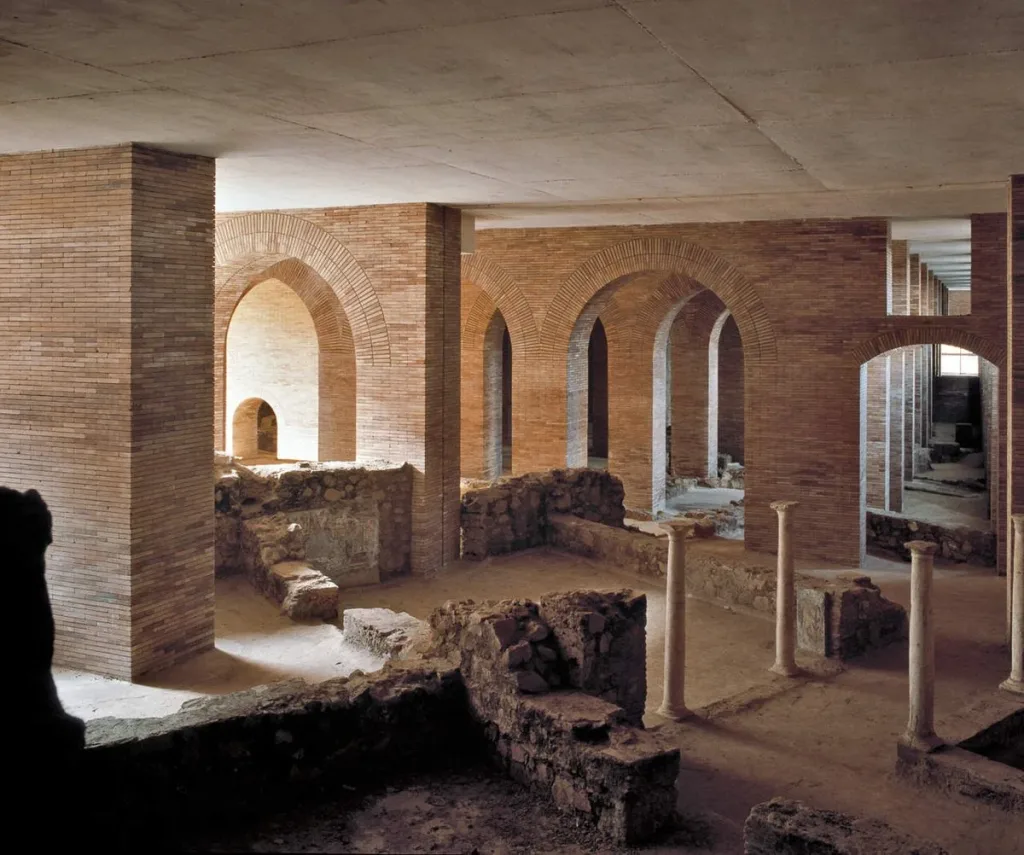
Rafael Moneo’s National Museum of Roman Art in Mérida adapts brick, arches, and measured divisions to a modern scale and use. It is a meticulous dialogue with its Roman predecessors and demonstrates how typology can be renewed through structure, material, and urban harmony.
Monumentality in modern landscape
UNESCO’s inclusion of Le Corbusier’s works, including the Chandigarh Capitol Complex, highlights how axial composition, urban scale, and the human scale system can create a new monumental language for democratic institutions. Current discussions regarding changes within the complex demonstrate the need for management and design objectives to be mutually compatible.

A living tradition
Even new monuments can learn from old ones without imitating them. Recent proposals, such as the Queen Elizabeth II memorial bridge in St James’s Park, extend the monumental project into today’s urban ecologies, aiming for symbolic clarity, ceremonial procession movement, and public accessibility rather than archaeological realism.