
“The Lost Roofline.” Once upon a time, you could tell where you were in the world just by looking at the roofs. The pointed thatched peaks of an English village, the pagoda eaves of an East Asian temple, the onion domes punctuating a Russian silhouette—every roofline was a signature of place, climate, and culture. Today, many of these local roofs have been replaced by generic flat roofs and standard trusses, erasing layers of local identity. In the age of globalized architecture, modest roof architecture may be the most endangered type. This in-depth study defends the value of traditional roof forms—cultural, climatic, structural, and symbolic—and examines what happens when we replace them with one-dimensional designs that fit everyone.

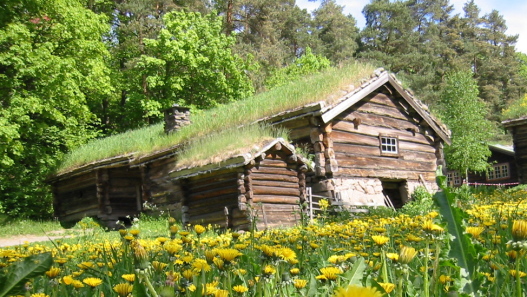
Traditional log houses with thatched roofs at the Norwegian Folk Museum in Oslo. These types of local thatched roofs provide natural insulation and were perfectly suited to cold climates. Today, such unique roofscapes are becoming increasingly rare.
Climate Intelligence in Roof Geometry
Local roofs are textbooks of local climate adaptation. Their shapes, materials, and details have evolved over generations to respond to extreme weather conditions—keeping home occupants dry, cool, or warm as needed. For example, in mountainous and northern regions with heavy snowfall, traditional homes typically feature steeply pitched A-frame roofs. The high angle isn’t just aesthetic: it allows snow to slide off before it can accumulate dangerously. In fact, modern builders note that flat or low-sloped roofs are not ideal for areas with heavy snowfall, whereas “traditional gable or A-frame roofs are better suited for snow retention.” If you disregard this logic, you risk leaks, structural stress, and even collapse under snow loads. Local builders in snowy climates have understood the importance of roof pitch—as philosopher Gaston Bachelard noted, “Even a dreamer builds his dreams on solid ground; for him, a pointed roof keeps out the rain clouds.”
In wet tropical and monsoon climates, local roofs have taken on contrasting but equally ingenious forms. Many traditional houses in rainforests or coastal areas have deep eaves and high pitches to cope with heavy rainfall. A steep roof with wide overhangs acts like an umbrella, diverting heavy rain away from walls and foundations. Raised roof ridges or ventilated attic spaces allow rising hot air to escape, while shaded eaves keep the sun away from windows. A study on monsoon architecture has shown that a sloped roof not only prevents water accumulation but also improves ventilation, as a high ridge creates pressure differences that draw fresh air into the building. In contrast, flat-roofed modern structures often struggle in such climates—they trap heat and require artificial cooling, and if drainage is poor, they can turn into puddles during heavy rain.
Hot, arid regions have developed another type of roof: flat earth or flat wooden roofs. In places where rainfall is scarce, the sun is intense, and daily temperature fluctuations are extreme, flat roofs minimize surface area (reducing daytime heat gain) and provide an added bonus: an open sleeping platform for cool nights. In some regions of the Middle East and North Africa, where indoor spaces remain very hot, it was common to move family activities to a roof terrace under the open sky during summer nights. These roofs were typically made of mud, clay, or palm trunks—materials with thermal mass to reduce the daytime heat and flat surfaces to accommodate people under the starry sky. They transformed the roof itself into a living space suited to the desert climate.
Finally, local traditions offer noteworthy hybrid solutions for ventilation and cooling. Iranian and Arab architecture is famous for its flat roofs with badgirs or wind catchers—long vents that capture cooler breezes and direct them inside. In tropical regions, local builders have invented “double roofs” or ventilated roofs: an inner roof for the structure and an outer canopy that shades it and leaves an air gap for hot air to escape. In Southeast Asia, steep thatched roofs often sit atop open-air houses, creating high ceiling spaces where hot air rises above living areas and is expelled through cradle vents or woven eave curtains. Reed itself is not primitive; it is a high-performance material known for its waterproofing and insulation properties, used in many cultures from England to Ethiopia. Reed roofs are thick yet breathable, keeping tropical rain out while allowing hot air to dissipate—an ancient “cool roof” strategy we are now trying to replicate with modern technology.
What happens when we ignore this climatic intelligence? Buildings become more dependent on mechanical adjustments (heating, air conditioning, de-icing) and often experience performance issues. A flat-roofed, unshaded glass box placed in a monsoon region would require constant air conditioning and drainage maintenance, whereas a local roof could largely manage itself. Conversely, a low-sloped minimalist roof moved to a snow country might require frequent snow removal and structural over-engineering to prevent collapse. There is also a loss of flexibility: local roofs would act as passive regulators. They would work with the sun, wind, and rain, whereas universalized modern roofs typically work against the climate—fighting nature through energy consumption or excessive structural brute force. According to the conclusion of an environmental analysis, a design that ignores the climate context (such as misdirection or the use of flat roofs in areas with high solar exposure) leads to exposure to “high temperatures and 300 hours of roof radiation,” while a redesigned sloped roof distributes heat much more effectively. In short, when we abandon local roof wisdom, we often end up reinventing the wheel—or enduring the consequences until we reinforce outdated solutions.
Roofs as Carriers of Identity and Memory
Beyond their function, roofs carry immense cultural significance. The roof is often the most visible element of a building from a distance, making it a powerful symbol—the “crown” of a city and a marker of its heritage. Distinctive roof silhouettes have become the stencils of civilizations: think of the wide, upturned eaves of East Asia, the onion domes of Orthodox churches, the conical thatched huts of Africa, or the domes and cupolas of the Middle East and Mediterranean. These forms encode stories, beliefs, and community identity in a way that no generic concrete roof ever could.
Think of the classic East Asian temple roof with its flying eaves curving upward toward the sky. In Chinese architecture (and later in Japanese and Korean architecture), the upward curving of the roof corners was not only elegant but also had symbolic meaning. Historical records and art tell us that the upward-curving eaves represent rising energy and protect the inhabitants from evil spirits. Curved roofs (as opposed to straight lines) were believed to prevent evil spirits from entering and to direct auspicious qi energy upward. During the Han Dynasty, these roofs took on the meaning of connectors between heaven and earth—their shapes evoked harmony between the human realm and the divine. Later, as Buddhism spread throughout China, the upward rhythm of pagoda roofs came to symbolize the ascension of the spirit to enlightenment. Thus, a simple roof geometry became spiritually charged. When you see the silhouette of the Forbidden City in Beijing or a Kyoto temple, the distinctive roofline immediately speaks of imperial grandeur, Confucian order, and Buddhist reverence—a form language that has been understood for centuries. To erase these roofs from a silhouette would be to erase a part of cultural memory.
Or let’s take a look at the onion domes of Eastern Europe and Central Asia. These onion-shaped, glittering domes atop churches such as St. Basil’s Cathedral in Moscow are unique to the region and carry multiple layers of meaning. Some historians note that onion domes in 18th-century Russian Orthodox churches were interpreted as flames rising toward the heavens, like candles of faith. Groups of onion domes on a church have a specific symbolism: three domes represent the Holy Trinity; five domes represent Jesus and the Four Evangelists. Beyond religious symbolism, the image of an onion dome against the sky is inseparable from Russia’s architectural identity—it instantly signifies a place and a people. When modern skyscrapers in this region opt for flat roofs and steel boxes, they not only lose an old style but also lose the visual language of faith and history. A silhouette created by generic high-rise buildings could be found anywhere, but a silhouette composed of domes and cross-topped towers is uniquely Russian. The disappearance of such forms is truly a “loss of architectural identity.”
Even more modest roofs convey a sense of identity. For example, the roofscape of Morocco’s medinas is a sea of flat earthen roofs, all in earth tones, occasionally punctuated by domes or minarets. These roofs are not elaborately decorated, but together they form a flawless panorama—the “brown carpet” of Fez or Marrakech, which has looked the same for a thousand years when viewed from a hilltop. Life unfolds on these roofs: women drying herbs, children playing, neighbors chatting in alleys. These are social spaces bound by cultural norms (private yet shared, shielded from street chaos). Replacing them with concrete terraces or towering blocks would mean losing this social fabric and the visual consistency that signals “this is the medina.” As architecture writer Alain de Botton argues, the shapes of our roofs and homes contribute to our sense of belonging; they are poems that are familiar to the eye. When an old roof form disappears, a part of the collective memory disappears with it—the city no longer “speaks” the same dialect as its inhabitants.
Architecture is often referred to as the physical archive of a society’s values. Roofs, which are literally the highest point, often have a ceremonial or symbolic significance. Consider the domes of Byzantine and Ottoman architecture, such as the great dome of Hagia Sophia or the stepped domes that dot the skyline of Istanbul. These were not merely utilitarian shelters, but cosmic diagrams. In sacred architecture, a dome represents the vault of heaven, a microcosm of the celestial sphere enveloping the congregation. The circular base of a dome meeting a square building symbolizes the meeting of earth (square, earth) and heaven (round, eternal). Such roofs have made theological ideas tangible. The disappearance of domes (in favor of flat roofs or helicopter pads) in a city like Istanbul or Jerusalem would mean the loss of this visual expression of faith. Indeed, how a city’s identity changes can be understood from its changing roofline. For example, Dubai’s new skyline of glass skyscrapers proclaims globalized commerce; however, Istanbul’s historic skyline “appeals to the city’s rich cultural heritage with its minarets and domes that evoke centuries of Islamic civilization.” If minarets and domes are replaced with generic towers, the skyline ceases to tell the old story.
In summary, local roof forms are narrative symbols. They encode religious cosmology, local craft traditions, social patterns, and civic pride. When we ignore or alter them, we risk flattening not only the physical roof but also the identity of communities. A city with completely flat roofs and anonymous silhouettes loses the reminders that connect people to a place—the feeling of “aha, we’re home” when you see a familiar roofline on the horizon. The disappearance of local roofs means the disappearance of architectural language. If buildings are messages, then local roofs are the idioms and emphases that make those messages locally meaningful. Losing them means losing that identity and memory, becoming just another silhouette each time.
Rules vs. Culture – Why Are Local Roofs Declining?
If local roofs are so clever and meaningful, why are they being replaced? There is a major reason for this: modern building codes, standards, and economic systems often undermine traditional roof typologies. This is not usually a deliberate war against culture—it is more a side effect of one-size-fits-all rules and industrialized construction.
Today, building codes prioritize uniform safety and efficiency standards, which can inadvertently push traditional methods aside. For example, a thatched roof may be superior in terms of water retention and insulation, but fire regulations consider thatched roofs a hazard (indeed, London banned thatched roofs entirely until 1189 following repeated fires). Modern laws require roofs to have certified fire resistance ratings, specific load capacities, and standardized connection elements. Natural materials like thatch or wooden shingles typically cannot easily meet these ratings without costly modifications. In some areas, using non-standard roof coverings (such as grass roofs or wooden shingles) triggers special engineering reviews and even bans. Result: builders are turning to composite, metal, or concrete materials that pass regulations without issue. As a protection expert noted, if the performance of a traditional material cannot be “determined” under code tests, it is assumed to have the lowest fire rating by default. This situation effectively penalizes local solutions that were never designed for code testing.
Then there is prefabrication and economy. Today’s construction industry values efficiency and repeatability. For example, prefabricated roof truss systems have become standard in residential construction because they are fast, inexpensive, and use less lumber than hand-cut beams. A typical factory-made truss can use up to 40% less lumber than a traditional cut roof, making it quite cost-effective. However, prefabricated trusses come in limited shapes—mostly triangles with a specific slope optimized for standard suburban homes. They do not allow for the complex curves of an Asian temple roof or the heavy mass of an earthen dome. As developers pursue lower costs, non-modular local roof types are left out. Ultimately, we end up with the same few truss profiles everywhere, because truss manufacturers produce them on a large scale (e.g., the 30-degree Fink truss found everywhere in homes). This is a classic culture clash against standardization: a handmade roof with unique character cannot compete on price with a mass-produced roof. Unless a customer is willing to pay extra for a custom roof, builders will always opt for the prefabricated option.

Globalization also means that material supply chains have become more homogeneous. While a village may source local straw or clay tiles, a modern builder orders factory-made tiles or asphalt zones from all over the country. These products come with guarantees, technical data sheets, and code approvals—all of which are very reassuring. In contrast, handmade clay tiles or slate are now niche and expensive; they are not used in new construction but mostly in restoration work. For example, in the United Kingdom, 70% of handmade clay tiles are used in restoration projects, while only 30% are used in new construction, largely because mass-produced tiles are cheaper and dominate new construction. The artisan roofing market is a limited niche sustained by heritage and high-end demand. Without intervention, the economy alone is pushing developers toward standardized “off-the-shelf” roofs rather than labor-intensive local styles.
Another factor is modern engineering education and practices. Engineers and architects are typically trained in international codes and standard solutions. They may not know how to calculate the stability of a traditional wooden truss without metal plates or the wind resistance of a curved Malay roof. Following code tables and using certified systems is simpler (and legally safer). In some places, regulations do not explicitly allow certain local techniques unless an engineer signs off on them—and very few professionals are knowledgeable about these techniques. A kind of circular logic comes into play: because regulations do not account for local designs, these designs are excluded, no one uses them, and so regulations assume they are outdated. For example, earthen roofs or domes can perform well in traditional buildings during earthquakes, but because they are not recognized in regulations, they are not permitted in new buildings—which ironically forces communities to adopt concrete slabs that may perform worse in some earthquakes. It makes sense for researchers to encourage finding ways to integrate local characteristics into modern applications while complying with local building regulations. The subtext suggests that laws currently constitute an obstacle that needs to be overcome.
Finally, liability and insurance pressures are discouraging traditional roofs. Insurers charge more (or refuse coverage) for roofs perceived as “non-standard,” such as wood shakes (fire risk), tile (hurricane risk), or thatch (all of the above). Homeowners and builders avoid these materials even when the actual risk can be managed with proper detailing. In summary, the entire system—from code books to lenders to the supply chain—has a bias against complexity. Approving a flat membrane roof or a generic truss is easier than approving a one-time local expression.
In conclusion, local roof forms are not disappearing simply because of stylistic preferences; they are often engineered and prohibited by law. A striking example can be found in Europe, where industrial agriculture and building standards led to the near disappearance of thatched roofs in the mid-20th century, prompting the introduction of conservation laws. In other words, market and legal forces had rendered thatched roofs impractical before cultural policies came into play. Similarly, in rapidly developing cities, laws may favor high-rise buildings (flat roofs) over low-rise local neighborhoods, leading to zoning-driven roof homogenization.
What can be done? Some forward-thinking regions have begun to adapt regulations to be more flexible—for example, allowing “alternative materials” such as adobe, straw bales, or wattle if certain safety measures are met. There are projects that certify fire-retardant wattle or design prefabricated bamboo lattice beams that comply with regulations. Experts are calling for “adaptable code frameworks” that can incorporate traditional practices rather than exclude them. Additionally, grassroots craft cooperatives working with authorities to test and approve local techniques exist (e.g., earthen roof builders demonstrating earthquake safety). The idea here is to bridge the gap between local knowledge and modern regulations and thus prevent culture from being sacrificed for safety. Ultimately, many local roofs can meet reasonable safety standards—they have withstood centuries of real-world testing. Inappropriate modern codes, when applied blindly, can even lead to failures (a study explicitly states that “inappropriate modern building codes in contexts where they are not suitable have caused roof failures”).
The key is to balance real security with cultural continuity. We can maintain standards without forcing every roof into the same mold. Some countries have begun offering code exemptions or incentives for traditional architecture in designated heritage areas. Others are supporting R&D to modernize local forms (e.g., adding hidden fountains to reeds or reinforcing mud domes with construction steel) in order to comply with regulations. The hope is for a future where local roofs are seen not as anachronisms or regulatory violations, but as valuable assets that can coexist with contemporary needs. Every time we revise a regulation to allow for some regional character—whether by permitting a steeper roof pitch for snow or approving handmade tiles for aesthetic continuity—we take a step back from homogenization.
Roofs as Urban Characters – Reintegrating Heritage into Cityscapes
Walk through the old quarters of a city such as Kyoto, Venice, or Fez and look up: the rhythm of repeating roofs creates the character of the urban fabric. Roof lines create scale, texture, and silhouette. They mediate between individual buildings and the horizon line. Local roof forms play a leading role in urban character, which is why historic cities often feel harmonious and “belonging.” In contrast, many contemporary cityscapes suffer from a confusion or absence of roof character—think of tall, flat-topped buildings that don’t “talk” to the street or to each other. Reintegrating traditional roof forms can humanize and ground our modern cities.

One of the obvious roles of local roofs in cities is to provide a harmonious visual profile. For centuries, regulations (official or unofficial) have been put in place to guide roof heights and shapes in order to create an attractive whole. A famous example is Kyoto, Japan, where traditional machiya houses have gently sloping tiled roofs, and even taller buildings in certain areas are kept below the height of iconic temple roofs or pagodas. Until recently, Kyoto enforced strict height limits (typically 15m or 31m depending on the area) and aesthetic rules to ensure that new buildings did not overshadow or clash with the old skyline. Even colors and materials were controlled to some extent—for example, using earth-toned or dark-colored roof tiles instead of shiny metals to preserve the old ambiance. These policies stem from the recognition that the roofline is an integral part of the city’s image. As stated in a city document, regulations on height, color, and design were established “to preserve Kyoto’s traditional aesthetic.” As a result, much of Kyoto continues to have a human-scale, sloping-roofed rhythm that immediately identifies it, rather than a random high-rise silhouette that could belong anywhere. Where Kyoto has relaxed its rules, the incongruous rise of modern towers is immediately visible—a clear tension between global and local architecture.
Elsewhere, traditional roof forms help new developments achieve contextual harmony. In culturally rich cities, architects are finding creative ways to reinterpret local roofs in contemporary projects – not only paying homage to heritage, but also making new buildings more distinctive to their surroundings. For example, some modern designs in China are bringing back the irmoya (hip and gable) roof shape of classical Chinese architecture, but using steel or glass. Parametric modeling allows architects to create free-form roof shells that are “inspired by historical domes and vaults, even though the materials are advanced, they carry the visual language of traditional forms.” A city museum could feature a wide, modern roof that mirrors the curves of the adjacent traditional temple, thereby maintaining a dialogue with the silhouette. In the Middle East, we see new structures made of modern concrete that incorporate updated windbreaks or parapet silhouettes reminiscent of old medinas—suggesting a horizon line that hints at the rough charm of the old city rather than a flat monotony.
Roofs also play a role in the scale transition of cities. Traditional sloped or stepped roofs typically provide an elegant conical shape from the building wall to the sky, which can reduce the perceived mass of structures. In historic neighborhoods of Europe, numerous dormers, roof windows, and chimneys at roof level reduce scale and add visual interest. When modern buildings in these areas opt for flat roofs or conceal mechanical boxes above, they create jarring voids in the textured roofscape. Urban designers often encourage the inclusion of articulated roofs—perhaps a faceted roof deck or a modern mansard—to keep the silhouette varied and interesting at pedestrian eye level. A city where every roof is a straight line at a 90° angle to the wall can feel harsh and overly simplified. As architects have noted, the reintroduction of sloped or varied roof forms (even in a contemporary style) “provides a sense of harmony and consistency in the urban landscape”. It helps connect the new with the old.
Think of Istanbul, with its unforgettable silhouette of Ottoman domes and minarets. The modern development across the Bosphorus has given rise to generic forest of towers (see Levent district) that are impressive but more international in style than Istanbul. There is a growing dialogue about how tradition and innovation can be balanced in the silhouette. Some projects have attempted to raise roof lines or add decorative crowns reminiscent of Ottoman forms, so that new buildings do not appear foreign when viewed from the historic side. Istanbul’s planners have also mandated that tall buildings be set back from the historic peninsula, preserving the iconic silhouette of mosques against the water—an acknowledgment that roof forms are part of the city’s heritage. “The silhouette is not just a physical panorama, but also a reflection of the city’s abstract essence,” writes one urban planner. Thus, preserving recognizable local roof forms means making the city’s spirit visible.

Looking ahead, how can we reintegrate local roofs? Strategies include:
- Design guidelines that require or encourage roof slopes or shapes that refer to local traditions in new buildings. For example, a city may require that new roofs in a specific area have a minimum slope or that regionally typical clay tiles be used. Some Swiss and Austrian cities require mountain-style roofs on new buildings to preserve the Alpine character—a modern apartment building may be permitted, but it must have a large, wide gabled roof similar to that of an old farmhouse.
- The contemporary reinterpretation of old roofs using new technology. Architects can abstract the geometry of a local roof and construct it using modern materials. A striking example is found in China, where some new public buildings feature large-span roofs that are clearly inspired by imperial palace roofs but are realized using steel grids or composite panels, embodying a design that is modern in form yet traditional in spirit. This “fusion of old and new” is seen as a way to embrace innovation while promoting cultural continuity.
- Silhouette zoning that preserves important views and roof profiles. Cities such as Paris have long restricted building heights and mandated mansard roofs on certain streets to preserve their famous rooftop views. New developments in such contexts often incorporate modern attics (with large glass roof windows, etc.)—proving that you can update the style without losing scale or character. In contrast, cities that disregard the character of the skyline may end up with jarring side-by-side developments. Thoughtful planning and incentives, for example, could require that the first few floors of a new building align with the cornices and roof lines of historic neighbors, perhaps with a sloped roof element before a setback for upper floors.
- Public awareness and pride in the architectural heritage. Sometimes reintegration is encouraged by the local population expressing a desire for the traditional appearance of their town. In some parts of East Asia, has been renewed—citizens have noticed that identical high-rise buildings have erased the charming roof lines of the past, and movements have emerged to save the remaining clusters and even rebuild lost towers and roofs (as in some temple reconstructions). When communities value roof shapes as much as dialects or cuisine, they make efforts to preserve them.
Local roof forms give cities their silhouettes, and silhouettes shape our emotional image of a place. A city without characteristic roofs is like a person who has lost their distinctive facial features. Reintegrating traditional roofs (in the literal sense of the word, at the top of new architecture) is a promising way to re-root development in its context. It sends the message that modernity in a city does not have to mean a lack of place—you can still have contemporary buildings that wear the “hat” of local culture.

Modern Istanbul’s new high-rise buildings are clustered across from the Bosphorus. While striking, these international-style skyscrapers contrast with the city’s traditional skyline of domes and minarets. Urban planners note that Istanbul’s historic roofline, defined by mosque domes, still defines its cultural identity. Integrating local roofline cues into contemporary design as this skyline evolves is a challenging task.
Losing Craftsmanship and Knowledge Alongside Local Roofs
When a traditional roof form disappears, we lose more than just its shape. We also lose the craftsmanship and human knowledge behind it. Each local roof type was typically built by skilled craftsmen—often over generations, within families or guilds. Therefore, the decline of local roofs parallels the decline of specialized craftsmen: thatchers, clay tile makers, slate carvers, hand-carved joinery carpenters, decorative ridgepole makers, etc. The cultural heritage here is as tangible as it is intangible.
Let’s take a look at one of the world’s oldest roofing methods, thatching. In places like England, thatch was widespread for centuries until industrialization made other materials cheaper and building regulations made thatch less practical. By the mid-20th century, the number of thatched roofs and thatchers had declined dramatically. Young apprentices were not taking the place of older thatchers, as demand for their craft had evaporated except for a few nostalgic or remote corners. This is a common story: once a local roof form falls out of favor, the next generation does not learn how to build or maintain it. In England, the thatching craft reached a critical level, but fortunately, thanks to efforts to preserve the heritage, it experienced a small renaissance—there are now an estimated 600–900 thatchers active in England, and this number has at least stabilized since the revival of the 1970s. However, the reality is that the saz has transitioned from the roofs of the poor to the roofs of romanticized wealthy individuals (due to the rarity of skills making maintenance costly). Apprenticeship under a saz master requires over five years of hands-on training, which is a commitment few young people are willing to make unless they see it as a viable career path. This is a craft learned by doing—“education must be done physically by making tiles… mastery can take years,” as a tile-maker also noted. If there is no work, there is no education, and knowledge disappears.
Similar declines have been observed in traditional clay tile and slate roofing materials. Many regions had their own distinctive clay tile styles (local clay and shapes and colors adapted to the climate). These were typically made by artisans in small kilns. With the advent of mass production, most handmade tile workshops closed down. The craft has not completely disappeared—some companies still produce handmade or “handmade” tiles, but mostly for restoration purposes. The Heritage Crafts Association in the United Kingdom notes that hand-made tiles are currently viable but niche, dependent on a trend among architects and property owners seeking something beyond mass-produced options. If this trend or subsidies were to disappear, the few remaining master tile makers would retire without successors. Similarly, the art of laying tightly fitted stone tiles or carving wooden tiles (as seen in Japan’s historic temples using hinoki bark tiles) is also at risk. The restoration of centuries-old temples in Japan, such as Ise Jingu or Horyu-ji, requires highly skilled roof carpenters who can bend wood and layer tiles with millimeter precision—these are crafts passed down through specific families. With the use of prefabricated trusses and steel roof coverings in modern construction, these elite families of carpenters have dwindled. There is concern in Japan that soon there will not be enough skilled sakan (plasterers) or roof tile makers to maintain the country’s many historic buildings.
Beyond the skills themselves, losing local roofs means an economic blow to rural communities that depend on these crafts for their livelihood. In some developing regions, local roofs (such as thatched huts or mud roofs) are seen as “backward” and are being replaced with imported tin sheets or concrete. This not only often results in poorer climate performance (tin roofs can become unbearably hot and noisy in the rain compared to thatched roofs), but also displaces local labor. Instead of paying local thatchers or builders who know traditional methods, people are purchasing industrial materials from elsewhere. A feedback loop emerges: local craft livelihoods decline, young people migrate to cities, and the knowledge base erodes further. A striking example of this can be found in Sub-Saharan Africa, where NGO and government housing initiatives have replaced thatched roofs with metal as part of “modernization” efforts; within a generation, intricate techniques like thatch harvesting and layering have become rare, and communities have become dependent on external materials that require cash to obtain.
It could be argued that this is merely progress, but it is increasingly recognized that traditional building crafts are a valuable part of cultural heritage worth preserving—not to mention their potential value for sustainable development. Organizations such as UNESCO and various heritage bodies are now supporting training programs for young artisans in nearly lost roof-building crafts. For example, in Europe, “roof master” is once again becoming an officially recognized qualification, and there are mentoring programs to ensure that 600 British roof masters pass on their knowledge. Similarly, in France and Germany, Dachdecker (roofers) guilds still include expertise in slate and thatch; these guilds actively promote the craft to apprentices with the promise of working on prestigious restoration projects.
The loss of craftsmanship also means the loss of maintenance knowledge. A local roof is not static—it requires periodic maintenance that the community traditionally knows how to provide. Who today knows how to replace wooden pegs in an old wooden roof, when to add a new layer of mortar to a clay roof, or how to tighten a bundle of roof reeds? Fewer and fewer people do. As a result, even the old roofs that remain standing sometimes decay more quickly because the tacit knowledge needed to preserve them is no longer available. For example, some historic thatched houses are exposed to fires or leaks because their owners or local fire departments lack the wisdom passed down through generations (such as how to properly wet a thatch during a drought to prevent it from catching fire or how to repair small thatch damages before they spread).
On the other hand, whenever we revive a local roof form, we also revive a community of practitioners. In the 1970s, thanks to Historic England’s conservation efforts, half of the thatched buildings remaining in England were saved, thereby preserving the craft of thatching. This encouraged farmers to resume growing reeds, supplying local economies with reed supplies, and so on, demonstrating how architecture and craft are interconnected. The “reed economy” is hyper-local—as described by a farmer-reed worker partnership in England, they grow and harvest the reeds, and local reed workers use nearly all of it, creating a tight cycle. If you lose one end of the cycle (roof demand or farmer supply), the cycle breaks.
Beyond economic and practical considerations, there is also an element of pride and identity for craftsmen. Being a master of a regional craft was often associated with social prestige—for example, the thatcher who placed a distinctive straw animal on the roof of a cottage, or the temple carpenters in Japan who are recognized as national treasures. When these roles disappear, a part of the community’s identity is lost. The next generation may work as laborers on general construction sites rather than as respected guardians of a tradition. As architecture scholar Paul Oliver has noted, local builders were not just workers, but historically cultural carriers. A house’s roof often includes small rituals, unique decorative embellishments, perhaps even a “capping” ceremony when it is completed—if we no longer build these roofs, all of this intangible heritage is lost.
In conclusion, the disappearance of local roof forms is not only an architectural or visual loss, but also a socio-cultural loss. Skills developed over many years are at risk of disappearing. Communities lose their self-confidence and identity that are linked to these skills. A roof is more than just wood or tiles—it is made by human hands and minds. Therefore, efforts to preserve or revitalize local roofs (through heritage conservation, updated laws, or simply homeowners choosing to uphold tradition) have a dual benefit: they keep the form alive and they keep the craft alive. In the 21st century, where we advocate sustainable and localized construction, these crafts and materials may even be crucial. The world is rediscovering the value of low-carbon, locally sourced construction—ironically, much of this knowledge lies in the techniques we have abandoned. By preserving a local roof type, we may also be preserving knowledge for the future.

Craftsmen rebuilding the roof of a cottage in Dorset, England. Such traditional craftsmen are becoming increasingly rare—there are fewer than a thousand thatchers left in England. Here we see them weaving bundles of reeds and securing them with sticks. The preservation of local roofs goes hand in hand with the preservation of these traditional skills and trades.
The Roof as the Soul of Architecture
Roofs may not be literally above our heads or in front of our eyes, but as we can see, they are at the heart of the story of architecture and space. They are marvels that fulfill multiple roles such as climate regulators, cultural symbols, urban landmarks, and craft heritage. Local roof forms encompass a synergy of function and meaning that modern design often struggles to replicate with the same elegance.
When we abandon a local roofing tradition, we lose:
- Environmental wisdom: finely tuned climate adaptation that keeps buildings naturally comfortable for generations.
- Aesthetic identity: the unique and emotionally resonant silhouette and style of a region’s architecture.
- Cultural continuity: the reflection of local values, beliefs, and history in roof forms ranging from temple eaves to church domes.
- Human craftsmanship: mastery of materials and techniques passed down through apprenticeship—a living heritage of knowledge and work.
Standardization and globalization have their benefits—no one is suggesting that we return entirely to pre-modern building modes—but the wholesale homogenization of roofs is a warning sign. It points to a disconnect from the local context and a potentially unsustainable design approach (if the same generic roof is used everywhere, most will perform below their optimum). It also points to cultural homogenization and a loss of richness in the built environment.
The good news is that there are movements around the world to reintegrate and celebrate local architecture. From academic research highlighting the durability of traditional methods, to architects incorporating local motifs into cutting-edge projects, and community-driven restoration of historic roofscapes, the value of local roofs is being rediscovered. Some call this a path toward more sustainable and humane architecture: one that does not view tradition and modernity as opposites, but rather as a foundation upon which to build responsibly. As one architecture writer put it, modern design that speaks to both the past and the future is possible. Roofs can serve as this bridge—literally wrapping new technology in old forms to anchor the building in place.
Not forgetting local roof forms means not forgetting who we are and where we come from. This is similar to preserving languages or folk music—they can evolve, but losing them entirely would impoverish humanity’s diversity. The roof is often referred to as a building’s “fifth facade”; I would argue that it is also the soul of a building’s design. The protective gesture, the symbol of shelter, the profile against the sky that we remember in our dreams and on postcards.
The next time we look at the skyline of a city or a village from afar, let’s pay attention to the roofs. Are they fulfilling their climatic functions? Are they telling a story? Do they belong to that land and its people? If so, we should value them. If not, perhaps we can find ways to bring some of these lost notes back into the urban chorus. Because in the grand narrative of architecture, local roof forms sing an emotional melody that we must not allow to remain silent in the age of global flatness. They sheltered our ancestors, defined our horizons, and encoded our hopes (and prayers) into wood and tile. That is why local roof forms must not be forgotten.
Discover more from Dök Architecture
Subscribe to get the latest posts sent to your email.