





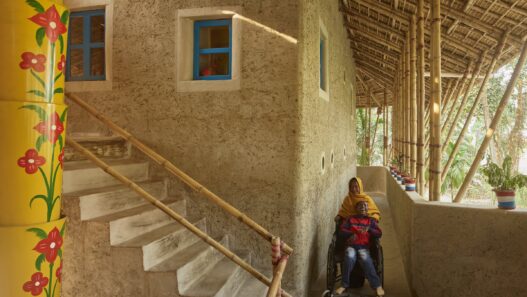


The term “Invisible Cathedral” evokes the concept of abstract qualities in the built environment, suggesting architecture’s capacity to transcend matter and resonate on the user’s spiritual plane. This idea is rooted in research that explores the relationship between space and metaphysical experience, aiming to “make the invisible qualities of the built environment more visible.” Different theorists have noted that the sacred does not always require explicit ornamentation, but rather a composition that engages in dialogue with perception and inner silence.
Architecture as a spiritual language
Understanding architecture as a spiritual language means accepting that materials, light, and space can express messages of remembrance and transcendence. Tadao Ando’s projects use polished concrete and penumbra to create an introspective atmosphere that invites contemplation. Similarly, Peter Zumthor’s work emphasizes the sensory qualities of space (textures, aromas, and acoustic resonances) to transport the user beyond the physical form.


The influence of modern thought
With its emphasis on purity of form and the elimination of ornamentation, modernism paved the way for understanding the sacred as a non-material experience. Writers such as Iain Boyd Whyte have argued that as institutional religiosity declined in the West, a “secular spirituality” emerged in modern architecture, with the quest for the sublime being realized through simplicity and abstraction. This legacy is evident in contemporary works that abandon religious iconography yet retain a powerful symbolic language.
Cultural and religious context
The Invisible Cathedral is also embedded in various cultural and ritual frameworks. In some indigenous communities, such as Maori architecture, buildings contain the narratives of ancestors through symbols and spatial arrangements without being a ‘cathedral’ in the traditional sense. Elsewhere, modern religious structures avoid monumental design in favor of flexible communal spaces where the spiritual is built upon shared experience rather than formal grandeur.
Its importance in contemporary architecture
Today, many architects and practitioners believe that integrating the abstract into their projects is essential. Companies such as Architizer are highlighting recent awards that value striking simplicity over excessive ornamentation, which is a fundamental precursor to an authentic spiritual experience. The significance of these approaches lies in their ability to respond to a society seeking meaning and refuge in everyday spaces: libraries, museums, and even homes where the “cathedral” is built from the intimate and quiet perception of its inhabitants.
Architectural Elements that Evoke Spirituality
The symbolic use of light
Light has been regarded as a privileged tool for expressing the divine in architecture, as its presence and modulations can reveal the omnipresence and omnipotence of the sacred. By filling a church with a diffuse clarity or by reflecting direct rays, a revelatory effect transcending the material is achieved. In the Islamic tradition, the play of light filtering through jali or decorative honeycomb patterns symbolizes the unity of God and the beauty hidden behind the veil of the sensory world.
Sacred geometries in design
Using forms such as circles, spirals, and mandalas to embody beliefs about geometry, the cosmos, and transcendence, it has served as a bridge between the universal order and the human microcosm. In the Khajuraho temples, the vastu-purusha-mandala diagram arranges the building in concentric layers representing the unity of the earthly and divine, placing the sanctum sanctorum at the center of the architectural cosmos. Similarly, the Lotus Temple in New Delhi adopts a nine-petaled symmetry symbolizing universal harmony and provides a meditative space focused on the perfection of the number nine. These patterns are not merely aesthetic; they resonate with universal geometric archetypes, facilitating the experience of inner balance.

Materiality and texture
The selection of materials and surface treatments can invite us to reflect on our relationship with nature and history, evoking a deep sense of connection with the fundamental. Peter Zumthor’s phenomenological architecture emphasizes how the texture and weight of concrete, wood, or stone can create a sensory dialogue that transcends appearance to touch memory and emotion. As Kisho Kurokawa also points out, the use of lightweight wood and natural paper in traditional Japanese practices enhances the honesty of materials by avoiding unnecessary ornamentation and highlighting the intrinsic beauty of their textures. In contemporary spaces, material authenticity also becomes a spiritual gesture: by revealing structural connections or allowing the patina of age to show through, the work reflects the transience and historical resonance of what has been built.
Places of silence and contemplation
Designing enclosures that encourage silence transforms architecture into a facilitator for introspection and full presence. The Chapel of Silence in Helsinki is a paradigmatic example of this, creating a refuge from the city’s noise with its curved wooden exterior and interior with skylights, encouraging a moment of remembrance. Marina Tabassum, in the Bait Ur Rouf Mosque in Dhaka, uses underground spaces and dim lighting to create an atmosphere of remembrance and collective memory where silence itself becomes part of the spiritual experience. These spaces require no ornamentation: their value lies in the quality of the void and in the way architecture modulates sound and light to create tranquility.
Proportion as a mystical act
The application of mathematical ratios such as the golden ratio or the rule of thirds has historically been seen as a way of aligning humans with cosmic harmony. From the Egyptian pyramids to the Parthenon, the golden ratio (approximately 1.618) has guided the composition of facades, floors, and sections to create an intuitive sense of beauty and order. Many Renaissance architects, following Luca Pacioli’s work Divina Proportione, used the golden ratio to imbue their buildings with a perceived perfection that linked the human mind to divine geometry. Le Corbusier’s legacy, the Modulor, continues this spirit by using proportional guidelines based on the human scale to impart an almost mystical character to the relationship between the body, space, and architecture.

Historical Precedents and References
Spirituality in Gothic architecture
Gothic architecture emerged in 12th-century France as “Opus Francigenum,” a style that combines structural innovations with a profound symbolic sensitivity. Flying buttresses, ribbed vaults, and stained-glass windows not only elevated the naves and filled the interior spaces with colorful light but also transformed light into a metaphor for the divine, thereby revitalizing the spiritual experience. Otto von Simson noted that the Gothic form reveals the tension and weight of the structure, embodying the fragility of humanity in dialogue with the transcendent. The iconographic program of the stained-glass windows at the Sainte-Chapelle in Paris takes visitors on a journey from the creation of the world to salvation, offering a narrative and mystical experience within the sacred space.

A modern reinterpretation of the sacred
With the secularization of the 20th century, some architects combined the principles of sacred tradition with a contemporary approach. Oscar Niemeyer, for example, discovered pure geometry and spatial fluidity to evoke transcendence in the Esplanade of Ministries in Brasilia, where curves rise almost like ritual gestures in space. Antoni Gaudí, on the other hand, reinterpreted organic forms and numerical ratios in the Sagrada Familia, blending art and mathematics to reflect a cosmic order in everyday life. Temples like the Unity Temple in Seoul play with wood and human scale to reimagine Buddhist tradition within a modern urban context.
The role of Le Corbusier and Ronchamp
The Notre-Dame-du-Haut Chapel in Ronchamp (1955) marks a turning point in terms of breaking away from the orthodoxy of traditional churches. Le Corbusier used concrete in sculptural masses and pierced thick walls to dramatically let light in, creating an atmosphere of gloom and revelation that seeks an intimate remembrance. His “new spirit” approach (Pavillon de l’Esprit Nouveau, 1925) advocated for a universal space capable of accommodating any ritual, emphasizing structural freedom and the direct relationship between light and matter. At Ronchamp, this lesson is embodied in a play of volume and openings that references the primal and contemporary, elevating the spiritual experience through modern architecture.

Symbolism in Louis Kahn’s work
Louis Kahn approached spirituality through serene monumentality and light quality. At the Salk Institute, parallel galleries frame ocean views, while interior courtyards and light from above create an atmosphere of remembrance and reflection. The Dhaka National Assembly (1962–1982) uses cubic forms and cylinders to symbolize democracy and hope, while celebrating Bengali heritage through a palette of local materials and clean proportions. Kahn spoke of the “presence” of buildings as traces of time and collective memory, using hierarchical spaces to create an almost ritualistic experience.

Japanese minimalism as spatial mysticism
The Japanese avant-garde tradition has turned simplicity into a sacred tool. The concept of ma, the space between elements, has been transformed into architecture that values emptiness and natural light as active elements. A disciple of silence, Tadao Ando constructed the Church of Light with a cross-shaped cut that allows a cross-shaped beam of light to enter the space, transforming it into a sensory object of meditation. Before him, Zen temples used walls made of wood, paper, and stone to modulate the perception of time and nature, creating minimalist contemplative atmospheres that revealed the essence.
Works that give shape to the invisible cathedral
Tadao Ando’s Chapel of Light
Built in Ibaraki (Osaka) in 1989, the Chapel of Light is defined by a solid wall pierced by a cross-shaped cut that creates a dramatic dialogue between presence and absence in the interior space, allowing pure light to enter. This beam of light, which changes according to the time of day and the seasons, imbues the space with a lively and meditative quality, inviting visitors to experience a moment of remembrance and awe in the presence of the immaterial.

Bruder Klaus Church by Peter Zumthor
Completed in 2007 in the town of Mechernich, Germany, the Bruder Klaus Church rises as a cube with exterior walls made of carbonized concrete, evoking the primal and the memory of fire. Inside, an irregular oculus floods the enclosed space with shifting light, merging it with the sky and transforming every raindrop or ray of sunlight into a temporary ritual of contemplation.

The Salk Institute as a temple of thought
Designed by Louis Kahn and opened in 1965 in La Jolla, California, the Salk Institute consists of two parallel buildings surrounding a narrow central courtyard overlooking the Pacific Ocean, designed as a place for scientific thought and laboratory spirituality. Kahn described his work as a “temple of nature,” creating a timeless atmosphere where light from above and the concentration of concrete surfaces encourage a dialogue between the mind and the cosmos.
The Elbe Philharmonic as a spiritual experience
Opened in Hamburg in 2017, Herzog & de Meuron’s Elbphilharmonie stands atop an old industrial brick base, with a wavy glass concert hall that seems to gesture toward the Elbe River, symbolizing the union of past and future. Its interior design, featuring a ‘vineyard’ layer surrounding the music platform, fosters an intimate connection between artists and audience, transforming each concert into a ceremony where sounds and silences are shared.


Sendai Mediatheque and Architecture as Ritual
Completed in 2001 by Toyo Ito, the Sendai Mediatheque redefines the cultural building with its transparent structure consisting of seven vertical tubes extending along the floor, visually integrating the activities inside with the surrounding city. By allowing natural light and the continuous flow of users, the space becomes an urban encounter and information ritual where the architecture itself acts as an “externalized brain” mediating between the public and private.

The User’s Role: Experience, Emotion, and Transformation
Spatial orbit and revelation
The way a user moves through a building can become a journey of discovery, where every turn or change of level reveals new relationships between light and shadow that spark curiosity and memory. Architects design spatial sequences with a variety of scales and materials to guide the gaze and mood, ensuring that the transition itself functions as an intimate ritual of revelation.
Everyday rituals within the sacred
Everyday activities such as sitting to read, chat, or meditate can be transformed into small rituals when framed in spaces that encourage concentration and introspection. For example, Peter Zumthor’s phenomenological design transforms simple actions like stepping over a threshold or touching a textured concrete wall into a sensory ritual that connects the user with the materiality and memory of the space.
Individual perception of space
Every person carries a baggage of memories, expectations, and moods that color their architectural experiences and make the same space unique. Studies in the field of neuroaesthetics show that emotional responses to architecture are closely linked to how the brain relates sensory stimuli to personal memories and meanings.
Emotions evoked by architecture
Curved forms tend to create a sense of comfort and connection, while straight lines and sharp angles can alter the user’s mood, evoking tension or dynamism. The combination of natural light, authentic textures, and harmonious proportions demonstrates that architecture is a powerful tool for evoking deep emotions, such as tranquility, awe, and even thoughtful excitement.
Personal transformation through the environment
When a space is designed to express ritual and emotional experiences, it can serve as a catalyst for internal reflection and change, promoting well-being, introspection, and personal growth. The integration of biophilic design principles, such as visual connections with nature, facilitates emotional and cognitive healing processes, allowing users to leave with a renewed perspective.
Towards a New Architectural Spirit
The need for the invisible in constructed buildings
Invisible architecture suggests that the desire to remain unnoticed can be as powerful as the desire to be noticed. This approach aims to integrate buildings with their surroundings, reducing their visual impact and expressing respect for the landscape and the authentic experiences of those who live there. Furthermore, the invisible becomes a bridge that brings people closer to their natural and urban environments, reconnecting human and ecological bonds, and redefining sustainability as a value that is as much spiritual as it is material.
Ethics and Spirituality in Architectural Practice
Incorporating spirituality into architectural education and practice requires ethical reflection on the purpose and social impact of design. Academic programs such as the Walton Critic Program at Catholic University of America have demonstrated that an interest in the sacred does not necessarily imply religiosity, but rather a concern for the holistic well-being of users. Similarly, current discussions on architecture, theology, and ethics emphasize architects’ responsibility to promote social justice and respect for the environment, viewing the building as a vehicle for moral transformation. Recent research also confirms that spaces designed to offer meaning and memory encourage deeper and more enriching experiences for their users.
Contemporary challenges to transcendental understanding
We live in an age marked by urban acceleration, climate change, and technological saturation; these factors make it difficult to connect with the more subtle dimensions of existence. However, contemplative architecture has scientifically proven its ability to reorganize mental states and improve public health. At the same time, architectural invisibility has emerged as a philosophy that advocates sustainable, community-centered solutions in response to the environmental and social challenges of our time, questioning the priority of form over content.
The future of contemplative spaces
Design trends for 2025 point to a shift toward the hybridization of technology, nature, and well-being, with “thin spaces” offering meditative landscapes and deep sensory connections. At the same time, digital transformation and sustainability are driving the creation of more livable urban environments by integrating green spaces, natural light, and controlled acoustics to design collective shelters at the heart of the city.
The Invisible Cathedral as an architectural manifesto
To express this vision, it is essential to formulate a manifesto that reinterprets architecture as “the great book of humanity,” as Victor Hugo put it, and in which form obeys ethical and metaphysical narratives. Drawing inspiration from avant-garde gestures that propose liberating architecture from tradition to address modern needs, such as Antonio Sant’Elia’s Futurist Manifesto of Architecture, or contemporary proposals for “quantum architecture” that reimagine cultural paradigms, the Invisible Cathedral is a call to revalue the sacred, social, and sustainable in every project.
Discover more from Dök Architecture
Subscribe to get the latest posts sent to your email.