

Brasília: The Planned Utopia of Modernism
This city emerged from Brazil’s interior as a fully formed entity, shaped by a deliberate will against geography and history. It is not an organic settlement but a concrete-built manifesto, an attempt to forge a new national identity through urban design. Its existence reflects the modernist belief that society itself can be rationally planned and perfected. The city stands as a monumental question of whether human ideals can be successfully carved into an empty landscape.
Vision: From Blueprint to Capital
The vision was to create a capital that would unify a vast nation by physically moving the center of power inland. This was a strategic step taken to develop the interior and break away from the colonial past represented by coastal cities like Rio. This act of relocation aimed to present progress as a tangible and livable reality. This plan was not merely a technical document; it was a symbol of national ambition, a future promised by Brazilians themselves.
Juscelino Kubitschek and the “50 Years in 5” Promise
President Kubitschek transformed a constitutional provision into a national crusade for accelerated modernization. His famous slogan reflected the urgent, almost frenzied optimism of mid-century Brazil, the desire to join the country with the developed world. This promise provided the political fuel and an unforgiving deadline that turned architectural plans into a frenetic, round-the-clock construction site. He framed the city not just as a new administrative center, but as the ultimate proof of what political will could achieve.
Lúcio Costa’s Pilot Plan: The Aircraft Concept
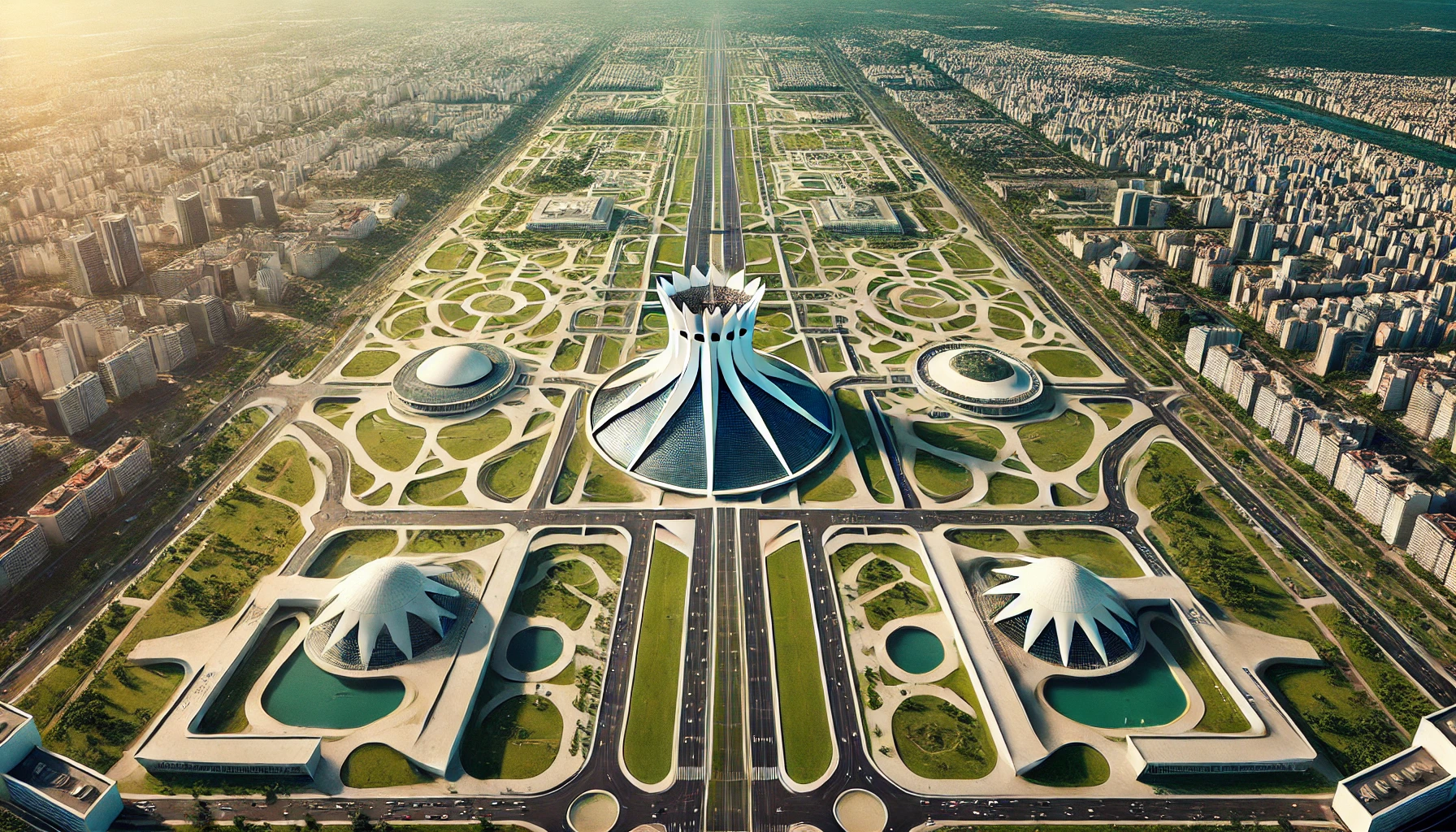
Costa’s winning design was a famous cross-axial drawing, resembling a flying bird or airplane, notable for its breathtaking simplicity sketched on a blank page. This scheme introduced a grand, symbolic layout where governmental, commercial, and residential functions were completely separated into distinct zones. The concept created a city that could be understood from above, prioritizing the clarity of the overall idea over the intimate scale of streets. It was a masterplan that organized life according to a rational ideal, where each part had its
Oscar Niemeyer: The Poet of Concrete
Niemeyer believed that architecture should inspire admiration and beauty, and he infused his designs with sensual and unforgettable forms. His buildings are characterized by sweeping curves and daring cantilevers that make heavy concrete appear weightless and fluid. These forms deliberately rejected the rigid right angles of earlier modernism, imbuing his work with a distinct Brazilian lyricism. He created a landscape of iconic monuments, where each ministry, cathedral, and plaza became a sculptural event.
Monumental Axis and Residential Superblocks

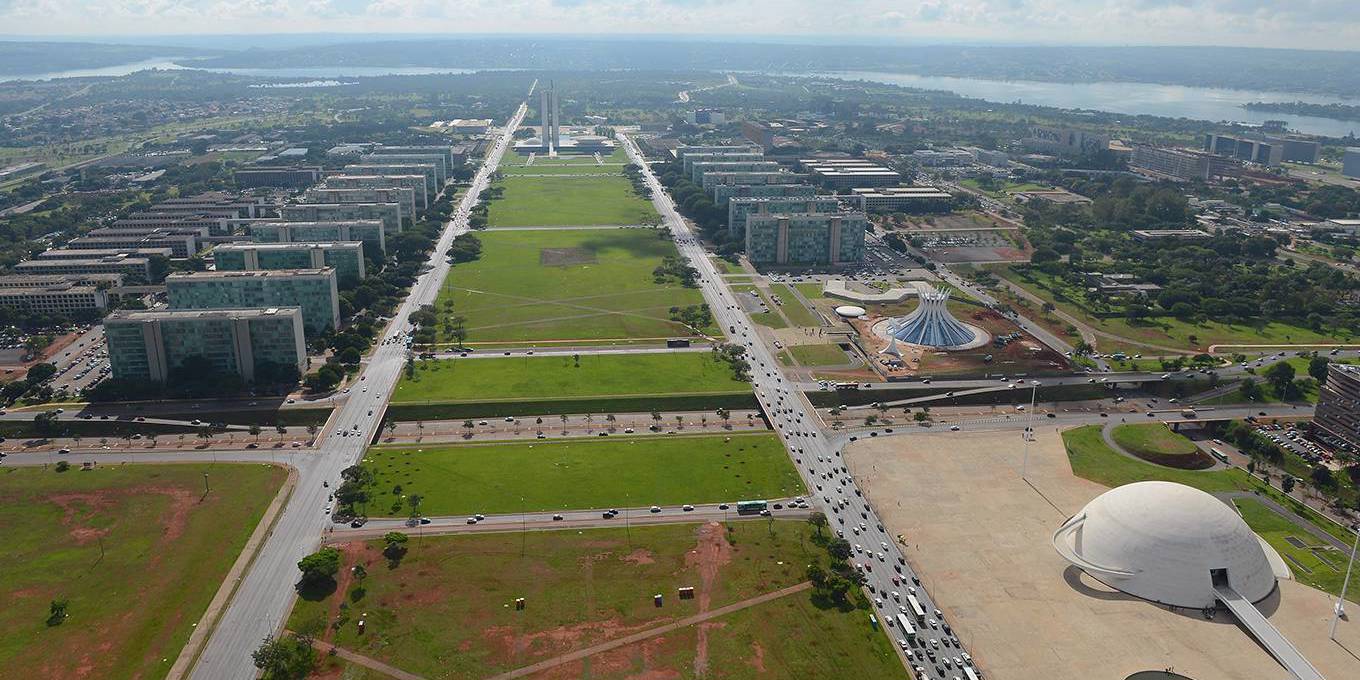
The Monumental Axis is the city’s formal, ceremonial backbone; a vast, awe-inspiring, and inhumanly scaled space designed for grandeur and processions. In contrast, the residential superblocks are conceived as self-sufficient vertical neighborhoods nestled within abundant greenery. This division has created a sharp duality between the symbolic, empty space of state power and the intimate, communal spaces of everyday life. The tension between these two realms, oscillating between monumentality and community, defines the lived experience of the city.
Opening: A City Born Overnight

On April 21, 1960, Brasília was inaugurated as a completely new capital built from the wilderness in just 41 months. This event was a spectacular display of modernity, as if a finished urban product had been magically presented to the world. This overnight birth created a place without a past, devoid of the slowly accumulated memories that characterize old cities. It marked a definitive rupture in time, signifying the moment when Brazil aimed to leave its history behind and step into a planned future.
Architectural Symbols and Urban Form
These structures are not isolated objects; they are precise punctuation marks in the grand sentence of the city. By lending rhythm and hierarchy to Brasília’s vast, open plan, they transform abstract geometry into a legible urban landscape. Their monumental scale and deliberate placement choreograph the experience of moving through a capital designed for the automobile age. Ultimately, they serve as physical anchors of national identity, making ideology permanently visible in concrete, glass, and marble.
National Congress: Symbolism in Twin Towers and Domes
Oscar Niemeyer inverted traditional architectural symbolism to reflect a modern political ideal. The twin administrative towers rise as pure, identical shafts, symbolizing a rational and egalitarian legislature. The towers’ sharp verticality is balanced by twin domes beneath: one concave dome represents the Senate’s open deliberations, while the other convex dome symbolizes the outward-facing Chamber of Deputies. This composition transforms the building into a diagram of democracy, where opposing forms create a dynamic yet stable whole. This is significant because it translates
Brasília Cathedral: Reaching for the Abyss of the Skies
This structure redefines the sacred not as a heavy, enclosed fortress but as a crown of light suspended above the earth. Sixteen parabolic concrete columns rise and converge, creating an upward movement that evokes both technological prowess and a profound sense of spirituality. Inside, the space is defined by a spiritual blue light filtering through the stained-glass ceiling and a feeling of weightlessness that dissolves the boundary between the material and immaterial. Representing a radical departure from historic church architecture, the building proposes a new kind
Palace of Dawn: Elegance and Structural Boldness
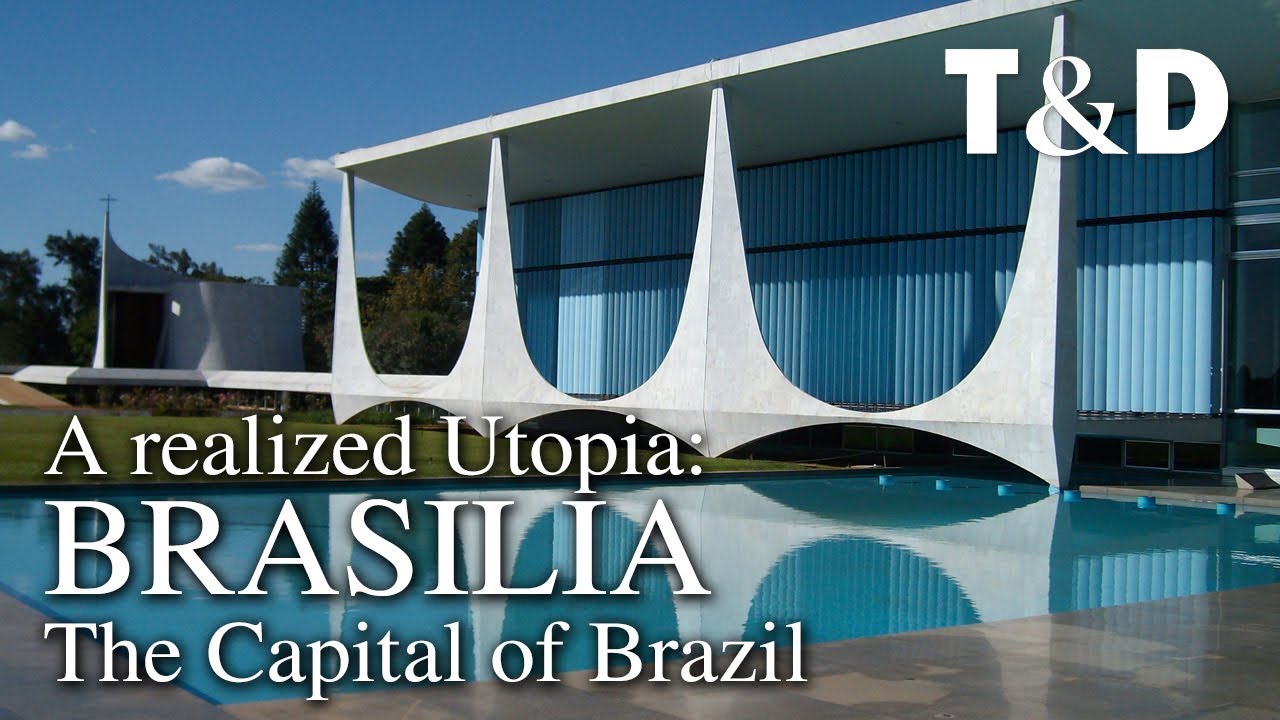
As the presidential residence, it establishes a language of elegant authority through its breathtaking structural honesty. The entire palace rises on slender, outward-curving columns that appear to barely touch the ground, creating an impression of poetic lightness. This daring engineering transforms the building into a pavilion floating above reflective pools, seamlessly integrating architecture with its landscaped surroundings. It demonstrates that power can be expressed not through sheer mass and fortification, but through refinement and transparency. The palace stands as a manifesto of modern Brazil’s
Urban Scale and Pedestrian Experience
The master plan of Brasília, designed from a bird’s-eye view, presents a sublime order that feels alienating when experienced at human scale. The vast open spaces between monumental axes and superblocks were crafted to emphasize the speed and grandeur of automobiles, reducing pedestrians to mere spectators. This creates a paradox where the breathtaking clarity seen on a map transforms into an experience of solitude and overwhelming distances for those on foot. It sparks a critical discussion about the place of the human body in utopian urban visions and
Miras, Criticism and Living Modernism
Brasília is not a relic; it is an ongoing debate between concrete and sky. It embodies the ultimate act of architectural faith—drawing an entire social plan from scratch onto a blank canvas in Brazil’s highlands. This heritage is a living one, constantly negotiating between its original, pure ideals and the complex, vibrant reality of human settlement. To engage with it is to confront the enduring power—and peril—of total design.
UNESCO World Heritage: Preserving Modernity
This assignment frames the city’s Pilot Plan as the museum of the future, a frozen moment of 20th-century ambition. It protects Lucio Costa’s urban cross and the formal purity of Oscar Niemeyer’s sculptural government buildings from insensitive alterations. This act of preservation allows us to see, beyond the aging concrete, the radical hope it once represented. It asks what we choose to monumentalize, turning a modernist experiment into an ancient wonder.
Architectural Criticism: Functionality and Monumentality
The city’s grand axial symmetry and vast open plazas often feel as if they were designed not for the feet of its citizens, but for the eyes of God. Buildings with deep symbolic power, like the twin towers of Congress, can seem detached from the intricate needs of daily life. This tension highlights a fundamental dilemma of urban architecture: should it serve the image of the state or the comfort of the people? In Brasília, the scale of this gesture can sometimes overwhelm the very humanity it seeks
Social Reality: Utopian Vision and Urban Segregation
The masterplan envisioned a classless society unified within a single, orderly landscape. In practice, however, the high cost of the planned center exiled the working class to distant satellite towns, recreating the very social divisions it sought to eliminate. Thus, the utopian diagram generated its own periphery—an informal ring of urban life that sustained the official center. This is the city’s most painful lesson: spatial order cannot legislate social equality.
Brasília Today: Harmony and Contemporary Interventions
The living city has continuously softened its rigid structure through informal appropriations and careful official additions. Once barren expanses are now covered in lush tropical vegetation, and new cultural institutions add intimate moments to the monumental scale. Contemporary architects working here must perform delicate surgery to breathe vitality into the historical skeleton without breaking it. This ongoing adaptation, though not yet perfect, is a sign of a healthy organism.
Lessons for 21st Century Architects
It teaches that a city is not a noun but a verb, a process that continues long after the master architect has departed. The project warns against the arrogance of tabula rasa and reminds us that context is not only physical but also profoundly social and temporal. Most importantly, it holds up a mirror to our own ambitions, asking whether we build for diagrams or for the unpredictable, magnificent complexity of human life. Its greatest value may lie in being a permanent question mark etched into the landscape.
Discover more from Dök Architecture
Subscribe to get the latest posts sent to your email.