

UTEC Lima Campus – Grafton Architects
UTEC is a university building that refuses to behave like a delicate object on a plot of land. Located in Lima’s Barranco district, it is a concrete landform constructed at the intersection of the city’s infrastructure, rocky terrain, and students’ daily lives, transforming this intersection into a legible section. The project won the first RIBA International Prize for its transformative approach to the educational space, becoming a global symbol of this goal.
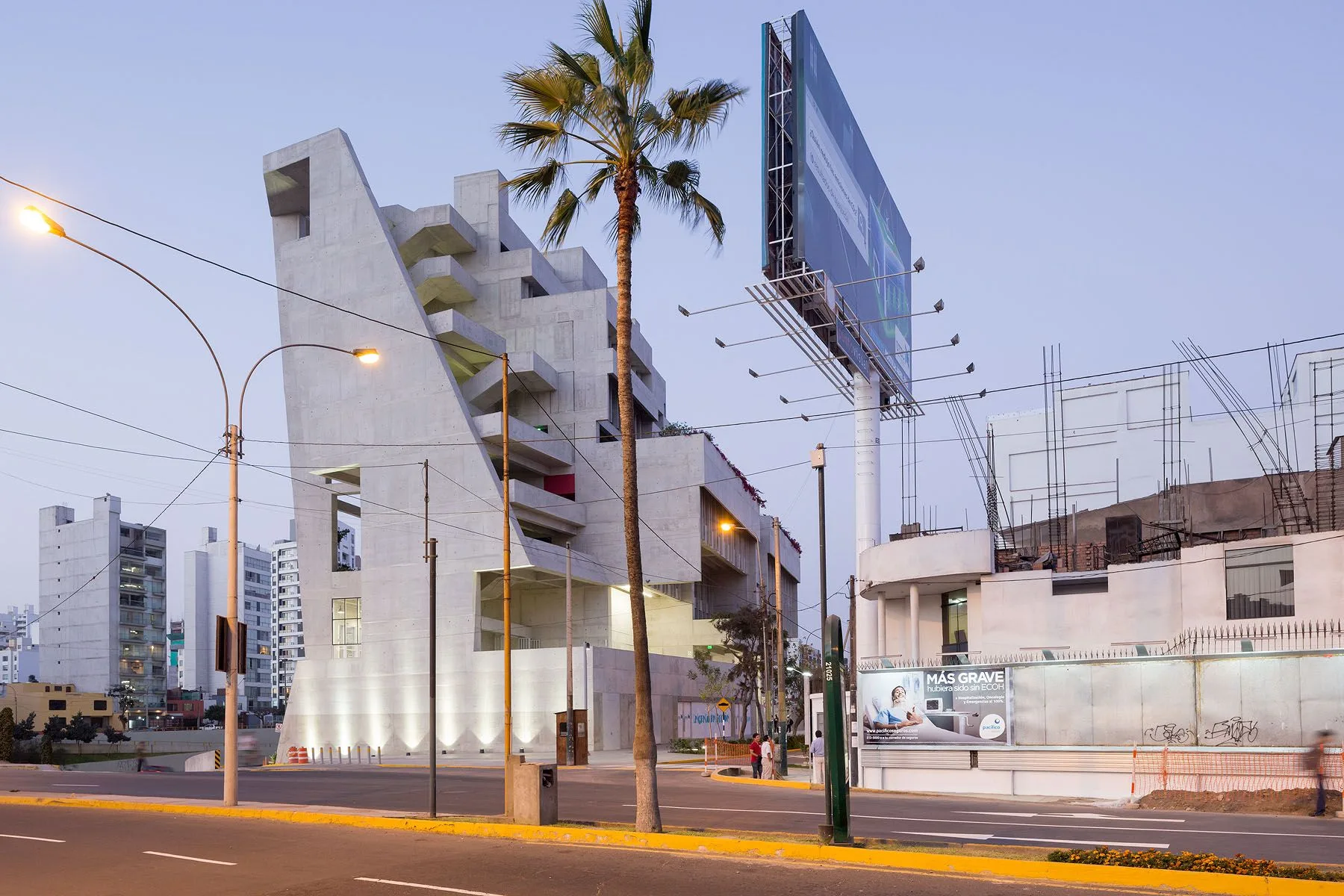
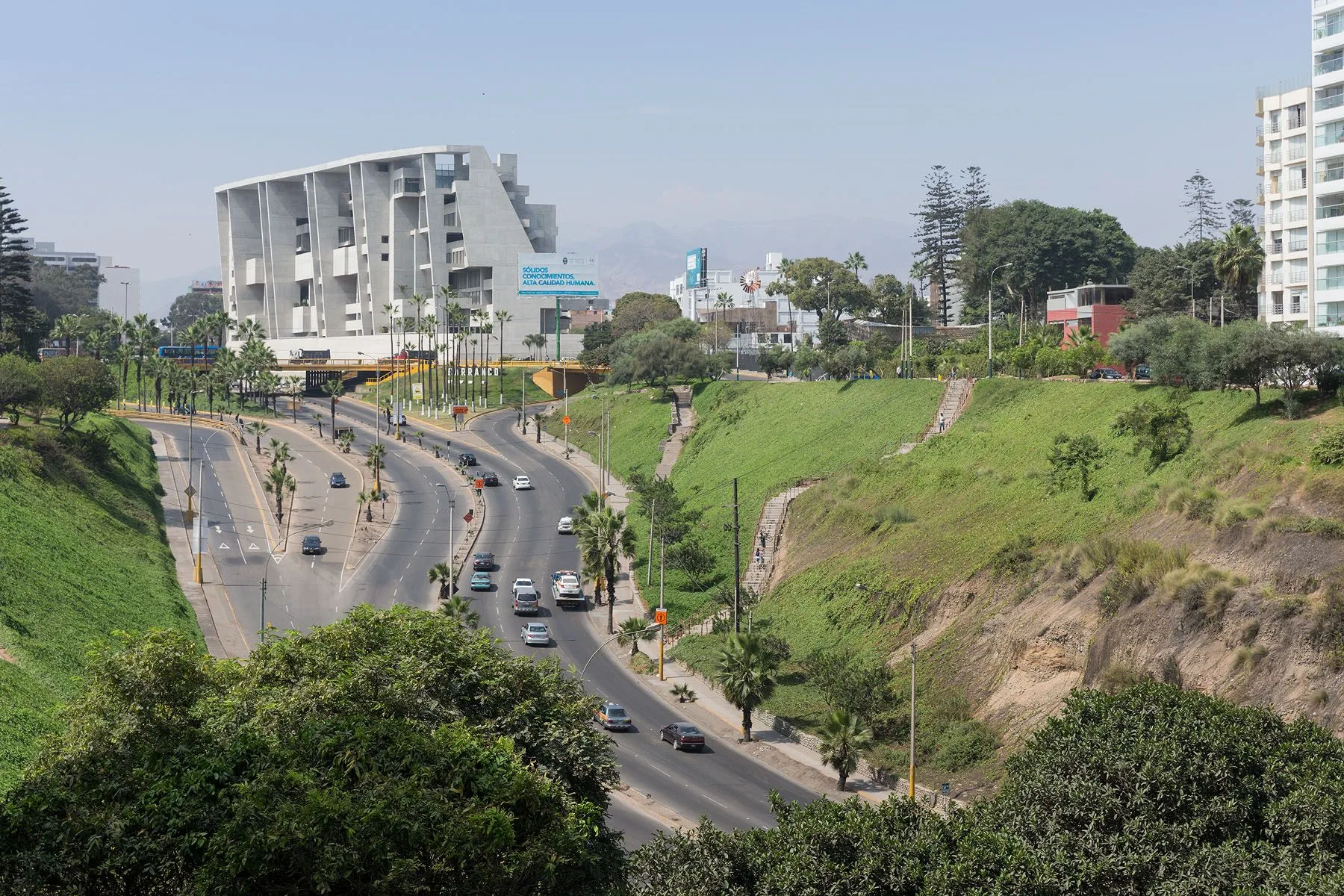
The basic idea is simple and radical: to make the campus feel like Lima itself. Instead of confining learning behind glass, the building uses stacked terraces, deep shadows, and open circulation areas to keep students in constant contact with the coastal air, strange light, and the city’s edge conditions. This is less a “building with classrooms” and more a vertical public landscape that you pass through, eavesdrop on, and encounter.
Site Context and Urban Conditions in Lima
The site is located in a kind of urban valley rising from the ocean road; on one side is a busy highway, on the other is the residential fabric of Barranco. Lima’s high coastal cliffs define a wider area, and the campus is located at the point where this dramatic terrain profile intersects with the daily urban fabric. Even the atmosphere is significant here: a desert city with cool coastal currents and light softened by fog forces architecture to be considered not only in terms of form, but also in terms of shadow, breeze, and thickness. Architect Magazine RIBAJ Inspired by Lima’s Coastal Cliffs: The “Man-Made Cliff” Concept Grafton’s “new cliff” is not a metaphorical decoration but a structural stance. Viewed from the sea, the building appears as a constructed slope mirroring the natural cliffs that define Lima’s boundary with the Pacific, instantly making the university part of that boundary. Concrete here becomes geology: heavy, carved, and quietly monumental, more like voids cut into rock than windows on a facade.
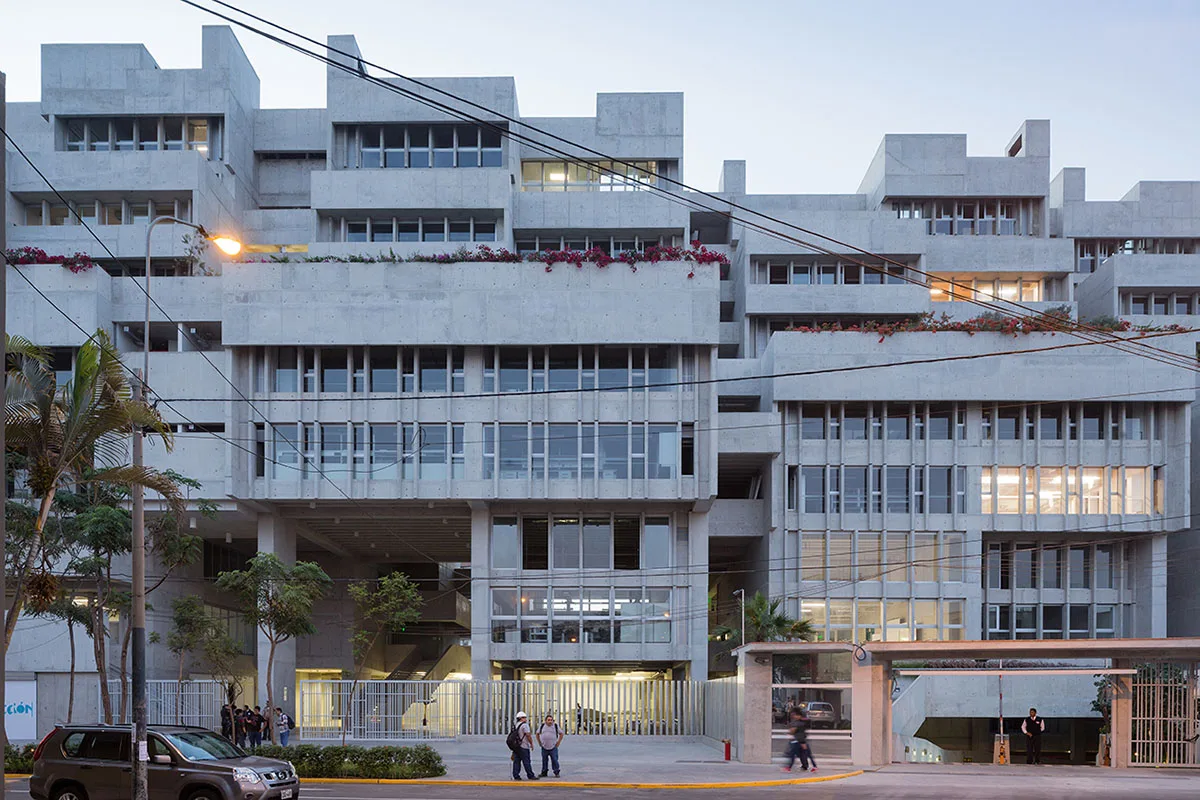
Inspired by Lima’s Coastal Cliffs — The “Man-Made Cliffs” Concept
Redefining the University Campus: From Horizontal Expansion to Vertical Campus
A traditional campus is spreading out. UTEC stacks its laboratories, amphitheaters, and workspaces in a vertical sequence, turning circulation into a social engine. Teaching areas are divided into upward layers, with terraces and stepped roofs serving as open-air rooms, and the library on the top floor designed as a destination with panoramic views. The “vertical campus” operates with the support of climatic conditions: most of the spaces in between can remain open to the air, so learning takes place at the thresholds as much as in closed rooms.
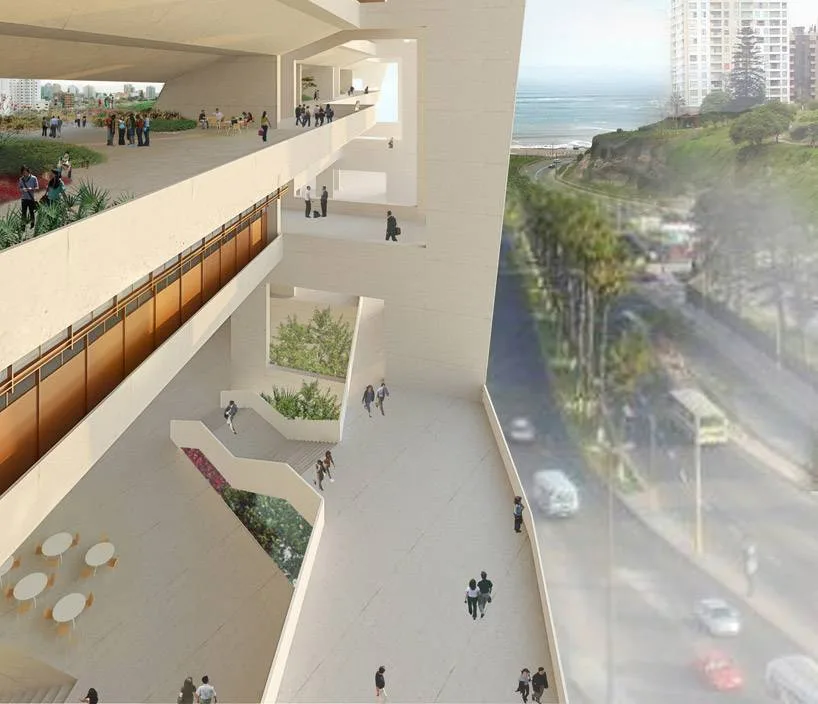
Integration with the Sea, City, and Housing Scale
The building has two urban facades with different functions. The side facing the highway creates a hard, visible edge that announces the institution’s presence to the city’s flow while protecting the quieter life behind it, while the side facing the neighborhood is broken up into stepped terraces and gardens that descend toward a lower residential scale. This campus is a structure that communicates at different distances: a symbol in motion from the road and a permeable, walkable section for the people inside.
Architecture and Spatial Planning
UTEC is organized like a cross-section of a city rock formation: first the structure, then the rooms, followed by the social atmosphere connecting them. The most important areas of the building are often the spaces in between, as the architects treat circulation, shade, and views as part of the curriculum.
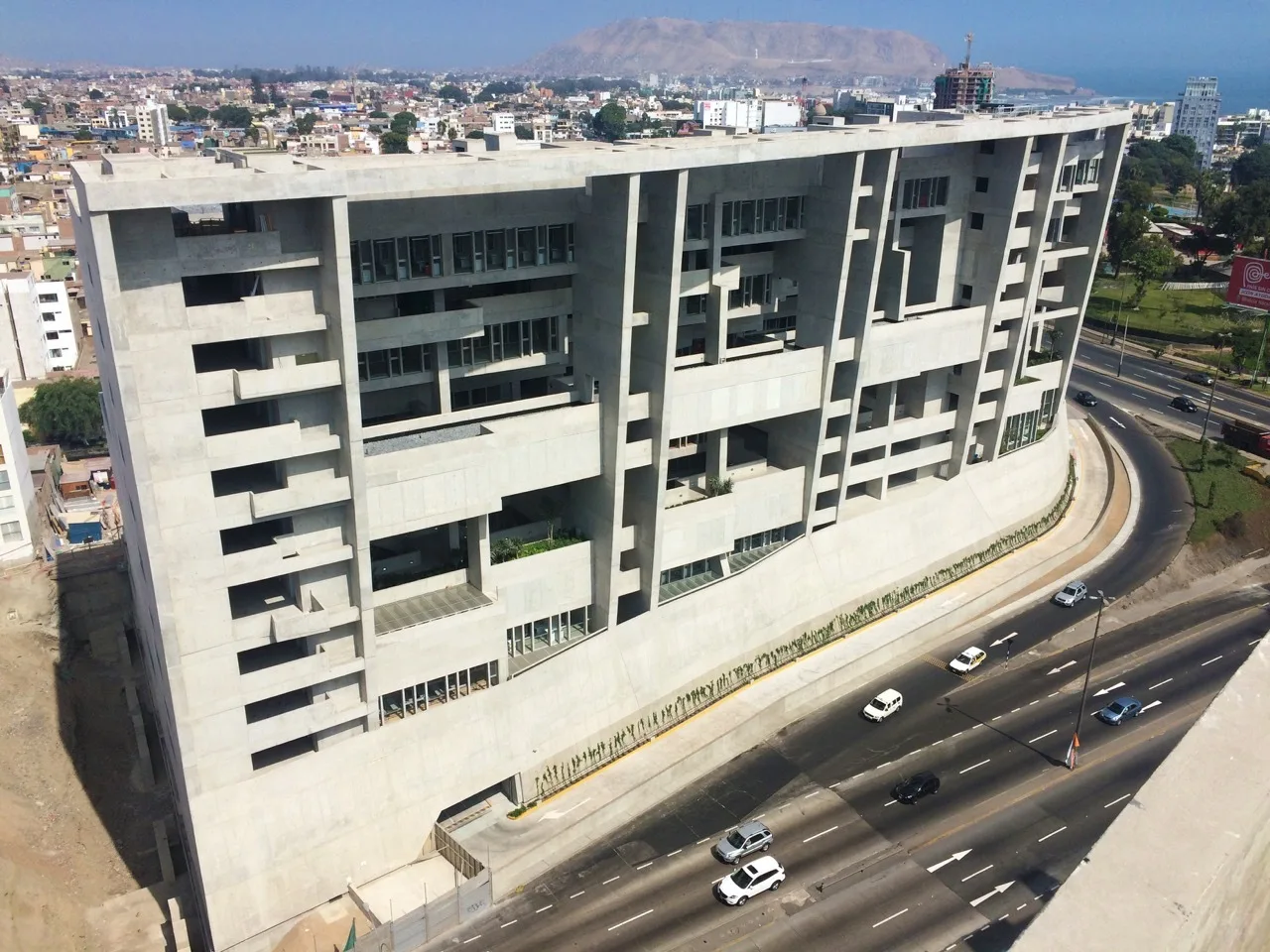
Structural System and Material Choices (Exposed Concrete, Brutalist Language)
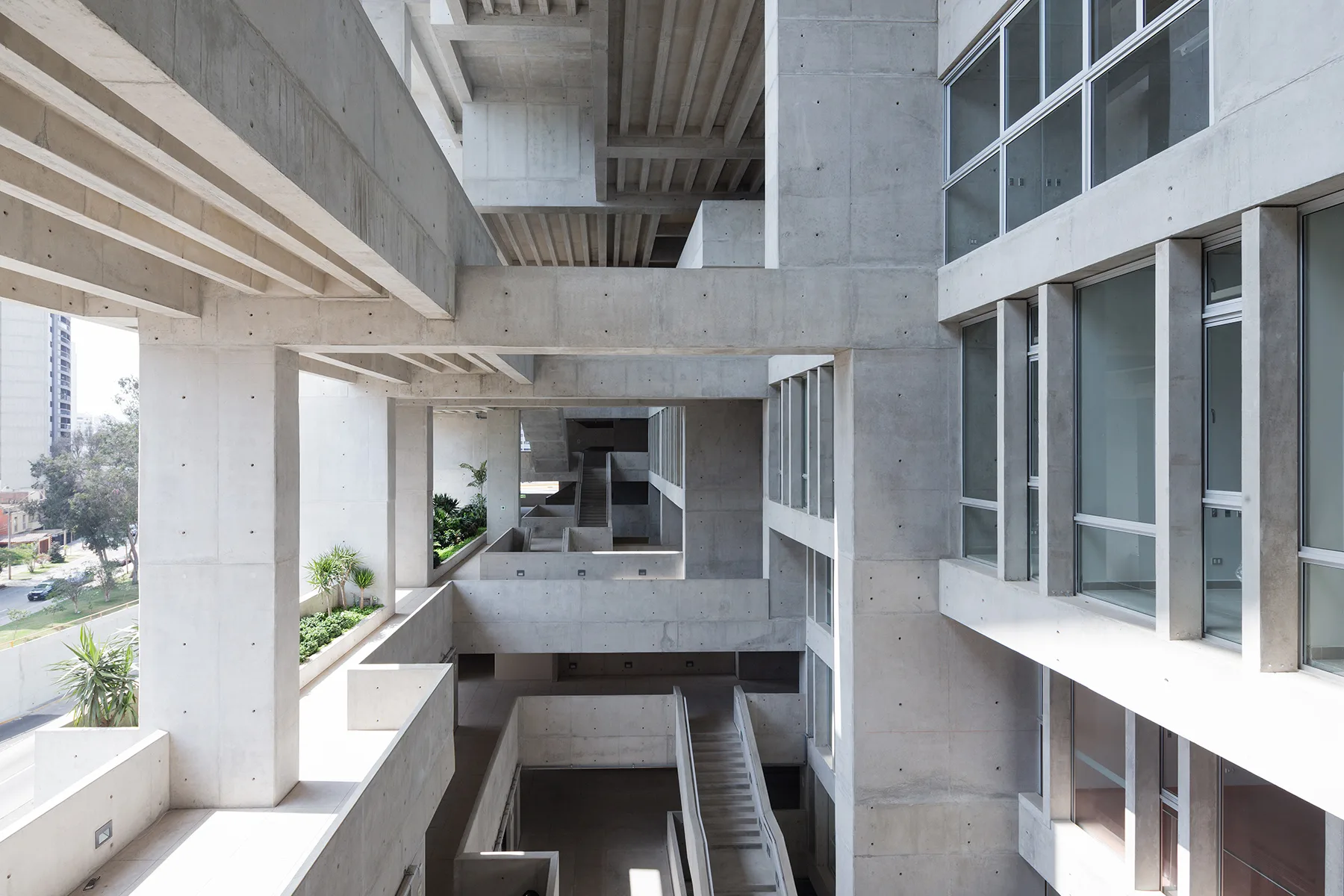
The exposed concrete skeleton is not merely an appearance, but the campus’s skeleton and climate machine; it holds everything in place while creating deep shadows. Teaching rooms, laboratories, and offices are read as sometimes glassy and delicate, sometimes heavy and recessed “added” volumes, so you constantly feel the tension between openness and protection. The Brutalist language works here because it suits the site’s harshness: a building that stands on the infrastructure, behaving more like an engineering product than a gentle façade.
Vertical Storage: Laboratories, Classrooms, Offices, and Library Between Floors
The program is organized by size and public function: larger volumes are closer to the ground, while teaching and administrative sections rise upward. Near the roof, the library becomes a destination point and, after the congestion below, is enveloped by a surrounding loggia that frames the city and sea like a long, tranquil panorama. The result is a campus where “up” feels not just like height but like progress, as if learning is literally gained by ascending. Circulation Strategy: Exterior Walkways, Atriums, and Open-Air Connections Circulation is designed as an exterior landscape with open-air paths that allow students to feel the coastal breeze as they traverse the campus through sun-protected voids. Instead of a single large corridor, the building platforms, ramps, and stairs are connected in a series of spatial sections, designed to trigger chance encounters and visual overlaps. This transforms movement from a private internal corridor system into a shared civic theater, showcasing university life.
Circulation Strategy — Exterior Walkways, Atriums, and Open-Air Connections
Terraced Gardens and Green Areas: Stepped Landscaping Facing South
The terraces act like an artificial slope, a contemporary reflection of Peru’s terraced landscapes, but have been transformed into an academic living space. Plants touch the stepped section, evoking a sense of lived-in campus, softening the concrete over time, creating shade and small ecosystems. These green areas are important because they make the height human-scale: each level allows one to stop, gather, and breathe, rather than just passing through.
Facade Operations: The Contrast Between the “Cliff” in the North and the Garden Facade in the South
UTEC presents two distinct approaches to the city. In the north, it forms a stark “cliff” against the fast-flowing street, a protective wall that can be read as architecture on an infrastructure scale. In the south, it transforms into terraces and gardens that harmonize with the smaller residential fabric, turning the building into a stepped neighborhood rather than a single mega-structure. This contrast is the project’s urban intelligence: one side declares, the other belongs.
Impact, Recognition, and Relevance for Architects and Users
Awards and Critical Acclaim: RIBA International Award and Global Recognition
UTEC’s turning point was winning its first RIBA International Award. This award framed the project as more than just a strong campus building, positioning it as a new global reference point. The award citation emphasized the project’s ambitious and comprehensive nature: a work that transforms a challenging edge condition into an integral part of the city, climate, and education. Such recognition is significant because, at a time when many public buildings have become gentle, closed, and generic, it legitimized a more assertive, infrastructure-focused urban architecture.
How Design Influences University Campus Typologies Worldwide
UTEC popularized the concept of the “vertical campus” as a serious alternative to sprawling academic parks, proving that density can still feel public, social, and spacious if intermediate spaces are designed with as much care as rooms. Circulation, terraces, and platforms are treated as shared spaces within the campus, transforming the building from a mere container for sections into an urban microcosm. For architects, this lesson is typological in nature: the campus can be drawn not only as a plan of blocks but also as a section and landscape.
User Experience: Social Interaction, Learning Flow, and Community Engagement
The building is fundamentally a collision zone: students move between open passageways and shared platforms where you can see experiments, conversations, and the city all at once. Program volumes feel “attached” to a larger structural framework, so that learning is perceived not as something hidden behind corridors, but as something suspended within a social skeleton. This creates the daily rhythm of encounters; passage becomes participation, and the university feels like a public space, even if you are just passing through.
Sustainability, Climate Sensitivity, and Passive Environmental Strategies
UTEC’s environmental logic is clear and elegant: keep air circulation open, use the concrete frame for shade and depth, and reserve air conditioning for rooms that truly require it. This approach transforms the concept of “passive” into a spatial experience, as comfort is achieved through sections, shade, and breezes rather than a completely enclosed space. In Lima’s coastal climate, the building treats weather conditions not as a problem to be eliminated, but as an integral part of the educational experience.
A Legacy for Future Architects: Lessons to Learn from Grafton’s Design Approach
Grafton’s most transferable lesson concerns discipline: start with climate, section, and public life, then allow form to emerge as a result. UTEC demonstrates how mass can be generous when used to frame air, light, and gathering rather than to become a rigid image. For future architects, this serves as a reminder that the strongest buildings often behave like a “new geography”: they create not just a silhouette you can photograph, but a place you can live in.
Discover more from Dök Architecture
Subscribe to get the latest posts sent to your email.