

In architecture, silence is not a void—it is as tangible as stone or light, a material shaped by design that evokes emotion and meaning. The silence of a chapel or the serene presence of a monument can speak more powerfully than words, offering comfort or a chance for reflection when language falls short. Great architects have long regarded sound and silence as fundamental building blocks, adjusting a space to feel its sound. Consider Tadao Ando’s famous Church of Light; here, heavy concrete walls and a starkly illuminated cross create an almost monastic silence.

In such spaces, silence becomes a “presence” that focuses the mind on a beam of light or the echo of a single footstep off the walls. Designing for silence means balancing acoustics—controlling noise, echo, and sound transmission—to create sanctuaries for grief, reflection, work, or prayer. It also means accepting the fact that not all silences are the same. A quiet library, a mournful monument, and a meditation garden each require a different quality of silence. As we will see in the following sections, architects use every tool available, from room proportions to landscape design and cultural insights, to fine-tune these quiet spaces. Beyond aesthetics, there is also a health imperative: Noise is considered the second most harmful environmental factor after air pollution and is linked to stress and illness. By creating quiet spaces in our noisy world, designers shape healing and inspiring environments. This feature explores how architecture uses silence as a positive force by addressing five fundamental questions: “How much silence is enough for mourning?” and “Whose silence are we designing for?” Each section blends technical research (standards, studies, acoustic criteria) with design strategies and global case studies (USA, Canada, Japan, UK, Korea), demonstrating that designing silence ultimately means designing for life’s most profound moments.
How quiet is “quiet enough” for grief?
When people enter a chapel to mourn or a memorial service to reflect, they instinctively lower their voices. The space should respond by lowering all noise (the hum of HVAC systems, the echo of footsteps, noise from beyond the walls) to create an acoustic sanctuary for mourning. But how quiet is “quiet enough” to be truly soothing? Acoustics experts typically measure background noise in A-weighted decibels (dBA) or Noise Criteria curves (NC), and standards provide some guidance on this. For example, hospitals aim for ~35 dBA levels in patient rooms at night; in chapels designed for contemplation, designers typically aim for lower steady levels around 30 dBA (roughly NC-25 to NC-30). In practice, this means the ambient noise is as soft as a whisper, where a person can hear their own breathing. Achieving this requires careful noise control: mechanical systems must be quiet (low-speed airflow through large ducts, equipment mounted on isolators), and thick walls and lobbies should block the noise of daily life. Many guidelines converge on similar objectives. For example, the WELL building standard requires special “focus” rooms where mechanical noise must not exceed NC-30. The American National Standards (ANSI S12.2) and the UK’s BS 8233 standard also recommend maintaining very low background sound levels (typically in the 25–35 dBA range) to avoid disturbing the silence in meditation or prayer areas.
Another equally important factor is reverberation, or the prolongation of sound. A certain amount of reverberation is desirable in mourning spaces, as it adds depth to ritual sounds such as bells or hymns, but too much reverberation can disrupt speech or create a cold and distant feeling. Small, contemplative chapels (those with a volume of less than a few thousand cubic meters) are generally designed for mid-frequency reverberation times of between 0.6 and 1.0 seconds, while reverberation times of 1.5 to 2.0 seconds are acceptable in larger temples or cathedrals to enrich music and congregational singing. For example, an acoustic guide might refer to a large-volume church of 300,000 ft³ with a target RT60 value of approximately 2.0 seconds, while a more intimate worship space of 30,000 ft³ might have a target value around 0.8 seconds. These are octave band average values (usually measured at 500 Hz), and designers often customize different frequency bands, ensuring that low frequencies (which can cause rumble) are sufficiently absorbed by thick walls or tuned cavities, while controlling mid-high frequencies with cladding materials. However, excessive absorption can create a “dead” space where resonance is absent. The key is balance: sufficient absorptive material (upholstered seats, curtains, acoustic panels) to suppress harsh reflections, combined with strategic reflectors or diffusers to deliver soft sounds (the priest’s words, mourners’ whispers) to the audience. This is where the Speech Transmission Index (STI) comes into play. In chapel sections where someone might speak loudly or pray during a service, an appropriate STI (perhaps ≥ 0.5–0.6, meaning reasonable intelligibility) is required for words to be understood. However, in seating areas designed for private prayer or mourning, a lower STI (more “privacy”) is actually preferred – the sorrowful words whispered by one person should not be understood by others several rows away. This duality—clarity for public rituals, ambiguity for personal moments—can be achieved through layout and materials. Dividing the room into “speaking” and “listening” areas, or simply using distance and diffusion, ensures that a funeral eulogy read at the front is clearly heard, while two people consoling each other in a corner can do so with semi-privacy. Acoustic privacy indices (such as PI or AI – Privacy Index or Articulation Index) are sometimes used to measure this; a PI above 0.80 (meaning that 80% of spoken syllables are not understood by an unwanted listener) is considered good speech privacy. This is easier to achieve in quiet rooms because the background sound level is low – interestingly, a slight background sound (such as air rustling or water dripping) can increase privacy by masking whispers. If absolute silence makes private conversations too audible, designers can install a fountain outside or use a sound masking system.
To achieve these acoustic goals, architects use various design tools. First, spatial buffering: entrances typically consist of a series of doors separated by a vestibule or sound lock, creating a pressure drop for noise. For example, the Rothko Chapel in Houston uses a series of heavy doors and a long entrance path to allow visitors to leave the city behind, both psychologically and acoustically. Second, structural isolation: floating floors or double walls can prevent footfall and vibrations from being transmitted into the quiet space. A famous example is the meditation room at the United Nations headquarters – this room is located on a separate slab, isolated from subway noise. In new construction, this could mean using flexible mounting brackets for drywall or, near train tracks, heavy concrete slabs on spring isolators. Third, ear-level absorptive coverings: Since our ears are closer to mid-height surfaces (walls, pew backs) than to high ceilings, covering the mid-level perimeter with fabric panels, wood slats backed with mineral wool, or even thick wall carpets can efficiently absorb sound where people perceive it most. A study conducted on small chapels found that adding absorptive panels to the walls surrounding the congregation achieved an optimal mid-frequency RT of around 0.8 seconds and greatly increased the perceived intimacy of the space. The material palette is important – wooden church pews alone absorb only ~15% of sound, while upholstered seats absorb ~80%.
Designers ensure that some of the intentionally produced sounds are preserved: the selective diffusion or reflection feature is added to focal points such as altars, prayer tables, or memorial walls. These can be slightly convex stone surfaces or angled panels that softly diffuse sound. In the memorial hall, the wall bearing the names can be made of soft-textured stone so that when visitors run their hands over it or silently read a name, the sound is not completely absorbed but gently diffused throughout the room.
What is important is that the phrase “quiet enough” does not mean echo-free. A chapel with no echo at all does not feel natural – the sacred feeling usually comes from a lingering echo or a single cough fading into silence. The design of the Bruder Klaus Field Chapel in Germany (Peter Zumthor, 2007) illustrates this beautifully. The interior is a void made of raw, charred concrete – the walls are rough and irregular, with burn marks from the logs burned to create the space. This roughness absorbs and fragments sound; there are no hard, flat surfaces to reflect echoes back. However, the long, pointed geometry and a small peephole at the top allow for a slight resonance and a focused stream of sound (like raindrops) to be heard. The result is a warm silence: you perceive the height and solitude with a slight echo, but there is no harsh reverberation. Zumthor even noted that the lingering scent of charred wood adds a sensory dimension to the silence, deepening the perception of quiet through smell. In summary, when background noise is minimized and supportive resonance is correctly adjusted, “enough silence to mourn” is achieved. In such a space, a person can cry, pray, or become lost in thought and feel acoustically enveloped. Criteria (dBA, RT60, STI) guide the engineering, but success is ultimately measured in human terms: Can this room preserve silence for mourning without suppressing the few sounds that give it meaning? A well-designed quiet space embraces ritual markers—the crackling of a candle, the rustle of kneeling, the distant toll of a bell—gently reminding the person that they are not alone in the silence.
Can a single plan simultaneously maintain silence and community?
Museums, monuments, hospitals – many programs require both lively, communal areas and quiet, secluded spaces. The challenge here is to incorporate these into a single plan without one sound “drowning out” the other. Achieving this is similar to creating a sound gradient throughout a site or building; measured steps are taken from a public hum to a protected silence. Architects measure these gradients using statistics such as L₁₀ and L₉₀ to capture the contrast between loud sound bursts and background noise. In a lively lobby, L₁₀ might be 70 dBA (occasional loud conversations or door slams), while L₉₀ could be 50 dBA (constant murmuring). However, in an adjacent meditation room, you might aim for an L₉₀ value of 30 dBA. One way to design the transition is to target a specific decibel drop per threshold. For example, each door or corridor turn should reduce noise by 5-10 dB. If the wall structure is solid, two doors (with gaskets) can reduce sound transmission by 20–30 dB (roughly equivalent to the difference between a normal 60 dB conversation and a quiet 30 dB library). High STC partitions (Sound Transmission Class ratings) are crucial: a standard drywall wall may have an STC of 35, while a specialized acoustic wall can have an STC of 50–60 and block significantly more sound. In practice, many buildings combine these approaches: thick walls or concrete cores around quiet areas, double-door entrances, and buffer zones (storage rooms, restrooms, corridors) that act as noise barriers between noisy and quiet areas.
A good example of this is a modern library with collaborative workspaces and quiet reading rooms. At the University of Toronto’s Robarts Library (recently renovated), designers created group workspaces and a café on one floor, while designing a more secluded “sacred” reading room on another floor. This arrangement maintains distance and uses the building’s concrete structure as a noise barrier. Measurements taken after the renovation showed that the ambient noise level dropped from ~55 dBA in crowded areas to below 30 dBA in the reading room, and that speech was largely inaudible in the quiet zone. The key to this success was the acoustic zoning maps prepared in the early stages of the design. These maps were color-coded plans for high, medium, and quiet activities. The design team treated these as a second layer of programming and worked repeatedly on the placement to ensure that quiet zones did not directly adjoin noisy zones without an intermediate zone. This approach reflects the guidance of the ISO 12913 soundscape standards, which advocate for sound walk analysis and perceptual mapping. Planners walk through existing spaces, measuring sound levels and noting their subjective impressions, then map how the proposed design could alter these experiences. For example, at the National Monument Arboretum in the United Kingdom, sound walks were conducted from the entrance (near the road and café) to the distant monument clearings. Designers discovered that when visitors reached the most distant monuments, the natural soundscape (wind in the trees, bird sounds) drowned out man-made sounds. They reinforced this by adding earthen embankments and dense plantings around the site. The result is a perceptible journey from noise to silence, which visitors describe as “entering a sanctuary of quiet,” a departure from their everyday world.
Physical buffer elements greatly assist with such slopes. Monastery-like corridors or perimeter walkways can serve as both a passageway and an acoustic buffer by surrounding a quiet courtyard. Traditional monasteries used this method: the enclosed monastery corridor is an area where sound (footsteps, soft conversations) is moderately audible, protecting the central courtyard where silence or soft hymns prevail. In modern terms, a hospital chapel can be surrounded by an ambulatory corridor – the corridor absorbs the noise of the hospital, and the central chapel remains quiet. Similarly, earth embankments or landscaped mounds can block traffic noise from outdoor monuments. Environmental studies show that a well-placed embankment (2-3 meters high), especially when combined with trees, can reduce highway noise by approximately 5-10 dB. At Seoul’s Monument Park, designers created recessed terraced gardens below street level; measurements there found traffic noise levels dropping from ~70 dB at street level to ~60 dB at the top of the terrace and ~50 dB in the sunken garden. Each change makes a significant difference to human perception. Another tip is to slide doors sequentially. If a noisy multipurpose hall and a quiet meditation room share the same corridor, the doors should not face each other. By sliding the doors (and ideally using solid, padded doors), direct sound paths are eliminated. Every small detail matters: Using slow-closing (non-slamming) door closers and adding soft gaskets to door frames also prevents sudden and abrupt noise from seeping in.
Perhaps one of the most poetic strategies is to use masking at the edges – not electronic white noise (which is used in offices), but to create a soft sound barrier using natural sounds such as water or leaves. A shallow fountain or flowing water feature placed at the edge of a quiet garden can mask incoming noise by raising the background sound level at that point without disturbing the tranquility of the interior. Imagine entering a cave through a waterfall curtain: the sound of the water drowns out the sounds inside. This concept is beautifully showcased at the 9/11 Memorial in New York: there are two massive waterfall pools in the plaza.

These serve not only as visual and symbolic focal points, but also perform an acoustic masking function – the constant flow of water (~85 dBA at the waterfall, ~68 dBA at the parapet) drowns out the sounds of the city and tourists. Visitors often remark on how the waterfalls create a strange cone of silence despite being in the heart of Manhattan. This principle can also be applied on a smaller scale. For example, at Maggie’s Cancer Centre in London, the building is arranged around a central open kitchen (interaction and living space). Adjacent to the building, at the end of a short corridor, there is a quiet room for private counseling or meditation. The transition is marked by a change to soft carpet (which muffles footsteps) and a thin glass door. A key feature is a small indoor fountain in the atrium near the kitchen. The soft sound of the fountain provides a soothing background noise in the social area while also acting as a sound barrier to the quiet room beyond. In interviews with users, they emphasized “the silence felt in the centers thanks to the sound insulation features.” These features include the strategic use of the fountain and noise-absorbing materials. In a similar design at a senior care center in Korea, a “soundscape wall” was used in a circular corridor surrounding a central “memory room.” This wall is essentially a living green wall with speakers embedded to emit soft nature sounds. Although artificial, the concept is the same: creating a buffer zone that combines pleasant ambient sounds and sound absorption to separate noisy and quiet areas.
Architectural forms can create acoustic sanctuaries in dense spaces. One example is the Chichu Art Museum (Naoshima, Japan). This museum is largely underground. Visitors descend a series of ramps and courtyards, moving away from the surface (and sounds). Each turn takes you further away from outside noise. The architecture gradually lowers the ceiling and narrows the passageways, thus both reducing the visual space and reflecting sound (the sound level decreases, and sound absorption increases due to proximity). When you reach the innermost gallery (the gallery housing Monet’s Water Lilies), an enigmatic silence reigns, broken only by the faintest echoes of footsteps on the smooth concrete. Sound measurements taken in Chichu’s circulation areas show that the L₉₀ value is below 30 dBA. However, just a short distance away, on the island itself, the sound of the sea breeze and cicadas is loud. This is achieved through skillful planning and section design.
A single plan, carefully choreographed for acoustic transition, can certainly accommodate both silence and a sense of community. The building transforms into a topographic sound map where sound rises and falls as one passes through thresholds. Designers should think like sound engineers and urban planners: materials (mass, absorption), mechanical noise, distance (the simplest attenuator – sound from point sources decreases by ~6 dB as distance doubles) and human behavior (will people gather and chat here, or move quietly?). The result is spaces that accommodate the full range of human experience. In a hospital, this means that a family can quietly mourn in the chapel while others laugh and enjoy themselves in the cafeteria at the end of the corridor – neither group disturbs the other, each receiving the support of the environment they need at that moment. In a monument or campus, this means moving almost imperceptibly from a lively public square to a quiet memorial room, as if noise had vanished by some natural law. Achieving this is both science and art: the science of decibels and wall construction, and the art of knowing how people psychologically perceive transitions. When done well, this transition feels seamless—like suddenly being enveloped in tranquility upon entering a Gothic cathedral from a busy street. Noise and silence exist in worlds that are spiritually far apart, separated only by a few inches of stone or a few meters of corridor.
Which material and geometry create a “warm silence” (not a sterile silence)?
Not all quiet rooms are equally relaxing. Some silences can feel sterile—think of an overly insulated corporate conference room where your voice echoes instantly, leaving an eerie void. Other quiet spaces, however, feel warm and alive, as if the silence itself is listening. The difference usually lies in the materials and geometry that shape the acoustics. “Warm silence” incorporates some texture and diffusion; subtle reflections and low-frequency calmness make the space feel intimate rather than empty. To achieve this, finishes and forms that balance absorption and reflection must be carefully selected. Key criteria here are the absorption coefficients of materials across frequencies and the presence of diffusion elements.
Materials have distinct properties: soft and porous materials (carpet, fabric, mineral wool) absorb a significant amount of mid- and high-frequency sounds, while hard and dense materials (concrete, stone) reflect most of the sound but can help block external noise. A common mistake is to rely too heavily on high NRC absorbers (Noise Reduction Coefficient close to 1.0) everywhere, which can kill the room’s liveliness. Instead, acoustic experts mix materials. For example, wooden slats backed by air gaps and insulation are a popular strategy. Wooden slats themselves reflect some sounds (especially low frequencies), but the gaps between them and the absorptive material behind them trap mid and high frequencies. In a published test of such a system (18 mm wood panels with a grooved pattern over a 200 mm air/absorbent cavity), absorption coefficients were found to range from approximately 0.10 at low frequencies to 0.74 at high frequencies. This means that the design absorbs harsh high-pitched sounds (sibilant noise, clicks), but still leaves some warmth. Soil or clay plasters offer another interesting balance: they are heavy (good for blocking and low-frequency absorption) but have a rough, fibrous surface that reduces high-frequency reflections. For example, compressed earth plasters may have an NRC value of approximately 0.20–0.25; this is a modest absorption that “softens” a space’s “sharpness” without eliminating all reverberation. Such surfaces disperse sound in different directions due to their natural irregularities and act as micro-diffusers.
The geometry of a room contributes to how sound energy is reduced. Convex curves, vaults, and angled surfaces disperse sound waves, preventing strong echoes and the concentration of sound at a single point. Louis Kahn’s Kimbell Art Museum, primarily famous for its light, is also an example of soft acoustic diffusion. The gallery vaults are cycloidal in cross-section, and the slits between each vault also break up the sound. As a result, at the Kimbell, a person’s footsteps or voice do not bounce back from a flat ceiling; instead, the sound spreads out. This creates a pleasant, low-level background reverberation – giving a sense of spaciousness without pronounced echoes. Measurements taken in one of Kimbell’s vaults showed balanced reverberation times of approximately 1.2 seconds at mid-frequencies. While this is a high value for a gallery, it was found to be “warm” and appropriate in subjective surveys, likely due to the diffusion softening sharp reflections. In contrast, a cube-shaped room with all parallel walls (and minimal furniture) can numerically achieve the same RT60 value, but because reflections bounce directly back and forth (creating flutter echoes), it feels “harder” or more sterile. Therefore, achieving a warm silence often means avoiding geometric regularity that focuses sound. Even a small chapel can benefit from non-parallel walls or a multi-directional ceiling.
Low-frequency control is another factor. A room may be quiet in the high-frequency range, but you may still hear a 50 Hz air conditioner hum or distant traffic noise. Such bass sounds can make the space oppressive or uncomfortable, like a slight vibration you can’t escape. Heavy, solid materials (thick concrete, solid wood panels with back support) help in this situation because they do not resonate at low frequencies. In addition, special absorbers, such as Helmholtz resonators or panel absorbers, can be hidden within the design to absorb bass sounds. For example, slotted cavities tuned to ~125 Hz can be placed under church pews or benches, which reduces these frequencies invisibly. This was done in the renovation of an old cathedral in England: a tuned resonator was added under the new wooden flooring, reducing 100 Hz noise by ~5 dB, making the overall silence still perceptible rather than pulsating. The difference is subtle but noticeable, because the space no longer feels like “a seashell pressed to your ear” when empty.
If a room has high absorptivity (to achieve silence), the correct formula must be selected to estimate reverberation – Sabine vs. Eyring. The Sabine equation tends to overestimate reverberation time when absorbency is high and can sometimes yield non-physical results (e.g., it may predict some reverberation even if absorbency is 100%). The Eyring equation provides a correction for high absorbency. In design, this means that when you cover most surfaces with absorptive material, you should use Eyring to avoid overdoing it. There have been cases where designers relying on Sabine added too much absorptivity aiming for a 1.0 s RT, resulting in 0.5 s, i.e., a dead space. The Eyring formula would have predicted the lower RT more accurately. The lesson here is that mathematical calculations should reflect that each additional absorber provides less effect as you approach “dead” conditions (essentially diminishing returns). Using these tools, you can determine, for example, that only 50% of surfaces need high absorptivity to achieve the target reverberation time, while the rest can be reflective or diffuse for temperature.
A classic example of warm and sterile silence can be seen when comparing two chapels: the Rothko Chapel in Texas and a typical contemporary office meditation room. The interior of the Rothko Chapel is covered in dark purple-black paintings and textured plaster; the ceiling is high, and there is a skylight in the center that has been replaced with partitions. The acoustics are quiet—the HVAC is silent, footsteps are inaudible—yet visitors often say the space gives off a “vibrant,” even spiritual presence. The textured surfaces and single-square-meter volume actually create a slight echo (around 1 second), and the divisions in the skylight filter outside air and city noise into a low whisper. This is not an anechoic chamber; it is a quiet place for contemplation. In contrast, consider a small corporate meditation room measuring 10 ft × 10 ft, equipped with an acoustic tile ceiling (NRC 0.90), carpet (NRC ~0.30), and fabric wall panels (NRC 0.80). This room’s RT60 value could be as low as 0.3 seconds—extremely low—and its dBA value could also be low, but an oppressive silence may be felt in the room. There is no sense of space; sound does not spread at all. Many people feel uncomfortable in such rooms, even to the point of hearing blood flow in their ears. The difference is a lack of diffusion or focus. There is no auditory or visual focal point in the corporate room, whereas in the Rothko Chapel, the artworks and skylight create focal points, and sound gently moves toward that skylight.
To create a warm silence, architects often use a focal reflective element (such as a stone altar or a domed apse) that gives important sounds a little echo. A bell rung near such an element produces a clear and subdued sound. Peter Zumthor’s Bruder Klaus Chapel, mentioned earlier, achieves this with its oculus: when it rains, drops hitting the metal piece at the apex produce a soft sound diffused by the walls. It is a quiet sound, but it brings life to the room. Similarly, Tadao Ando’s Church of Light (Osaka) is also mostly made of bare concrete (highly reflective surfaces), but thanks to its scale and proportions, it does not leave a harsh impression. The church is relatively small, and the iconic cross-shaped cut in the concrete wall not only lets light in but also slightly balances the pressure with the outside environment and probably allows very little sound energy to escape. The result is a chapel with a reverberation time of about 1.5 seconds, which is sufficient to enrich the priest’s voice and the hymns. However, thanks to Ando’s clean geometry, there are no strange echoes, only a soft decay. Concrete has an absorption coefficient of nearly zero at mid-to-high frequencies (reflecting ~95% of sound), but Ando balanced this with wooden pews and absorptive listeners. When empty, the space is quite lively; when full, it becomes tranquil – this dynamic range makes it suitable for multi-purpose use (prayer and quiet meditation times).
Another material frequently used to add warmth is wood. Beyond its acoustic value, wood provides a psychological sense of warmth. However, from an acoustic standpoint, untreated wood panels are mostly reflective. The trick lies in the joining and support methods. Slatted wood panels, coffered wood ceilings, or wood grids create a diffusion effect by breaking up sound waves. The scattered reflection emitted by wood can make a small, quiet room feel more spacious. For example, a “slatted wall” product tested by a manufacturer had an absorption value between 0.3 and 0.7 at mid-frequencies (when supported), but it also had a high diffusion coefficient. This means that most of the non-absorbed sound is not reflected directly back, but is scattered in countless directions, slightly extending the reverberation but softening its character. In a small prayer room at a mosque in Toronto, designers installed wooden lattice screens on two walls (for visual and acoustic purposes). The room’s RT60 value was measured at approximately 0.8 seconds, which was very comfortable, and the congregation noted that the silence felt like a “gentle presence” rather than an empty void. If these walls had been made of plain drywall and fabric panels, the RT value might have been lower, but the environment would likely have felt more sterile.
Geometry can also separate direct and reflected sound paths. For example, high vaulted ceilings ensure that any returning echo is delayed long enough (perhaps 50-100 milliseconds) that it will not be perceived as noise. The concept of using longer path lengths for some reflections is why many sacred spaces feature domes or high lanterns. The initial speech is heard directly, and the dome’s reflection arrives a second later, enriching the sound. The listener’s brain transforms this into a single experience of spaciousness. A low ceiling covered with absorbent tiles eliminates this effect and provides clarity, but there is no sense of warmth. Therefore, when designing a quiet space, you can consciously keep the ceiling high and hard while treating the lower walls and floor. For example, in a small meditation room, absorbent wall panels up to 7 feet high can be used, with plaster or wood surfaces extending above them up to the high ceiling. The upper volume acts as a reservoir for the warm, reflective sound. This approach is also supported by Sabine’s formula itself: the effective absorption area AAA is equal to the sum of each surface’s area × its absorption coefficient. By concentrating absorption on the lower half of the walls and floor (where sound first hits) and making the ceiling less absorbent, you can precisely control the amount of sound that “escapes” to the upper region and remains there. Advanced simulations (using ODEON or CATT-Acoustic) allow you to test these combinations. Generally, an even distribution of absorption is most effective at reducing RT (Sabine assumes even distribution for accuracy), but a uneven distribution (as researched by Fitzroy and others) can provide a more pleasant sound: provide absorption where people sit and at ear level, leaving some reflectivity higher up.
Materials such as fabric, carpet, and foam provide silence, while materials such as wood, stone, and concrete produce sound. A warm silence finds a blend—for example, textile surfaces behind perforated wooden screens, or carved decorative stone walls (micro-diffusion), or shaped plaster ceilings. The goal is that when you step into the silence, you feel enveloped, not suffocated. A soft air should dominate the silence; you should feel the room itself breathing. You may hear a slight echo of your movements or a soft sound when you tap a bowl or clap lightly. However, you won’t hear ventilation noise or outside traffic (these are muffled by mass and insulation). And you won’t encounter annoying echoes or dead spots—the sound field is even and smooth. Achieving this often requires as much art as science: listening to the space (or its accurately simulated model) and making fine adjustments. As one acoustics expert put it: “We tuned the chapel, panel by panel, like tuning a piano, until the silence felt right.” Warm silence is silence that feels right: supportive, intimate, and alive.
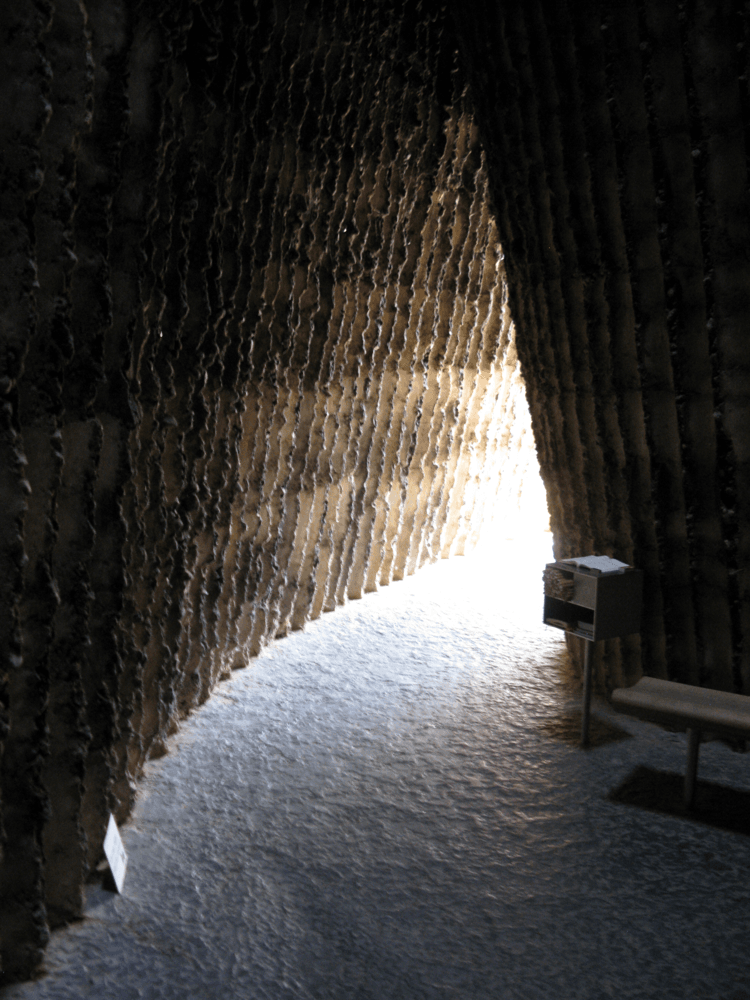
The interior of Peter Zumthor’s Bruder Klaus Field Chapel (Germany) features rough, charred concrete walls. The irregular texture and heavy mass create a quiet and intimate acoustics: high-frequency sounds are absorbed and diffused by the charred protrusions, while the solid walls block external noise. The result is a “warm” silence – footsteps and whispers are softly audible, not muffled, and the space feels isolated yet alive.
How can landscape, water, and wind play a role in shaping silence?
Silence is not always found within four walls; gardens, monumental courtyards, and city parks also seek tranquility amid the noise. Here, architects and landscape designers turn to nature’s own tools—soil, water, vegetation—to mask unwanted sounds and create soothing soundscapes. Outdoor acoustics is somewhat paradoxical: you cannot trap sound outdoors as you can indoors, but you can modulate it through absorption (ground and leaves), deflection (landforms, walls), and masking (adding natural sounds). The guiding concept is the soundscape approach (ISO 12913), which emphasizes designing the perceived acoustic environment rather than simply reducing the decibel level. In other words, a successful quiet landscape may not eliminate all noise, but it ensures that the sounds heard are pleasant or appropriate to the environment (rustling leaves, birdsong, flowing water) rather than disturbing (horns, loud conversations).
Water is one of the most effective tools for masking noise. The sound of water, whether a gentle dripping or a powerful waterfall, can controllably raise the ambient noise level (L₉₀) and cover intermittent noises. Studies have quantitatively measured this masking effect: One research paper found that adding water sounds to an urban park environment significantly reduced the audibility of road traffic and that people rated the environment as quieter despite the overall dB level being higherpubs.aip.org. The frequency content of the water sound is important for its effectiveness. Generally, waterfalls produce a broad-spectrum “white noise” rich in high frequencies (such as the gurgling of a waterfall or fountain), whereas deeper flows or larger bodies of water produce lower-frequency noise (like coastal waves or large waterfalls). Traffic noise is typically low-frequency (engine noise, distant road noise), so interestingly, a very loud fountain may not mask it well—it may cover the high-frequency part of the noise, but not the low engine sounds. Conversely, a water sound containing low-frequency energy can mask traffic more completely. Designers sometimes choose the shape of the water feature accordingly. To mask traffic, a falling water curtain or a waterfall flowing into a resonance pool can create a broader spectrum. To mask human voices or provide a soft background in a quiet garden, a fine spray or a series of small droplets (emphasizing mid-to-high frequencies) may be sufficient and less intrusive. At the 9/11 Memorial in New York, twin waterfalls drop from a height of approximately 30 feet; this height and volume create noise that covers the entire audible range. Next to the waterfall, one must speak quite close to someone’s ear to be heard over the sound of the waterfall. This is part of the design and creates a bubble effect for contemplation. In contrast, in an area such as the Portland Japanese Garden (USA), small waterfalls are placed in corners. They produce a soft trickling sound that masks distant city noise, yet allow for quiet conversation a few meters away. It is reported that designers experimented with different stone arrangements to adjust the “curtain” of these waterfalls in order to achieve a natural white noise that blends with the surroundings.
Vegetation – trees, shrubs, hedges – is often thought of as a noise buffer, but its role is more complex. A dense tree belt can reduce high-frequency noise by absorbing and scattering it, but in terms of decibels alone, plants are less effective than solid walls or soil. A frequently cited rule of thumb is that a dense forest 100 feet (30 m) wide can reduce noise by approximately 5-10 dB. Very dense hedges can also provide a few decibels of reduction at mid and high frequencies. However, the psychological effect of greenery is profound: people perceive green spaces as quieter even when measured levels are similar. This is partly due to visual masking (not seeing the source of noise makes it less annoying) and partly due to the positive contribution of natural sounds from the vegetation itself. Wind blowing through leaves creates a sound spectrum that varies with wind speed—a light breeze creates a soft rustling, barely noticeable at around 20–30 dBA, while strong gusts can produce sounds above 50 dBA. However, because this sound is associated with the visible movement of trees and is inherently “natural,” people generally find it pleasant or at least neutral. Some landscape architects even select plant species based on their sounds: large-leaved deciduous trees like plane trees produce a distinct rustle, pines a softer hum, and bamboos a rattling sound in the wind. By planting a specific tree species, you can add a particular acoustic note to your garden that helps mask unwanted noise or divert attention elsewhere. In the famous Bongeunsa temple garden in Seoul (on the outskirts of the city), tall bamboo trees are planted along a wall; when the wind blows, the bamboo stalks gently collide and rub against each other, creating a meditative percussion sound that distracts the ear from the noise of traffic.
The shape of the terrain can literally create acoustic shadows. Just as a hill blocks the view behind it, an earth embankment or mound can also block the spread of sound by directing and dispersing it upward. Physically: to significantly reduce noise, a barrier (earth or wall) must block the line of sight between the source and the receiver. A 5-meter-high embankment along a highway can typically provide a 5-8 dB attenuation immediately behind it, and if there is vegetation (soft surfaces absorb some of the sound energy), it can provide even greater attenuation at certain frequencies. Interestingly, studies comparing berms to vertical walls have shown that a well-designed berm can perform as well as or better than a wall, partly because its gentle slope absorbs more sound and it lacks a hard top edge where sound would break sharply. The US Federal Highway Administration states that effective noise barriers (including berms) typically reduce traffic noise by up to 10 dB, which is subjectively perceived as halving the sound level. In open monument landscapes, berms are often aesthetically integrated and appear as gentle hills or raised grassy areas. At the Canadian National Holocaust Memorial in Ottawa, angular concrete walls serve as noise barriers against the nearby street, while surrounding sculptural earthen mounds both block sound and create a sense of enclosed space. Tests show that these features reduce traffic noise inside the memorial by approximately 6 dB compared to outside. In another example, the designers of the Korean War Memorial Park used a sunken courtyard (essentially a bowl carved into the ground) to keep city noise out; visitors descend stairs to reach a grass amphitheater protected by the surrounding ground and walls. Measurements showed that city noise was greatly reduced (high frequencies >10 dB, low frequencies several dB) and that the remaining ambient noise was mostly wind noise from above and occasional distant aircraft noise.
Landscape elements not only mask noise, but can also function as a tool to “score” emotions. Consider, for example, wind chimes or bells in some monuments. Hiroshima Peace Park in Japan has placed a memorial tomb along an axis on the water. Although it is generally a quiet park, there is a peace bell that visitors can ring. The sound of the bell spreads across the water, which keeps the city noise low, and this singular sound becomes the “sound” of silence, stirring emotions. Another example: At the Oklahoma City Bombing Memorial, there is a shallow reflecting pool designed not to mask noise (the city is not that noisy), but to provide a certain tranquility. However, to prevent stagnation, a slight flow has been added to the pool, which means the pool makes a slight splashing sound. This sound is almost imperceptible, but on quiet days, a slight ripple can be heard. Survivors have described this place as a “breathing” space. This shows that even a very quiet environment needs a little natural sound to prevent an eerie silence. The ideal sound balance: disruptive sounds outside, supportive sounds inside.
To achieve these results, designers typically rely on both common sense and advanced modeling. Environmental acoustics experts use ray tracing models to predict how sound will propagate around the proposed sets or from the tops of trees (though modeling trees accurately is difficult—a general “scattering/absorption” coefficient is usually assumed). They also examine the spectrum of the disturbing noise (for example, there are peaks in the low frequencies around 63 Hz–250 Hz caused by engine and tire noise in traffic, and peaks in the mid/high frequencies caused by horn or brake noise). Armed with this information, they can adapt the sound spectrum of the water element to fill in the gaps. In an interesting experiment in Antwerp, Belgium, “noise-canceling fountains” were installed to counteract 60 dB of constant traffic noise. These fountains essentially use water as a white noise generator. Sound experts and the community are testing various fountain designs with different sound profiles to determine the design that best masks traffic noise while also producing a pleasant sound. This is the use of the landscape as an active acoustic instrument.
Climate and maintenance considerations should also be taken into account. Water and wind vary seasonally; deciduous trees shed their leaves in winter (and thus lose their noise-reducing properties); fountains may be turned off at night or during droughts. A well-designed outdoor quiet space typically incorporates a combination of evergreen shrubs or hedges for continuous physical noise reduction, along with water features or grass that can be “adjusted” or turned on and off as needed. For example, in a university meditation garden, a small fountain could operate during the day (when campus noise is high, to mask the noise), but be turned off in the early morning or evening, when it is naturally quieter and people may want to experience pure silence or the sound of crickets. Therefore, the fountain’s design should not be entirely dependent on it for silence. If turning off the fountain suddenly reveals traffic noise, this is not an ideal situation. In this way, creating silence outdoors is a dynamic, living process—more akin to gardening than construction. You observe how the soundscape develops (you can even gather feedback by conducting sound walks with users according to ISO 12913 guidelines) and then prune or make adjustments: plant more shrubs here, add a second small waterfall there, etc.
We can see these principles applied in places such as the Portland Japanese Garden (Oregon, USA). Despite being in an urban area, it is considered one of the most tranquil public gardens. Landscape designers have clearly addressed sound: winding paths (there is no direct route from the street to the inner garden), surrounding walls, dense vegetation, and a series of strategically placed water features – the waterfall in the valley (masking city noise) and the shallow trickle pond in the quiet moss garden (providing a soft sound that creates a focal point in a quiet area). Visitors often notice how the city acoustically disappears. Sound level measurements show that ambient sound near the waterfall is ~60 dBA (mostly water sound), while in the moss garden it is ~40 dBA, with occasional peaks from distant water or wind. This 20 dB drop is significant, but it feels even more profound because the character of the sound has completely changed from the waterfall’s broad-spectrum “pink noise” to narrow, sparse natural sounds.
As a result, landscape elements can serve both as buffers and tools: As a buffer, they physically block or suppress unwanted noise, while as a tool, they shape mood by adding positive sounds to the environment. Water can create an auditory curtain that preserves solitude; wind and leaves can create natural music that brings life to an empty courtyard; terrain features can carve out an ideal corner for contemplation, separating it from the chaotic world just beyond. When designing these spaces, you can imagine orchestrating a symphony of natural elements, each contributing to the overall composition of silence. The genius loci (spirit of place) of a memorial park or healing garden is often found in its soundscape as much as in its visual elements. By carefully arranging water, wind, and earth, architects and landscape architects enable the construction of silence under the open sky—not with a roof and four walls, but with whispering pine trees, reflective pools, and the soft applause of leaves.
The South Pool of the 9/11 Memorial in New York, with its continuous waterfall cascading into the void. The falling water creates a broad-spectrum sound wave that masks the city’s noise. Visitors experience a surprising acoustic refuge: the sound of the water (around 70 dB at the edge of the plaza) drowns out traffic and conversation, allowing time for reflection despite the urban surroundings. The waterfalls act like giant natural sound machines, preserving the sanctity of silence in the heart of Manhattan, where sight and sound become one.
Whose Silence Are We Designing? (Culture and Neurodiversity in Silent Spaces)
Silence is often referred to as universal, but in reality, silence is interpreted and valued differently across cultures and individuals. What is a “quiet space” for one community may create an uncomfortable feeling of emptiness for another. The silence of a library, a source of happiness for a neurologically normal reader, can be very oppressive for someone with tinnitus or an anxiety disorder. Therefore, architects should ask: Whose silence are we designing for? When designing a quiet space, we must consider cultural norms related to sound, the different needs of users with neurological diversity, and even the purpose of silence (prayer, work, mourning, calming down).
Cultural and religious differences play a significant role in the type of acoustic environment desired. Research on soundscapes in religious buildings, for example, indicates that Christian churches tend to emphasize the acoustic properties (reverberation, musical resonance), Islamic mosques prioritize speech intelligibility and comfort for spoken sermons and prayers, and Buddhist temples focus on integrating natural sounds and a tranquil environment. The implication for design is this: while a mosque prayer hall may feature sound systems and acoustic treatments to ensure the imam’s voice is clear (without long reverberation), a Gothic cathedral may prioritize long reverberations that enrich choral music at the expense of speech clarity. In Japan, Shinto and Buddhist spaces generally welcome the sounds of nature—a Zen rock garden, for example, does not deliberately block out birdsong or distant wind, as these are part of the meditation experience. On the other hand, a European war memorial may strive to create an almost completely silent environment to evoke solemnity. As a designer, it is crucial to consider these expectations. The typical approach for a multi-faith prayer room (at an airport or university) is to create a neutral acoustics – moderate reverberation (~0.6 seconds), good speech privacy between users, and low ambient noise. Such a room can accommodate whispered personal prayers or small group reading activities without overly emphasizing the acoustics of a tradition. On the other hand, a space specifically designed for Buddhist meditation may include subtle natural sounds (a stream recording or a wall opening onto a garden) since it aims for a harmonious soundscape rather than complete silence.
The concept of sensory comfort transcends culture and enters the realm of cognitive and neurological differences. Today, many public institutions recognize the importance of design for people who can perceive sounds (and other stimuli) very intensely, such as those with autism, ADHD, sensory processing disorder, PTSD, etc. For these individuals, a quiet sanctuary in a chaotic building is not just a nice thing, it is a vital necessity. Therefore, quiet rooms and sensory-friendly spaces have become commonplace in places such as airports, museums, and schools. The design of such spaces is often not just about reducing noise; it is about predictability and control. Sudden or unpredictable sounds can be triggering, so there should be no surprise noise sources in the room (e.g., noisy air conditioning systems that could unexpectedly start up should be avoided). If there are alarms or loudspeakers in the building, soundproofing is crucial—a person using a quiet sensory room should not be startled by an announcement from the next room. These rooms typically feature white noise machines or soft background music depending on preference. Interestingly, giving the user control over a calming sound can be better than absolute silence. For example, someone with tinnitus may prefer some background noise to mask the ringing in their ears. The WELL Building Standard now encourages quiet areas for focus and relaxation in large offices and includes guidelines on sound and lighting. Typically, these areas require a minimum space (e.g., 75 ft² per person plus extra space) and features such as dimmable warm lighting and NC-30 or lower background noise – essentially, creating a space that is not only quiet but also relaxing on many levels.
Inclusive design can also include furniture and layout for quiet areas. In a library, providing various quiet areas—such as individual work booths (semi-enclosed desks) for those who need visual and auditory isolation, open reading desks for those who are not bothered by movement in the environment, or even small soundproof booths—means acknowledging that users have different preferences for quiet. Some people with neurological differences find peace in cocoon-like areas that absorb the sound around them and signal “do not disturb” (hence products such as high-backed acoustic chairs or privacy booths). Others may prefer a corner of a larger quiet room where they feel in tune with the collective silence of others (knowing you’re not alone, even if no one is talking, can be comforting). Head-height sound-absorbing furniture is a smart way to increase subjective quiet without major architectural changes. For example, some libraries use sound-absorbing cladding and upholstery on the back and side panels of bookcases. Since bookshelves are arranged at head height in the room, they act as a continuous sound-absorbing surface. In open offices or student centers, acoustic “phone booths” or padded relaxation booths can serve as mini quiet shelters for anyone feeling overly stimulated.
Silence can pose a different challenge for visually impaired individuals: these individuals often use auditory cues to find their way. For someone who relies on the hum of an elevator or sounds echoing off walls to find their way, a completely silent corridor can actually be confusing. Inclusive design can use subtle auditory orientation methods—for example, a soft beep or distinct sound at information kiosks, or strategically placed fountains (e.g., the sound of water indicates the location of the entrance to a quiet garden). These cues should be soft enough not to disturb the silence of others, yet distinct enough to assist those who need them. Hospitals sometimes use audible cues in large, quiet courtyards to help visually impaired visitors find the reception desk (a very soft, periodic sound). It is important that this sound is audible to those who need it, but can be easily ignored by others.
When considering “whose silence,” designers also address the purpose of silence. Academic silence (study hall) differs from spiritual silence (chapel). Students may tolerate (or even enjoy) some sounds and noise that arise because others are concentrating; however, since silence in a church is generally intended for communication with the divine, disruptive sounds may be perceived as disrespectful to something sacred. Furthermore, different groups show different tolerance for different uses occurring simultaneously. In a multi-generational community center, there may be elderly people who want a quiet lounge and young people who make a lot of noise in the game room. Designers can solve this problem by creating separate acoustic zones rather than imposing a single behavior. However, there are also spaces where different quiet activities occur simultaneously. Consider a modern large library: Some people may be reading quietly, some may be quietly crying due to personal work (e.g., reading historical records or memoirs can be emotional), while others may simply be daydreaming. The design should prevent one user (or a small group) from unintentionally disturbing others. One approach used in some UK and Canadian libraries is vertical separation: placing quiet work areas on upper floors (heat rises and noise also rises in atriums – by placing quiet users upstairs, the building’s stack effect carries noise upwards, away from them). Group collaboration areas are located on the lower floors or in the basement. Essentially, the building is divided into sections based on noise level. In multi-story chapels or temples (less common, but some pagoda-like temples have floors), more sacred quiet areas may be located on the upper floors, while more social areas are located on the lower floors.
The ethics of inclusivity means accepting people who do not want silence. Some people find complete silence stressful and prefer a slight hum or music. We see this in some shared workspaces that offer a “quiet but not silent” area with a quiet room and soft music playing. Users make their own choices. The idea that “sensory comfort varies from person to person” is becoming increasingly accepted. For example, in autism-friendly design literature, it is recommended that areas providing both low and medium levels of stimulation be offered, as not all autistic people have the same sensitivity. A well-known example of this is the Autism Garden Design exhibited at the Chelsea Flower Show (UK) a few years ago: This design featured a main shelter area that was very quiet (acoustically isolated by plants and with sound-absorbing interiors) and an adjacent outdoor area that was slightly more stimulating, with a water feature that produced gentle sounds. Visitors could choose the place where they felt more comfortable. In educational settings, too, “quiet rooms” or “escape areas” are provided where a child can withdraw for a while if disturbed by the noise of the classroom. These rooms are usually small, covered with soft surfaces, and have dimmable lights – essentially a sensory decompression chamber. Importantly, there is no judgment or strict rules in these rooms: Some children may mumble or talk to themselves in this safe space, so it is not strict silence but controlled personal sounds that are allowed.
Public policies have begun to reflect these needs. Libraries in some cities have introduced “quiet hours” or “sensory-friendly hours,” where noise is particularly restricted and specific regulations are enforced (such as turning off buzzing lights or limiting speaker announcements). This acknowledges that even the library’s basic quietness may not be sufficient for people with extreme sensitivity – these individuals need a quieter and calmer period to comfortably use the space. Designing for this could mean extra acoustic insulation for a specific area used during these hours or simply operational rules to reduce noise during these times.
The emotional dimension should not be overlooked: silence is associated with comfort, but it is also linked to profound experiences such as grief and healing. We must ask whom this silence serves. In a multicultural city, the silence of a public monument should be accessible to everyone—this can be achieved by offering various opportunities for neutral design and participation (areas where you can sit in complete silence and peripheral areas where you can quietly talk or pray in your own way). In a multi-faith chapel, silence is essentially a blank canvas for visitors to fill—a Christian can silently recite the “Our Father,” a Muslim can pray, a secular person can simply lose themselves in thought. The design should not impose a particular kind of silence (for example, by using overt religious imagery that makes some feel they must be solemn) or favor one practice over another by accident (for example, an overly lively acoustic that is conducive to singing but makes quiet prayer difficult). Flexibility is crucial: In some multi-faith spaces, there are even movable partitions or alcoves that are acoustically separated from each other so that different groups can use them at the same time.
A concrete example of culturally adapted silence: The Whispering Gallery at St. Paul’s Cathedral in London is a famous place where a small whisper echoes around the dome. This is an example of an acoustic oddity (curved surfaces that focus sound) turned into a pleasure. Culturally, this has become part of the cathedral experience – one of those rare occasions when it is necessary to gently break the silence to fully appreciate the space. Compare this to the Myeongdong Cathedral in Seoul, where silence is strictly maintained and even the slightest sound is muffled by heavy wooden pews and curtains. Worshippers in both environments expect different types of silence – one cheerful, the other extremely respectful. Designing according to these expectations means understanding the users. Involving the community or user groups early in the process can help define acoustic goals: Do people want absolute silence, or a low level of background noise? For example, surveys conducted in university study rooms revealed that students preferred a little background noise (around 40 dB) to complete silence, because it made them feel more “natural” and less isolated. Therefore, in some new libraries, quiet HVAC noise or distant café sounds are intentionally allowed to seep in to prevent the space from feeling eerily quiet.
Designing inclusive silence may require providing multiple types of quiet spaces within a single project. We can illustrate this with a hypothetical community center: There could be a “thinking room” with dim lighting, carpeted floors, and complete silence for personal meditation or prayer. Nearby, there could be a “reading lounge” that is brighter, with soft seating and light instrumental music—a quiet but not silent place for relaxation and calm reflection. And perhaps an open-air quiet garden for those who find the sounds of nature more soothing than indoor quiet. By offering options, the center acknowledges that one solution does not fit all. A real-life example is the Toronto Metropolitan University Student Center, which opened two types of sensory rooms: one is a quiet dark room with mats and noise-canceling headphones, the other is a low-stimulus room with light sensory inputs (such as bubble tubes and calming music) – students can choose the environment that helps them de-stress. Both are “quiet spaces,” but their character is different.
In inclusive silent design, other senses also come into play. Lowering light levels, using warm colors, providing tactile comfort (soft cushions, rugs) – all of these contribute to the perception of silence. There is a saying: “Perceptual silence usually begins with light.” This means that if a space is too bright, people perceive it as noisy or chaotic, while dimming the lights can psychologically trigger silence. Designers use this: High glare can be as disturbing as high noise, so harsh lighting or visual clutter should be avoided in a quiet space. For focus areas, the WELL standard requires dimmable lighting at 2700 K, because a warm, soft visual environment complements acoustic tranquility.
Another aspect: time-based sharing of silence. Certain cultures or groups may need this space at specific times (for example, Muslims who pray at certain times each day may create some noise by collectively using a quiet room for a short period). Good design can accommodate this without disrupting others’ experience—for example, through scheduling or creating secondary spaces. A university’s multi-faith room often displays a schedule of group prayer times, so others know when the room will not be quiet. In the design, a small foyer area can be provided where people can wait or take off their shoes, absorbing noise before and after prayer, so that the room remains a sanctuary outside these hours.
The question “Whose silence?” reminds us that silence is for someone and for something. Silence is not an abstract ideal. As architects, asking this question during the programming phase leads to richer and more sensitive designs. Ultimately, people actually use quiet rooms because they feel suitable for them. A grieving family, an exhausted autistic traveler, a monk, a student, or a survivor seeking solace—each comes to this space with different ears and hearts. Our job is to tailor the environment to meet them where they are. Practically, this means using various methods: involving stakeholders (perhaps conducting sound walks or surveys to learn which sounds they find soothing and which they find disturbing), consulting inclusive design guidelines (such as the UK’s PAS 6463 standard for neurodiversity, which offers strategies similar to Gensler’s recommendations), and being ready to adjust. Post-occupancy evaluations can be illuminating. Users might say, “It’s too quiet; I can hear people breathing in the next room,” or “I wish there was fan noise; I can’t relax.” Then we make adjustments: perhaps adding a small independent sound modulator or adjusting door seals. Designing for everyone is a repetitive and empathy-driven process.
To illustrate the positive results: Vancouver International Airport has established a “multi-faith sanctuary” equipped with acoustic adjustments and an adjustable lighting system. Initially, it was very quiet. Based on feedback from some users, it was suggested that playing soft music might help, so now soft ambient music is played at certain times (except during hours when people may be praying quietly). Maggie’s Centres (cancer support houses in the UK) are praised for their tranquil atmosphere; interviews highlight both the silence and the soothing sounds of home (like a kettle boiling in the kitchen) – this is not library silence, but a gentle, humane silence. One researcher said that at Maggie’s, “it is accepted that silence enhances quality… People emphasized the silence felt in the centers thanks to their soundproofing features,” but what matters is that, alongside private corners, there is a shared kitchen (with low-level clattering and soft conversations), allowing the person to choose how much silence or soft sound there will be around them.

Designing silence for different cultures and neurological diversity needs means creating diversity, flexibility, and control. It requires us to go beyond a single acoustic target and instead offer a range of quiet experiences. Just as we accommodate different physical abilities with ramps or visual contrasts, we must also accommodate different levels of auditory comfort with thoughtful acoustic zoning and options. The best quiet spaces are empathic spaces – adapted not only to decibels and reverberations, but also to the rituals, comfort, and well-being of the specific people who will use these spaces. In this way, we fulfill the fundamental purpose of silence in architecture: to provide a universally accessible yet personally meaningful refuge for the mind and spirit.
From chapels to campuses, from materials to landscapes, a unifying theme emerges throughout these explorations: in architecture, silence is not an absence, but a designed presence. The resonant silence that holds our deepest emotions is a soft backdrop against which life’s most meaningful moments unfold. Achieving the “right” silence is a delicate art involving subtraction and addition: removing noise, chaos, and disorder while adding form, texture, and subtle sounds to create an environment that meets human needs. We learned that being “quiet enough for grief” means adjusting the room’s acoustics so that mourners feel enveloped without feeling isolated, allowing tears to flow and whispers to spread without fear of being overheard. We learned that a single plan, using thresholds like key changes in a building’s partition, can embrace both community and solitude by arranging sound like a gradient. We discovered that warm silence arises from the interaction of absorbent and reflective elements, like light and shadow, creating gentle spaces for the ear and the soul. In outdoor spaces, we discovered how water, wind, and earth transform into instruments, masking unwanted sounds and amplifying tranquility. Thus, we succeeded in composing silence under the open sky. And most importantly, we understood that silence does not have a single form that suits everyone: Understanding the cultural context and the spectrum of human sensory needs is crucial for designing a healing and inclusive silence.
While researching and writing this article, it became clear that modern architects and acoustic specialists have access to both ancient knowledge and the latest technological tools for designing with sound. Principles such as thick walls, courtyards, monastery courtyards, and domes have been known for centuries. Consider how medieval monasteries were acoustically compartmentalized complexes, or how traditional Japanese gardens cleverly utilized walls and waterfalls. Today, we support this intuition with standards and simulations. ISO reverberation standards (3382) guide us in measuring sacred halls; soundscape standards (12913) guide us in evaluating parks and squares. By modeling with software such as Odeon or EASE, we predict how a planned monument will sound before it is built and adjust the materials virtually. To ensure the performance meets its promises, we meticulously measure dBA levels, STI for speech, and L₁₀/L₉₀ for variability. It is human experiences that tell us whether we got it right after the opening ceremony. When a widow at the Holocaust memorial said she felt truly alone with her thoughts for the first time since the tragedy, that is the success of silence. When a student in a crowded union finds a quiet corner to calm her nerves and rejoins her friends refreshed, that silence is therapy. When a worshipper steps from a noisy street into a temple and immediately feels a sacred silence, this silence is soul-elevating silence.
Designing for silence is deeply intertwined with designing for moments that define us: grief and healing, concentration and enlightenment, prayer and inner peace. This reminds us that architecture is not only visual or functional, but also sensory and experiential. Ceiling cassettes, water fountains, wooden slats, earthen walls – these play an important role in shaping sound as much as form. From Louis Kahn to Peter Zumthor, renowned architects have often spoken of the “silence” of their buildings. This refers to the presence and tranquility that buildings radiate. We now interpret this in the literal sense: acoustic silence is the foundation of metaphorical silence.
In an increasingly noisy world, such spaces are gaining importance. Urbanization, technology, the constant bombardment of media – all of these increase the need for quiet refuges. By publishing noise guidelines that highlight the negative effects of noise on health (cardiovascular diseases, sleep disorders, etc.), the World Health Organization indirectly called on urban designers to create quieter environments for public health. However, beyond avoiding harm, designing for silence is about providing dignity and depth. It is about ensuring that a nation’s monuments allow its citizens to mourn appropriately, that a hospital offers patients and their families a place to recover, that a library or temple provides seekers with a place for uninterrupted thought or prayer, and that our cities and campuses include “quiet spaces” that remind us of our humanity amid the hustle and bustle.
When bringing these threads together, the following question may arise: Can over-engineering silence be dangerous? Can the pursuit of perfect silence strip a space of its character? The answer is balance. The goal is not to fill every space with echo-free rooms—this would be just as alienating as constant noise. Instead, as we’ve emphasized before, the richest silences often contain a layer of meaningful sounds: the echo of history, the soft song of nature, the subtle sounds of other people that reassure rather than disturb. The future of acoustic design is moving towards a holistic soundscape approach. Projects now consider how a space acoustically evolves over time. A lively square at midday can become intentionally quiet at sunset, thanks to amplified sounds of water features or lighting cues that encourage quieter behavior. There is talk of “smart soundscapes” where sensors and adaptive systems can modulate masking sounds or silent interventions based on ambient noise levels (think of a fountain that gets louder when a jet flies overhead, then softens again). Although high-tech, these ideas reflect older practices (such as temple bells or wind chimes that respond to the wind and thus modulate their sound).
Discover more from Dök Architecture
Subscribe to get the latest posts sent to your email.