
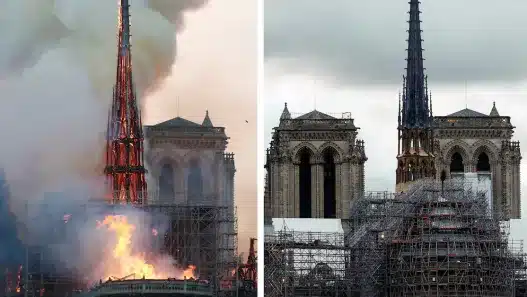

On April 15, 2019, the world watched in horror as a fire broke out at Notre-Dame de Paris. Flames engulfed the cathedral’s ancient wooden roof, and its 19th-century spire collapsed. Five years later, on December 8, 2024, Paris reopened the restored Notre-Dame. The stones were cleaned, the vaults rebuilt, and a new spire, nearly identical to the original, now reaches toward the sky. Between these two dates lies a story of restoration and cultural choices: what to preserve, what to change, and what our decisions say about who we are. This process tested France’s commitment to memory and heritage and offered valuable lessons to architects and leaders around the world.

In the composite image, smoke rises from Notre Dame’s tower as it burns on April 15, 2019 (top), and the tower, rebuilt during restoration work in March 2024, is seen with its golden rooster and cross. France decided to rebuild the tower à l’identique (exactly as it was) opting for a familiar historical silhouette rather than a contemporary design.
1. If we rebuild “the same thing,” what kind of originality would we be choosing?
France has decided to restore the exterior of Notre Dame to its original state. This decision includes rebuilding the iconic spire designed by architect Eugène Viollet-le-Duc in 1859. This decision was made following bold proposals, including a roof garden, a modern glass tower, and even a swimming pool, as well as an international design competition organized by the government that briefly brought a contemporary “gesture” to the table. However, the public and heritage experts opposed this, and in July 2020, Emmanuel Macron reversed his decision and approved the reconstruction of the tower in its original form. Parliament even passed a special law requiring the restoration to preserve the cathedral’s historical design and materials. Thus, France has canonized a specific moment in the cathedral’s long history—Viollet-le-Duc’s mid-19th-century vision—as the “true” image of Notre-Dame.
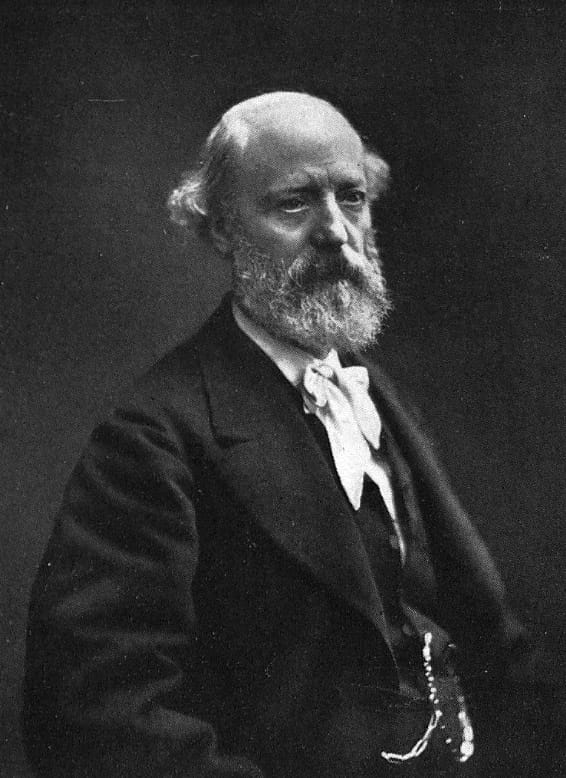
However, originality here is a palimpsest. The structure of Notre-Dame has undergone centuries of change, both before and after Viollet-le-Duc. Rebuilding the tower as it was in 2019 restores its familiar silhouette and honors a part of history, but it also “undermines the originally more creative approach”—the innovative spirit that Viollet-le-Duc brought to the 13th-century structure. What does it mean to freeze a monument in a specific time? From a conservation philosophy perspective, this decision highlights the classic tension between material reality and the continuity of form. In much of Europe, the Venice Charter tradition prioritizes honesty in restorations—leaving layers of change and the patina of time visible. In contrast, in Japan, sacred structures (such as the Ise Shrine) are periodically rebuilt, so that renewal is continuity. The path chosen for Notre-Dame prioritized the continuity of form—that is, an exact replica of the previous design—as the highest value of authenticity. The French state and the church argued that the material and semantic values of the World Heritage site could be preserved by reproducing its historical appearance. As a result, the cathedral will not be a museum of all its past lives, but a defining portrait of the era with which people identify “Notre-Dame.”
When the image of a monument is intertwined with civil identity, preserving its familiar form may seem more “authentic” than preserving each individual stone. Formal continuity can be a powerful form of authenticity, but it is never a neutral choice. Deciding which history we want to commemorate (13th-century Gothic? 19th-century Neo-Gothic?) inevitably changes the story. If we rebuild the “same” thing, we must ask the question “as it was when?” and define the values behind that choice. Notre-Dame’s new/old spire reflects a collective preference to remember the cathedral in modern memory as it was, even if this means removing other authentic layers. The lesson to be learned here: before drawing, define the true meaning of “the same” – authenticity is not absolute; it is a series of decisions about which truths to honor.
2. Oak and Lead: What do material choices reveal about memory, ecology, and health?
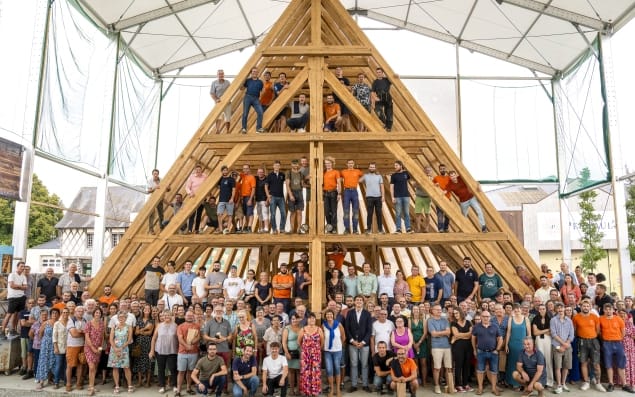
The reconstruction of Notre-Dame has served as a lesson in material ethics. The fire destroyed the large wooden “forest” between the roof, namely the complex oak framework dating back to the 13th century. To restore it, approximately 1,000 oak trees were carefully selected from around 200 French forests in early 2020, meeting the size and quality requirements specified by the lead architects. Most of these oak trees were 150–200 years old and over 18 meters tall. The trees were cut down in a narrow time window at the end of winter (before the sap rose) and dried for over a year. As a result, experts estimate that 1,200–1,400 oak trees will be needed to rebuild only the roof beams over the nave and choir. This is an extraordinary example of using living trees in an age when engineering materials are commonly used. Traditional carpenters shaped these beams by hand using hand-made axes and centuries-old carpentry techniques instead of modern electric tools. Supporters praised this as a “living connection” to medieval craftsmanship and a tribute to the artisans who built Notre-Dame. It was an opportunity to preserve old skills and rebuild the cathedral’s lost skeleton from oak wood, just as it was originally constructed.

However, critics raised sharp questions. In a period of climate change and declining biodiversity, was it really necessary to cut down so many centuries-old oak trees for a “historic” appearance? Would anyone have noticed the difference if modern laminated wood or steel had been used in the roof’s hidden structure? The ecological cost of cutting down old trees—even though France claims it accounts for only a tiny fraction of its annual forestry output—has troubled some observers. Officials noted that the trees came from sustainably managed lands (some had been planted by French kings as ship timber) and represent only a tiny percentage of the oak trees cut down in France each year. In fact, most of the selected oak trees were nearing maturity and would have been cut down as part of routine forestry cycles. In other words, the government presented this decision as an opportunity to incorporate culturally significant materials (French oak) into restoration efforts without endangering the forests. The selection of oak as a material has become a symbol of continuity and craftsmanship—a message that the spirit and form of medieval architecture are worth preserving in 2024.
While oak trees pose ecological dilemmas, lead sounded public health alarms. The roof and spire of Notre-Dame were covered with approximately 400 tons of lead sheets. The 2019 fire turned much of this toxic metal into dust or dispersed it, contaminating the area and surrounding neighborhoods with lead fallout. (A scientific study found that approximately one ton of lead particles accumulated within a 1 km radius of the cathedral, which was more than ten times the initial official estimate. Following the fire, Paris authorities faced criticism for responding too slowly to the lead hazard. Schools and streets were not immediately cleaned, and it was only weeks later that children were advised to undergo blood tests. Understandably, as restoration plans progressed, many assumed that an alternative material would be used for the new roof. However, officials confirmed that the roof and spire would once again be covered in lead, citing historical fidelity and durability. This decision sparked protests from environmental and health advocates. In late 2023, as lead panels were being prepared, NGOs, local politicians, and residents held a demonstration in front of the cathedral, calling for greater attention to “ecological and public health risks.” They argue that allowing the reuse of large quantities of lead (even at a height of 40 meters) in a city center and a building visited by millions of people is an avoidable risk. The government’s stance is that modern safety measures (such as special protection during installation and long-term monitoring) will mitigate any risks, and that no material equivalent to lead in terms of longevity and resistance to weather conditions exists for a complex historical roof.

The restoration of Notre-Dame caused a conflict between authentic materials and contemporary sensibilities. The choice of oak confirmed the continuity of craftsmanship and the emotional connection between the ages, but raised questions about sustainable resource use. The choice of lead honored the original structure and performance of the building, but sparked a public relations battle over environmental health. The most important lesson for architects to take away from this is that “authenticity” is not just about form, but that materials carry meaning and consequences beyond aesthetics. Every material choice must be carefully considered throughout its entire life cycle. If we decide that lead or other historical materials must be used for valid reasons, we take on the responsibility of modeling emissions, implementing strict safety protocols, and communicating transparently with the public. Historical heritage and health are not mutually exclusive concepts; with planning, both can be preserved. However, the Notre-Dame debate highlights the ethical dimensions of material authenticity: it asks us what heritage (craft traditions, environmental impacts, health outcomes) we wish to preserve in a restoration project.
When copying historical details, combine cultural responsibility with modern responsibility. Show respect for the past by using materials and methods that have a story and significance, but also show respect for the present by ensuring that these choices are safe and sustainable. In the case of Notre-Dame, this meant cutting down oak trees with consideration for forest ecology and reusing lead only under strict restrictions and monitoring plans. Authenticity is achieved not by the appearance of a restoration, but by how it respects the people and the place of today.
3. Can medieval craftsmanship and 21st century risk management really coexist?
Visitors touring the reborn Notre-Dame will gaze upon a medieval roof structure (oak beams, traditional mortise and tenon joints) and remain oblivious to the high-tech systems silently protecting it. This project is a deliberate blend of old craftsmanship and modern engineering. On one hand, centuries-old handcrafted carpentry techniques have been revived on an unprecedented scale: carpenters shaped massive beams with axes, installed full-length beams on the ground for testing, and used lifting methods reminiscent of Gothic architects. In July 2023, a crowd gathered along the Seine River cheered enthusiastically as six massive oak beams (each 10 meters high and weighing 7 tons) were lifted into the sky by a barge and the reconstruction of the nave’s roof began. “Seeing the first pieces of the roof come together is incredible,” said a Parisian, experiencing the excitement of encountering such craftsmanship in the modern age. This practical approach added a sense of authenticity to the restoration—the feeling that it was being rebuilt using traditional methods.
At the same time, the Notre-Dame team skillfully integrated 21st-century protective measures to prevent such a disaster from happening again. Behind the scenes, state-of-the-art fire detection and suppression equipment was installed. For example, a mist spray system was installed under the new roof structure to extinguish sparks before they can turn into a fire. Electronic sensors and alarms continuously monitor all areas of the building. Engineers also faced unique structural risks: The fire had cracked and destabilized part of the stone vaults, and approximately 600 tons of charred scaffolding from pre-fire renovation work had dangerously adhered to the transept. In a complex operation, teams first stabilized the fragile stone vaults with special wooden supports and rods, then carefully cut and removed the shattered scaffolding over months of work. Once the site was fully secured, the wooden roof beams could be reattached to the restored walls. Meanwhile, the cathedral’s 8,000-pipe organ, which had survived the fire but was covered in toxic lead dust, was completely dismantled and sent to workshops for cleaning and restoration. After a four-year process, the organ’s components were returned, meticulously reassembled, and tuned, enabling this magnificent instrument to once again produce sound as if nothing had ever happened.

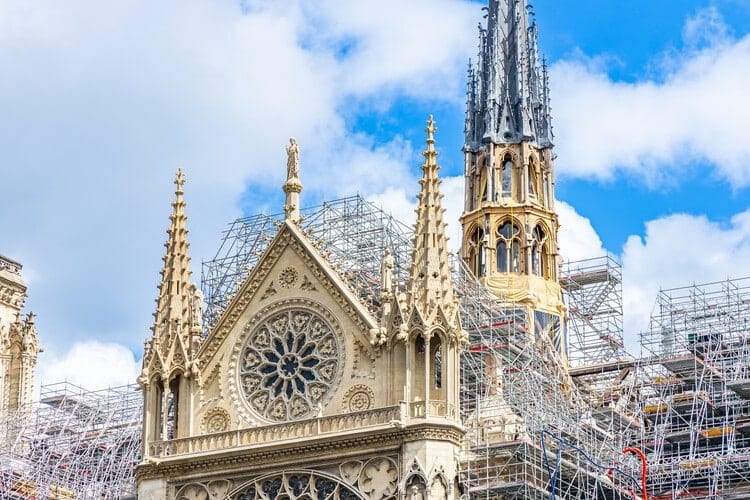
The reconstruction process was a great success in terms of process as well as design. Contractors had to plan the work phases to eliminate immediate hazards (structural collapse, lead contamination, water damage) while preserving the historical fabric. They developed innovative solutions such as securing the vaults with special frames while the mortar set, enclosing the work areas to prevent lead contamination, and designing scaffolding that allowed access to every corner while protecting the building. This delicate dance ensured that medieval stones and modern steel scaffolding, traditional techniques, and the latest safety measures worked in harmony. And when Notre-Dame reopened, the public saw a medieval masterpiece restored—and did not see the extensive “safety net” supporting it. This invisibility is a sign of success.
Treat every heritage project as a two-stage task: first, restore the visible historical fabric; second, improve the invisible performance. Historical architecture can certainly coexist with modern safety and functionality standards, but this requires creative integration. The goal is for visitors to experience the space as authentically as possible (in the case of Notre-Dame, hearing the sound of the centuries-old organ under a wooden roof) while being unconsciously protected by modern engineering. When done well, history feels alive and unchanged, but behind the scenes, sensors, sprinkler systems, and support structures quietly ensure the reborn monument’s longevity. Conservation is not just a style; it is an operating system. At Notre-Dame, architects and engineers have written a new “source code” for the cathedral’s longevity, preserving its spirit while inoculating it against the risks of the 21st century. We hope the public never notices this code, but only sees the living heritage it protects.
Carpenters at Ateliers Perrault in France are using hand tools to shape massive oak beams for the new roof structure of Notre-Dame. The restoration combines traditional craftsmanship, such as hand-cut wooden framing, with modern scientific oversight. While craftsmen recreate the cathedral’s medieval wooden “forest,” engineers simultaneously implement new fire prevention systems and structural reinforcements, blending 12th-century construction techniques with 21st-century conservation measures.
4. Who is now writing the sacred experience – the Church, the State, or the City?
Notre-Dame is not just a work of art; it is also a place of worship, a national symbol, a tourist attraction, and a structure listed as a World Heritage Site. This multifaceted nature became even more apparent when plans emerged to redesign the interior of the cathedral following the fire. While the main structure (owned by the French state) will be restored to its historical appearance, the Archdiocese of Paris saw this closure as an opportunity to “reintroduce” the interior to 21st-century visitors and believers. Proposals included new modern liturgical furnishings, reorganization of seating and circulation, improved lighting, and the projection of multilingual Bible verses. Church officials argued that these changes would enrich spiritual reflection and make the Bible’s message more accessible in both the church and the space, which has become a highly visited museum. In short, they aimed to blend the old with the new to curate a sacred space experience for visitors.
News of these plans sparked a heated debate in late 2021, exposing a rift between creative renewal and preservation traditionalism. Critics, including academics, architects, and even former culture ministers, condemned the proposed interior renovation plan as “vandalism” against Notre-Dame’s identity. They painted a bleak picture of a historic church being transformed into a “politically correct” Disneyland filled with ornate artworks and lights. In an open letter signed by hundreds of well-known intellectuals, the Church was accused of “taking advantage of the restoration project” to redesign the interior in a didactic, theme park style without respecting the cathedral’s artistic integrity. An architect made a witty remark, saying, “Notre-Dame de Paris has turned into Disneyland.” This turmoil has raised an important question: Who will now tell the story of Notre-Dame? The bishopric, as the religious authority responsible for the building? The state, as the legal owner and guardian of the heritage? Or the broad public, who see Notre-Dame as a cultural symbol and place of pilgrimage, regardless of their religious beliefs?
France’s response was to seek a delicate compromise. The National Heritage and Architecture Commission (a state agency) reviewed the Church’s plans and gave the green light in December 2021, but allowed for a softened version of the interior redesign. The approved plan allows for some contemporary interventions, but these must remain within a “conservative” framework. For example, designer Guillaume Bardet has been tasked with creating a new set of liturgical furniture (altar, ambo, font, tabernacle, chairs) in a modern style, but these pieces will be intentionally simple and respectful to avoid clashing with the Gothic surroundings. The famous wicker-backed chairs that fill the nave will be replaced with modular benches, but these will be made of wood, simple, and even able to be moved aside for large ceremonies. Subtle lighting will be added to highlight art and architecture, and sacred texts can be projected onto key points, but there will be no overwhelming sound or light show. In particular, the 19th-century stained-glass windows (designed by Viollet-le-Duc) that survived the fire will not be replaced; a proposal to do so was strongly rejected by heritage experts (and petitioners). Essentially, the interior will be renovated—cleaner, better lit, and with new focal points—but it will not be radically redesigned.
When Notre-Dame reopened in 2024, observers noticed a blend of old and new in the nave. Centuries of smoke and grime were cleaned from the stones, and the interior became surprisingly bright—some say a “soot-preventing” cleaning that made the old stones look almost new. Along the side chapels, medieval murals and colorful painted sculptures have been vividly restored, revealing long-hidden multicolored details. Among these historical elements, contemporary touches also stand out: a sleek bronze altar and ambo, a minimalist mahogany bishop’s chair, and modern lighting embedded in Gothic capitals. The positions of some pieces of furniture have also been changed to improve visitor flow and visibility. However, the overall impression still bears the hallmarks of Notre-Dame. The Guardian‘s architecture critic wrote after attending a service that “the heat of the fire has given way to light and splendor, but thankfully not kitsch.” The new interventions do not overshadow the old, but rather frame it in a more understandable way. For example, the altar designed by Guillaume Bardet is located in the center of the cathedral and draws attention to itself, but the elements that dominate the sacred space remain the large golden cross and the Pietà sculpture that survived the fire. The “sacred choreography” of the space—the procession, prayer, and the line of sight stretching along the nave—has been preserved intact, though refined with subtle touches.
So who wrote the new section of Notre-Dame? In practice, it was the result of collaboration (and sometimes conflict) between the church’s clergy and liturgical advisors, the state’s architects and heritage curators, and the public, as expressed through the media and petitions. Everyone had a claim. The result was neither a purely curatorial restoration nor a free artistic reinterpretation, but a compromise reached through negotiation. The Catholic Church obtained some updates to convey its faith to a modern audience (e.g., a new presentation of the Crown of Thorns relic in an illuminated reliquary in the apse and multilingual explanatory panels for tourists). The state ensured that all changes complied with strict heritage standards and took into account “the spirit of Viollet-le-Duc.” The city of Paris, which expects millions of visitors each year, demanded that crowd flow, accessibility, and security be included in the design brief. As a result, a new controlled entry system and a planned visitor center were created. The global public played a corrective role in addressing excesses. Strong opposition to “overly modern” or “Disney-like” ideas pushed the design toward greater restraint and respect for tradition.
Designing (or redesigning) a sacred space such as Notre-Dame means striking a balance between layers of ownership and meaning. The physical building may belong to the state, but its use has been entrusted to the Church, and its significance extends to the urban and international community. All these voices matter. The key is to develop a “reader’s guide” for the space—a way for different audiences to navigate and find meaning without one use erasing another. In the case of Notre-Dame, this meant planning for worship and admiration: ensuring that pilgrims could pray without feeling like they were in a museum, and that tourists could appreciate the cathedral’s history without disrupting worship. Design elements such as lighting, furniture, and informational tools must serve both the liturgy and the educational mission at the same time. Ultimately, authorship is a collaborative effort. In such a context, as an architect or designer, it is necessary to be a good listener and translator between stakeholders. The result achieved at Notre-Dame shows that compromise and beauty are achievable: the church, gently updated to adapt to a new era, retains its unique identity. The space remains fundamentally awe-inspiring and thought-provoking—not a theme park or a dusty temple, but something in between. This was made possible by each of the Church, the State, and civil society giving up a little and contributing a little. The interior of the new Notre-Dame is thus a collective creation, and its success will be measured by how well it resonates with all its visitors.
5. Should a national symbol erase its trauma or show its scars?
As the embers cooled in 2019, a final philosophical question emerged: When a beloved landmark is scarred by disaster, should restoration visibly acknowledge the trauma, or attempt to erase it entirely? In France and beyond, voices have been raised arguing that the 2019 fire should have a permanent memorial in the restoration of Notre-Dame. Ideas such as displaying a charred beam, preserving a section of the melted roof as an exhibit, or placing a delicate “fire memorial” in the square or triforium were put forward. It was argued that the fire should be commemorated within the rebuilt structure as part of the cathedral’s history, serving both educational purposes and as a tribute to resilience. The cathedral could teach a lesson about “risk and recovery” by transforming its wound into wisdom for future generations. Indeed, UNESCO advisors frequently emphasize that World Heritage sites are not just physical structures but also carry layers of meaning—and sometimes tragedies—that become part of their value. A dramatic event like the Notre-Dame fire can be interpreted by visitors as part of the building’s survival story.
On the other hand, many people believed that the best outcome would be to “forget the wound” and return Notre-Dame to normal once its security had been ensured and it had been restored. For the people of Paris, the sight of the dark, roofless cathedral had become a source of collective mourning. From French billionaires to schoolchildren sending coins in the mail, large and small donors contributed approximately €840 million for a single purpose: to see Notre-Dame rebuilt and restored to its former glory, not as a ruin or a fire museum. There was a strong desire to erase the trauma. This sentiment was further strengthened by practical considerations. The restoration of the exterior aimed for uninterrupted continuity. The replaced stones were sourced from the same quarries and worked to match the existing medieval walls. When the new spire rose, it appeared as if the fire had never happened, standing where the old spire once stood, “at the top of the cathedral in the Paris sky.” Even in the interior, where new design elements were introduced, a conscious effort was made to integrate them gently. As a result, an ordinary visitor entering the cathedral in 2024 may not notice any “scars” at first glance. The large windows have been reinstalled and are brighter than ever; the organ produces magnificent sounds; the roof stands firmly above our heads. Only a few subtle details give it away: perhaps the observer may notice that some stones are lighter in color (the new ones where the domes collapsed), or that the roof wood is clearly new during the ceiling tour, or that a small exhibition in the Treasury recalls the fire. However, the overall impression is one of continuity.
France’s approach was clearly aimed at restoring the cathedral to its pre-fire appearance. As a reporter observed in the final stages, the restored parts of the cathedral looked “brighter than ever” – Notre-Dame appeared more renewed than scarred by the visible traces of battle. At the reopening, Macron described the restoration as a story of “determination, hard work, and commitment,” saying it had healed “a national wound” – framing the fire not as an event to be remembered, but as something that had been overcome. Indeed, there will be a new exhibition space (in a nearby building) to display the remains and tell the story of the fire and restoration, fulfilling the church’s didactic role outside its walls. However, within Notre-Dame’s architecture, the narrative continues to tell a story of timeless grandeur rather than trauma. Donors have received their reward: not ruins, but a return.
The choice to re-sew the fabric flawlessly rather than leaving visible “scar marks” is neither right nor wrong, but it is extremely meaningful. This choice reveals a cultural preference: to celebrate Notre-Dame’s resilience by restoring it to its original form, ensuring that daily life (and worship) can continue without the shadow of disaster. Some other restorations have taken a different path; for example, some churches bombed during World War II were deliberately rebuilt with modern additions or left partially ruined as monuments. However, Notre-Dame was not treated as a war monument, but as a living monument in need of repair. French stakeholders believe that the cathedral’s identity as a place of worship and a symbol of Paris will be best preserved by minimizing elements that remind us of the fire. The “memory” of this event is preserved not so much in the physical experience of the cathedral as in documents and exhibitions outside the cathedral.
In the post-disaster reconstruction process, a decision must be made about what to make visible: the event itself, the repair process, or just the restored result? This is an extremely social choice. Both approaches have their merits. Leaving the scars of trauma visible can mean honoring those who were lost and educating future generations (and perhaps reminding people of the importance of fire prevention). On the other hand, a flawless restoration can also be a powerful message in itself—a rejection of despair and a return to continuity. Neither path is “neutral”: each reflects values. In the case of Notre-Dame, the decision was made to show the world a “rescued” Notre-Dame, not a “wounded” one. And so every drawing, every stone carving, every brushstroke was made to fit this story of resurrection. Future projects may choose a different path and add modern elements that open a new chapter (for example, after World War II, a new church was built on the remains of the old church at Coventry Cathedral in England). However, the key lesson is to define the narrative early on and ensure that the entire project is shaped by that narrative. Notre-Dame teaches us that even the absence of a monument is a narrative choice: Paris chose to celebrate the triumph of restoration rather than display the ruins.
Visitors unfamiliar with the fire can tour Notre-Dame and simply marvel at its magnificence—perhaps noticing only a few new touches—and that is exactly what many people hoped for. Paris has fully reclaimed its cathedral, and the trauma lives not in the cathedral’s appearance but primarily in the collective memory. The success of this approach will be measured by how the public relates to Notre-Dame: not as a site of disaster but as a place of solace and wonder. And for many, this is healing in and of itself.
Lessons learned for the future reconstruction of Notre-Dame
The restoration of Notre-Dame was a massive project carried out in full view of the public, with all the pressures that entailed. There were unforeseen difficulties, the most significant of which was the tragic death of the restoration’s chief coordinator, General Jean-Louis Georgelin, in an accident in 2023. The coordination of thousands of experts and artisans from dozens of different professions was required (at one point, over 250 companies from across France were involved, with approximately 1,000 people working on-site or in workshops each day). UNESCO and international experts conducted rigorous oversight to ensure the preservation of World Heritage values.

There was a firm deadline: the French government had promised that the cathedral would be ready in time for the 2024 Paris Olympics, and this goal was achieved with only a few days to spare. Throughout the entire process, the project progressed largely according to schedule and budget. This surprised many skeptics, but it was proof of the resources allocated to the project and the care taken. In a secular 21st-century country where debates are frequent, the reconstruction of this medieval church became a rare unifying mission, described by Macron as “the project of the century” and proof that France is still capable of great achievements. In December 2024, the restored Notre-Dame welcomed worshippers and visitors once again with its familiar bell sounds. This was a moment of national pride and relief.

For architects, conservators, and civil society leaders elsewhere, the Notre-Dame experience serves as a kind of guide for responding to heritage crises. This experience has demonstrated that a democratic culture can take a strong stance on reconstruction without resorting to either a tedious imitation or an egocentric spectacle. It is possible to honor history while making contemporary choices in a responsible manner. Here are a few lessons drawn from Notre-Dame that could guide future projects involving world-renowned structures:
- Define the meaning of the word “same” and do so early on. After a loss, there will be pressure to rebuild, but the word “same” can mean many things (material, structural, stylistic). Clearly define which period or state of the structure you are aiming to restore and why. This will influence all subsequent decisions and help manage public expectations.
- Define materials not only as technical components, but also as cultural symbols. Every material you choose (oak, lead, steel, glass) conveys a message. Use materials to create symbolic connections—to reflect traditions, original architects, national identity—but also consider their impact on the environment and health. Reduce negative impacts through innovation and transparency.
- Combine craftsmanship with performance. Don’t let the uniqueness of craftsmanship compromise safety or durability. Embrace both: hand-carved stone and seismic reinforcement; wooden beams and fire suppression systems. Plan from the start how modern engineering can seamlessly support traditional structures.
- Share authorship and responsibility among institutions. In the Notre-Dame example, the Church, the State, international experts, donors, and the public all had a stake in the matter. Create governance structures that include key stakeholders to ensure a holistic solution. This collaborative approach can bring forth the trust, expertise (and funding) that no single organization can provide on its own.
- Decide on the story you want to tell—damage, repair, or rebirth—and adapt the design accordingly. If you decide to incorporate memories of the trauma into the memorial or to make the memorial “look new,” determine the consistency of the design based on this story. In drawings, when deciding whether to show new and old materials, ensure that the message is clear in the interpretive elements. Reconstruction can emphasize or heal the rupture; both are valid, but a mixed approach is less effective.
The successful return of Notre-Dame does not mean the end of the story – the restoration of areas such as the chapels and the sacristy will continue until 2025-26, financed by remaining donations. However, the difficult part – returning “Our Lady” to Paris in her former glory – has been successfully completed. The cathedral has risen again, its silhouette once more visible on the horizon, and its bells ring out across the Seine River. In the words of a Parisian architect, “Whether you believe in God or not, Notre-Dame is a universal symbol, and its restoration is a magnificent thing.” For those working in the fields of design and conservation, there is a deeper message of renewed commitment. Rebuilding is not just about repairing damage; it is about actively choosing what we value. By making the right choices, rebuilding with understanding and care, we not only restore the past but also strengthen our connection to it for the future.
Discover more from Dök Architecture
Subscribe to get the latest posts sent to your email.