
In the heart of Rome stands a paradox made of travertine stone. The oval-shaped Colosseum, with its massive arches and vaults, now hosts selfie-takers and school groups, but once upon a time, this structure was the site of deadly entertainment spectacles. When it opened in 80 AD with 100 days of games, tens of thousands of Romans poured in through 80 entrances, holding clay ticket shards that precisely indicated where they would sit. Inside, they were greeted by a marvel of design: a central arena covered in sand, surrounded by uninterrupted elliptical seating. Known to the Romans as the Flavian Amphitheater, it was the largest amphitheater ever built at the time, measuring approximately 189 meters by 156 meters and 48 meters high, capable of holding 50,000 spectators in a tightly engineered pit. In essence, it was a massive entertainment machine that transformed the brutal reality of bloody sports into a finely tuned social ritual.
Overview of Architectural Features
- Official Name and History: Amphitheatrum Flavium (Flavian Amphitheater), built between 70 and 80 AD by Emperor Vespasian and Titus; renovated during the reign of Domitian.
- Capacity: Estimated 50,000–80,000 spectators.
- Dimensions: Oval footprint ~189 m long, 156 m wide; outer height ~48 m. Arena floor ~83 x 48 m.
- Structure: Independent (not carved into the hill). Concrete and stone vaults for the substructure; load-bearing pillars made of travertine limestone; radial and circular walls made of tuff and brick. Three-story arched exterior facade (Tuscan, Ionic, Corinthian columns) and a roofed upper story with windows and Corinthian pilasters. Approximately 100,000 m³ of travertine was used, secured with iron clamps (no mortar used) – the clamps were later looted (holes are visible).
- Entrances: 80 vomitoria (76 numbered I–LXXVI for the general public; 4 unnumbered large entrances for the elite, located on the axes). Tickets (tesserae) contained section, row, and seat numbers; during recent restoration work, traces of red paint were found on the entrance numbers to enhance visibility.
- Seating arrangements: The emperor, Vestal virgins, and senators on the podium (lower level); Equites (knights) on the first level (maenianum primum); Second row (maenianum secundum) for the plebeians – divided into lower immum (middle-class citizens) and upper summum (lower-class citizens); The ceiling gallery (maenianum in ligneis) added by Domitian for women, the poor, and slaves – wooden benches or standing room.
- Hypogeum: A two-story underground complex added after the opening. It contains an estimated 32 animal elevators (28 of which are operated by capstans around them, the others) and numerous small elevators and trap doors. Approximately 60 cranes (added in a later modification) were used to move stage decorations and animals. The complex is connected via tunnels to the nearby gladiator training school (Ludus Magnus) and animal housing areas.
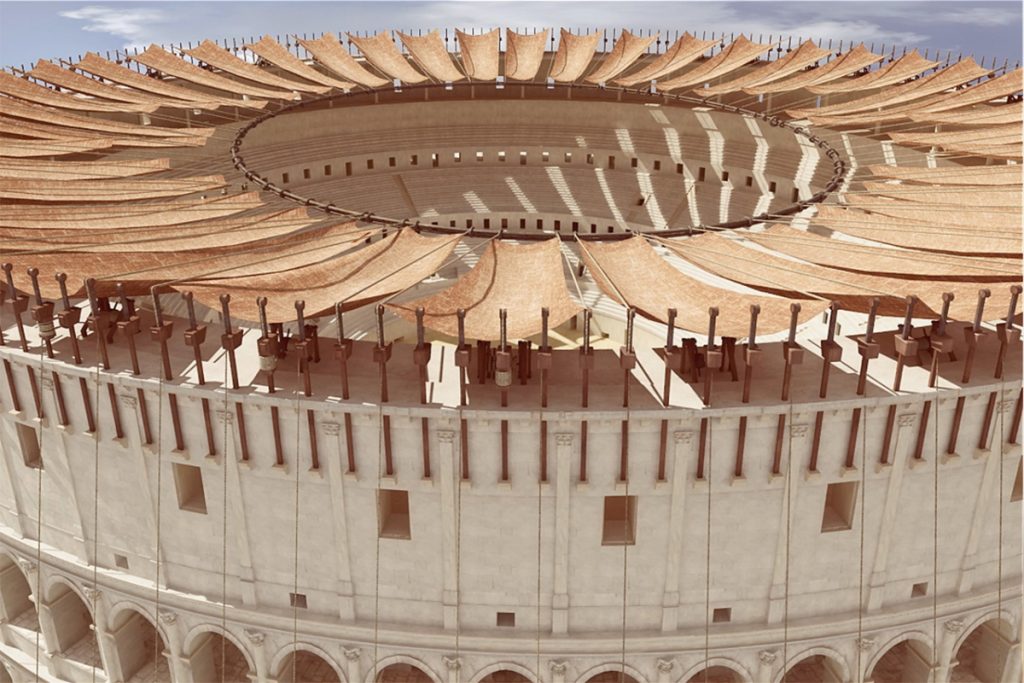
- Velarium: A massive retractable canopy supported by 240 wooden poles at the top, operated by sailors from Misenum. It provided shade for approximately one-third of the spectators and created a cooling breeze. The ropes were secured to the ground with large paving stones (some of which are still in place outside the amphitheater).
- Important Events: The first games (Titus, AD 80) lasted 100 days; 9,000 animals were killed. Trajan’s games (around AD 107) – 11,000 animals and 10,000 gladiators are said to have participated over 123 days. The last known gladiator fights took place in the early 5th century AD; animal hunts continued until the early 6th century (last recorded in 523 AD during the reign of Theodoric). In the Middle Ages, it was reused as a castle and a Christian temple.
- Current Status: Partially collapsed (south side) but more than 50% of the perimeter is still standing. Restoration work (cleaning, structural reinforcement) is ongoing by Italian authorities. It is visited by approximately 7 million people per year. It is used as a symbol of world heritage and occasionally for cultural events (under strict control). A new retractable floor project is underway to restore a functional arena floor for interpretation and conservation purposes (as of mid-2020).

For the people of Rome, the amphitheater meant both “bread” and “circus.” Emperors such as Vespasian and Titus (who built the Colosseum with war booty and slave labor after Nero’s excesses) understood the political power of providing food and entertainment to the masses. However, while circuses—chariot racing tracks—spread out over a wide, linear area, the Colosseum was a compact, dense structure, a source of controlled chaos. Its architecture had to solve a problem that is almost modern: safely moving huge crowds in and out, ensuring that everyone could see the events clearly, and even managing the climate and special effects – all with 1st-century technology. The Romans succeeded. The Colosseum’s design was so effective that its fundamental principles still form the basis of stadiums built 2,000 years later. However, this ingenuity served a horrific purpose: normalizing cruelty as entertainment. As we examine the Colosseum’s form, hidden technologies, social logic, and environmental systems, we confront the unsettling truth that this building, which inspires us with its engineering, was explicitly created to stage calculated violence. By examining how the Colosseum choreographed its cruelty, we can better understand both its enduring impact and the moral mirror it holds up to our appetite for spectacle.
How did the shape of the Colosseum transform cruelty into choreography?

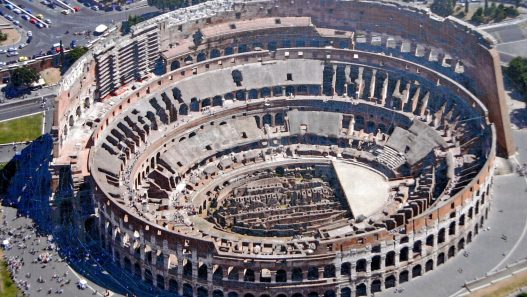
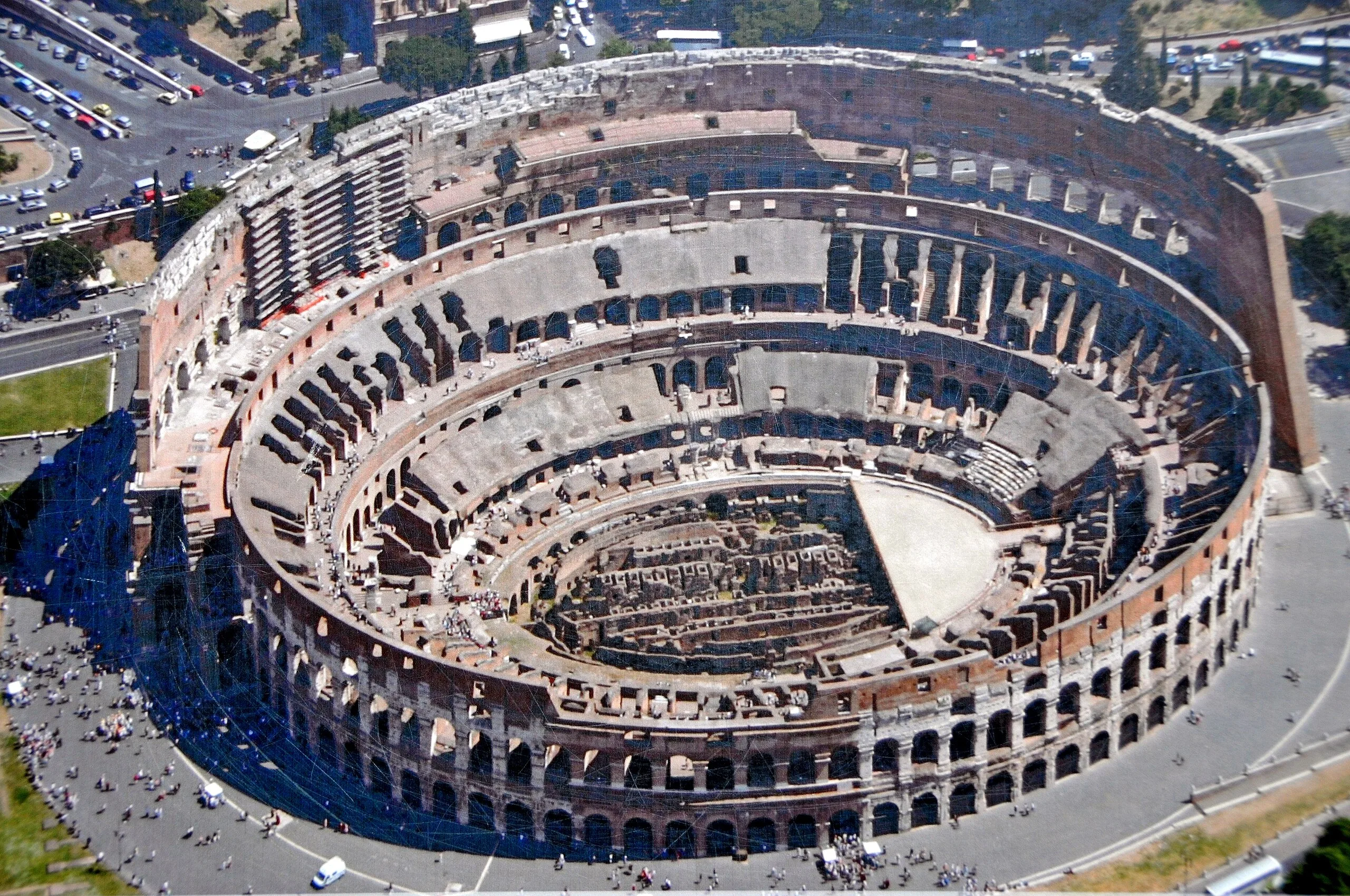
Aerial view of the Colosseum in Rome, showing its elliptical footprint and the layered arcades of its exterior. The continuous oval design kept all 50,000 spectators facing the arena, with optimal sightlines from every angle.
When designing an amphitheater to host gladiator fights, Roman engineers moved away from the semicircular shape of previous theaters and created an effective round theater. By doubling the traditional semicircular plan, they created an elliptical arena surrounded by seats on all sides. This shape was not chosen at random; it was crucial to ensure that the brutal “action” remained at the center and within full view. In the Colosseum, no seat was too far from the sand, and no seat was positioned at a bad angle. Spectators surrounded the uninterrupted oval, watching the fight below as if under a giant spotlight. A modern stadium architect notes that the ellipse “gives spectators a clear view of the arena from almost every angle” and that this layout has inspired today’s arena designs. Essentially, the shape of the Colosseum transformed mass violence into a kind of grotesque ballet, with each seat becoming a privileged viewing point. The sloping cavea (stands) were steeply and efficiently tiered, minimizing visual parallax so that even those in the cheapest seats could clearly see a spear thrust or a lion’s leap. By design, the architecture focused 50,000 pairs of eyes on the drama at the center, so that every expression, every breath, or every sob of the crowd was heard simultaneously.
Beneath the feet of the spectators, the structure of the Colosseum was a triumph of concrete and stone – a skeleton of rigid order concealing the chaos within. The amphitheater’s basic skeleton consisted of eighty radial walls extending outward from the arena like the spokes of a giant wheel, supported by concentric arched rings. These radial walls bore the weight of the rising tiers of seats, while the arched corridors between them distributed the load evenly around the oval. Built largely from load-bearing travertine blocks (held together with iron) and lighter tuff and brick in the secondary walls, the structure was strong enough to carry tens of thousands of people and withstand the sound and vibrations of their footsteps during exciting moments. The design was also modular and repetitive: the rhythm of the arches and vaults created a structurally redundant shell, so that when one section was under pressure, the others took over the load. This redundancy was an early form of safety engineering that prevented the Colosseum from collapsing under its own weight. It is humbling to think that this building, constructed in the 1st century, could be filled and emptied as safely as modern stadiums. This fact is proven by the building’s long use and survival. Modern analyses show that the vomitoria (exits) and passageways were so well planned that the entire space could be evacuated in minutes if necessary. This is a crucial feature, given the intense emotions (and occasional fires) generated by the games.
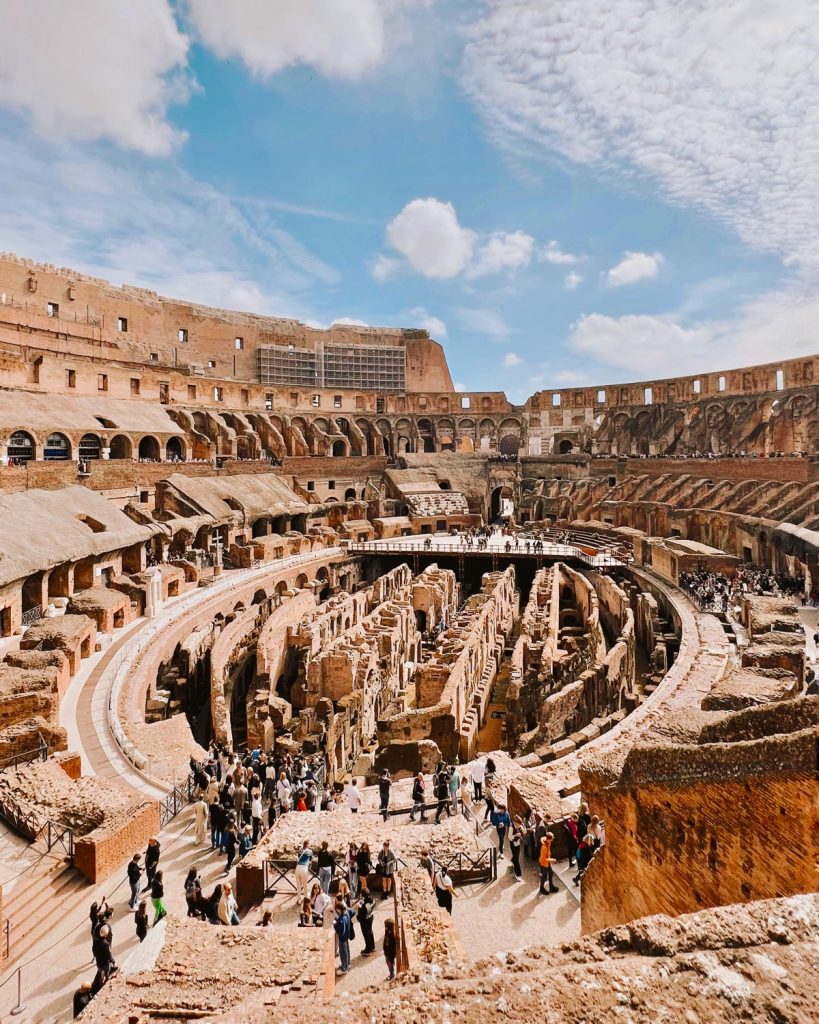
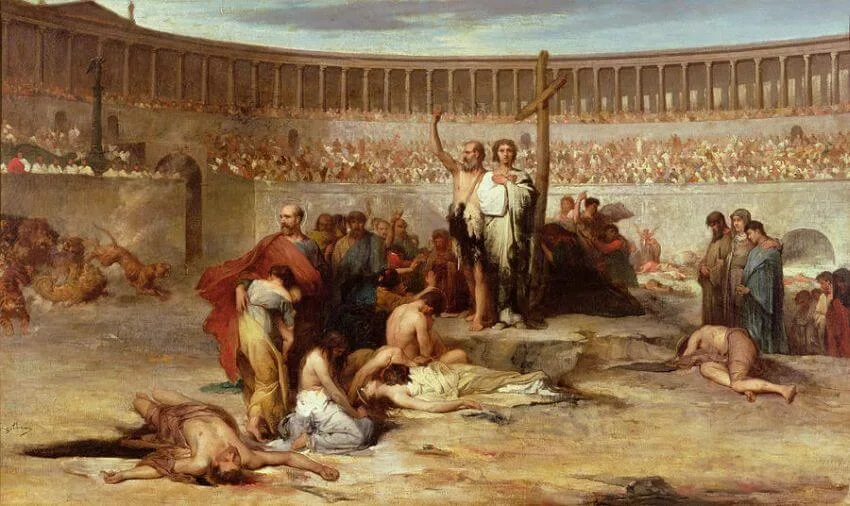
As an important point, the architects of the Colosseum were as concerned with crowd control and flow as they were with visibility. They designed a rather “modern” circulation system to regulate the movement of people. On the ground floor, 80 entrance arches surrounded the oval, each corresponding to a seating section and ticket number. Usher (or painted signs) directed ticket holders to the correct arch. Archaeological restorations revealed that the Romans painted these numbers red for visibility. This resembles the bright door numbers found in modern sports arenas. Spectators passing through each door entered a vaulted corridor and easily found the stairs (marked with Roman numerals carved into the stones) leading to their assigned floor. Derived from the Latin word vomere (to vomit), these vomitoria could quickly empty thousands of people into the stands or outside “like vomit.” As a result, there was a strict division and orderly flow: patricians and plebeians, soldiers and civilians were separated in advance according to their class and tickets before seeing the arena. Such efficient crowd management was important not only for convenience but also for security and control. In 59 AD, a deadly riot at the Pompeii amphitheater (depicted in a famous fresco with a canopy over the seats) demonstrated what could happen when crowds were not managed properly. The Colosseum’s design took no risks: the plan meant “know your place” and “stay there.”
Indeed, it is impossible to ignore the philosophical undercurrent of this architectural design. The Colosseum transformed the raw brutality of gladiatorial combat into an experience with a set start time, intermissions, and designated seats. By channeling disorderly human behavior (screaming for blood) through arches and corridors, these behaviors were ritualized, constrained, almost scripted. The building itself was the stage director. From the attention-grabbing elliptical shape to the angled seats that amplified cheers like an auditorium, and the easy exits that prevented post-show chaos, every detail worked in harmony to choreograph the experience of the crowd watching state-sanctioned violence. The Romans even used psychological tricks: the transition from dark passageways to the bright arena itself created an opening scene on a theater stage, preparing the audience for awe. The Colosseum was stadium user experience before the term even existed—an extremely calculated environment designed to keep people moving, watching, and reacting as one unified body. And in the unity of that experience lay the power of the empire: if you can physically move the people with a clever design, you can move them emotionally and politically as well. The poet Martial marveled at how the new amphitheater could transform its ever-changing crowd into “a single house” through applause or silence. In short, the Colosseum’s form turned oppression into choreography. The slaughter was real, but the experience was masterfully staged. Two thousand years later, as we pass through turnstiles and enter arenas to find our color-coded seats, we are following in the footsteps of that Roman crowd—thankfully for much more civilized entertainment.
Which invisible technologies created surprises?
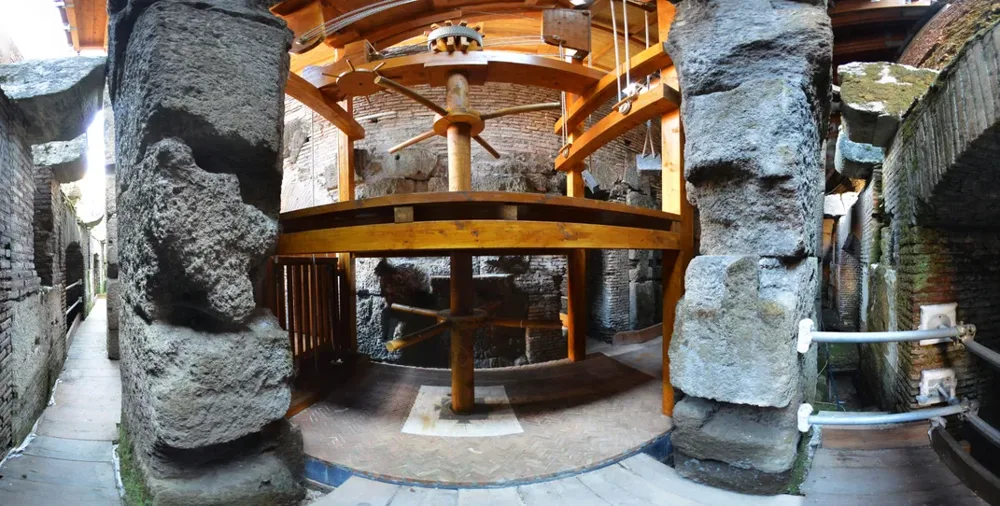
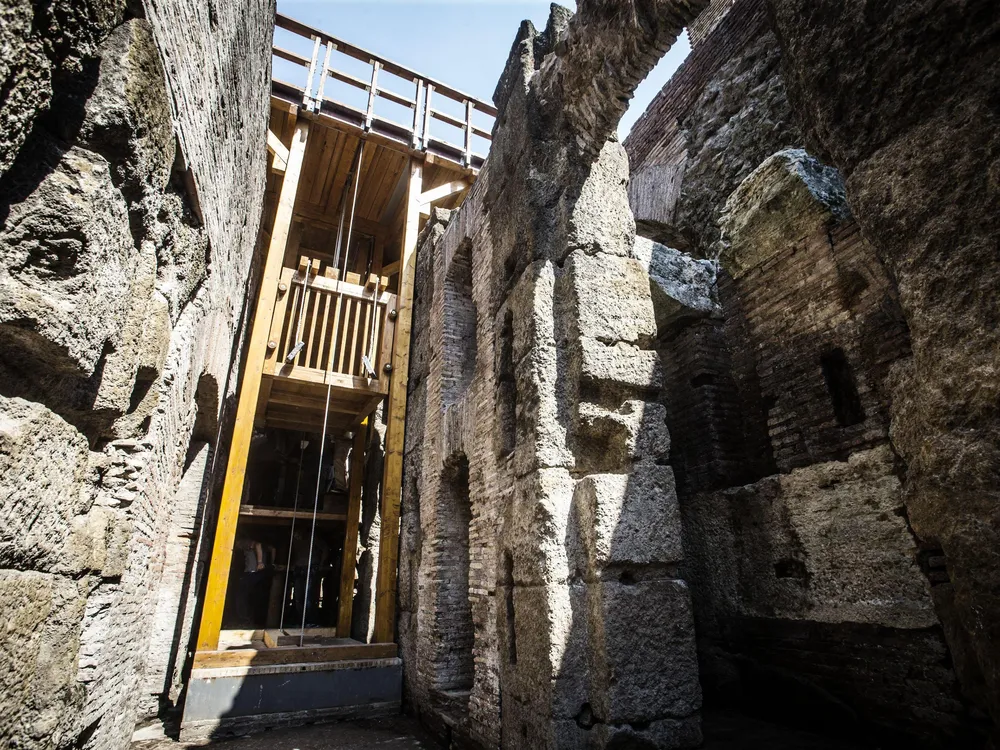
The ancient elevator rebuilt in the hypogeum (underground) of the Colosseum. Arena workers could lift cages or stage decorations from trapdoors in the arena floor by turning a large winch, creating sudden, “magical” images in front of the audience.
In ancient times, during a famous show, the producers of the Colosseum convinced an unsuspecting criminal that he would be torn apart by lions. The man, who had been found guilty of selling fake jewels to the empress, was thrown into the arena as punishment. A cage rose from beneath the ground—the crowd expected a large cat—and a harmless chicken jumped out. The spectators laughed heartily at this clever prank, and Emperor Gallienus pardoned the relieved swindler. This anecdote, recorded in an old chronicle, perfectly illustrates the engineering magic beneath the arena. The Colosseum was not only a stage for suffering but also a stage for illusion. Its architects and technicians installed a series of secret technologies in the amphitheater to amaze and entertain (or terrify) the crowd. Today, the secret of these special effects lies in the honeycomb-like corridors and cells beneath the arena floor—the hypogeum (Greek for “underground”). What now appears as a labyrinth of brick walls was once a bustling backstage area where stagehands, prisoners, gladiators, and wild animals waited for their cues. Rome’s creativity transformed this dark space beneath the sand into a marvel of stage arts.
When the Colosseum was in use, the wooden arena floor (Latin for “sand,” harena) completely concealed this underground world. For spectators, the sand served as a solid and opaque stage. Thus, every trapdoor that opened, every animal that sprang from the ground, and every stage prop that suddenly appeared seemed to come from nowhere. The hypogeum was essentially a massive machine designed for a vertical theater. Historical records and archaeological evidence indicate that it contained a series of elevators, winches, and trap doors skillfully integrated into the infrastructure. An ancient spectator might have seen an empty arena one moment, and then—with the creaking of wood and ropes—a full-grown elephant or a massive tree suddenly appear. Heinz-Jürgen Beste, an archaeologist who studied the hypogeum for 14 years, says, “The Colosseum’s underground stage area had countless ropes, pulleys, and other mechanisms in a very limited space.” This space was operated by well-trained teams, like the crew of a large sailing ship, who “rehearsed nonstop to ensure everything ran smoothly during the show.” And it truly was like a ship: the Romans even brought in sailors from the navy to operate the upper canopies and likely assist with the heavy lifting below. The entire lower floor of the amphitheater functioned as a hidden industrial complex dedicated to a single purpose: controlled astonishment. As described by the Parco Colosseo (Colosseum Archaeological Park), all the necessary apparatus, “hidden from public view,” was kept beneath the arena, which was “filled with trap doors through which people, animals, and stage equipment could suddenly emerge to astonish the audience.”
To understand how sophisticated this system was, consider the mechanism known to have existed during Domitian’s renovation of the Colosseum (around 82 AD, when the hypogeum was added). The underground was divided into two main levels connected by elevators leading to the arena. Along the edges, approximately 80 vertical shafts extended, capable of quickly lifting cages or platforms to the arena floor. Most of these shafts contained wood-powered elevators. Recent reconstructions indicate that on one side of the hypogeum, there were 28 large freight elevators operated by winches (giant cranes), each capable of lifting a cage containing a bear, leopard, or lion. Teams of eight working on two-story cranes could lift all 28 cages almost simultaneously. This theoretically meant that two dozen animals could emerge from different trap doors onto the arena at the same time. (One scholar imagined: “Can you imagine 56 lions appearing at the same time?” – because each elevator could carry two large feline animals.) Additionally, 20 smaller platforms located at the center could be raised to lift stage decorations or props—such as trees that appeared mid-performance, paintings of bound captives, or mythological stage decorations. Later, in the 3rd century, the system was changed: sources mention dozens more smaller elevators (perhaps as many as 60) distributed across new tunnels, capable of bringing not only animals but also human performers into view. This constant innovation throughout the Colosseum’s 400-year active use highlights a key point: the arena was not static. It was a programmable environment that represented Rome’s response to high-tech special effects. Stagehands below could synchronize the elevator’s operation with a dramatic moment during a performance, such as releasing a lion when a gladiator thought he had defeated all his enemies, or coordinating multiple surprises to instantly transform the arena into a forest clearing filled with animals.
Modern archaeology has dramatically confirmed these ancient accounts. In 2015, engineers and archaeologists collaborated to build a working replica of the Colosseum elevator on site. This full-scale structure, built using period-appropriate materials, was constructed in the hypogeum and operated by several people pushing winch rods. During a series of demonstrations, the team showed how a cage could be lifted approximately 8 meters upward from the lower corridor and locked into place at the same level as the arena floor. A trapdoor mechanism would open the cage’s ceiling toward the arena, releasing everything inside. In June 2015, for the first time in 1,500 years, an animal (in this case, a wolf) was lifted into the Colosseum’s arena in front of a crowd—fortunately, it was only for a demonstration. The replica confirmed what the Romans wrote: it took approximately 8 men to operate a single elevator. These men pulled the ropes in a coordinated push-pull rhythm to turn the capstan and lift the platform. Multiply that effort by the many elevators in the original hypogeum and imagine hundreds of underground workers, animals, and stage decorations emerging from near darkness, all working to ensure that everything was timed perfectly. The fact that it worked, and worked reliably, is a testament to the mechanical prowess of the Romans. Behind the scenes, the scene must have been breathtaking: lantern lights glinting off bronze elevator pulleys, wooden beams creaking, men straining on winch poles, an orchestra conductor signaling with horns or whistles—all while a flawless performance above ground diverted the audience’s attention from the labor taking place below.
A long-debated question is whether the arena of the Colosseum was filled with water for mock sea battles (naumachiae). Ancient writers suggest that during the opening games held during the reign of Emperor Titus (AD 80), the arena may have been temporarily filled with water for a short-lived naval spectacle. Some modern scholars argue that in the early years of the Colosseum (before the hypogeum was built), the arena’s infrastructure may have been temporarily made waterproof and filled with shallow water from aqueducts. Indeed, engineers have found traces of flow channels and a cleverly designed drainage system that could have been used to fill and empty the arena. A reconstruction suggests that scaled-down ships fought in water approximately 1 meter deep, sufficient for flat-bottomed vessels to float, allowing spectators to enjoy a brief interlude between the morning animal hunts and the afternoon gladiator fights. However, after Domitianus constructed the permanent hypogeum with its walls and mechanisms, regular flooding became practically impossible, if not entirely impossible. As a result, naval shows were moved to other venues. Today, the historical consensus is cautious: perhaps a few one-off sea shows were held in the early years of the Colosseum, but this practice did not continue. In any case, the idea that the Colosseum was also used as a massive water reservoir is interesting but less significant than its actual function. Whether through water shows, surprise animal displays, or “magical” stage decorations, the Flavian Amphitheater was built as a marvel of engineering. The Romans did not come to the games just to see blood, but for the show, that is, for the excitement of unexpected events. The Colosseum’s invisible technologies also made this possible. Eyewitnesses described animals “magically” leaping out of trap doors. The poet Martial marveled at how the stage machinery could “move rocks” and “make an entire forest suddenly run.” Its architecture immersed the audience completely in the story: one moment the sand was empty, the next—voilà—a mythical scene or a herd of panthers appeared. In modern terms, the Colosseum was the state-of-the-art special effects stage of its time, as rehearsed and magnificent as Broadway shows or Hollywood blockbusters—but performed live and with real blood.
The ethical implications (then as now) were chilling. The hypogeum allowed human and animal lives to be used as simple elements of stage art. However, the Roman crowd’s ability to suspend reality in order to marvel at an illusion in the midst of a deadly battle highlights the power of this engineering marvel. The builders of the Colosseum captivated audiences by transforming violence into an entertaining and plot-driven spectacle, distancing them from moral horror. If there is a direct ancestor to modern blockbuster action films and arena shows, it lies in these dusty foundations. As archaeologist Beste observed, the Colosseum’s underground section was the heart of a “grand spectacle” machine that celebrated imperial power through technical display. In a very real sense, the Romans invented the concept of the “stage surprise” and built an entire building around it. Our continued fascination with these mechanisms (the 2015 elevator reconstruction captured the world’s attention) demonstrates that the Colosseum’s miraculous legacy lives on, even if its original purpose gives us pause. Two thousand years ago, the Colosseum perfected the art of controlled astonishment—an art that, with the exception of deadly risks, forms the foundation of much of our entertainment today. The invisible hands in the Hypogeum prove that even in the arena of death, the Romans knew how to leave the crowd in awe.
How did a seating area code the social order of an empire?
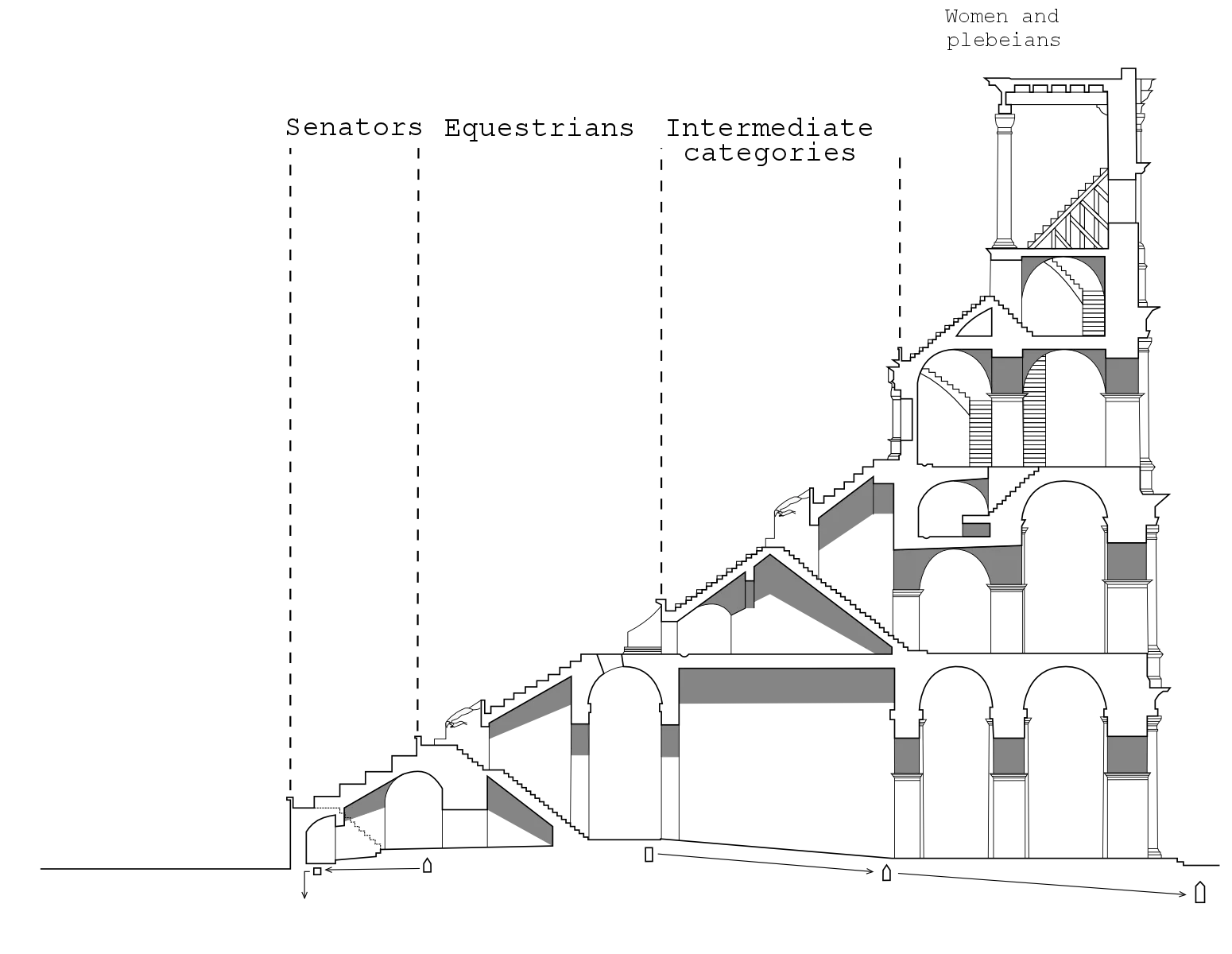
Simplified cross-section of the Colosseum seats (arena wall on the left). Roman law classified spectators according to their status; elite patrons sat in the front rows, while women and the poor were directed to the upper sections.
Every seat in the Colosseum was a lesson in Roman social hierarchy. As a citizen climbed to the tier assigned to him, he was literally climbing (or descending) a status staircase carved into the stone. The seating arrangement in the amphitheater was in no way egalitarian or first-come, first-served; it was rigidly predetermined according to rank, gender, and class. In fact, the Romans had placed a social diagram in the vertical section of the building, so that looking at the audience was like reading a miniature model of Roman society. The emperor sat in the most prestigious place—at the northern end of the arena, in a raised private box (pulvinar) at the center of the short axis. Thus, all eyes were on him as he watched the games. Directly opposite the imperial box, at the southern end, was another VIP box for the Vestal Virgins. This box was reserved for female participants, who had the privilege of sitting in the best seats. On either side of these boxes and surrounding the elliptical floor was a wide marble row, the podium, reserved for the Roman senatorial elite. Here sat the senators, judges, and priests—the upper echelons of power. In fact, inscriptions indicate that in later centuries, certain rows were marked with the names of senators, literally “carving power into the front row.” From this privileged podium, it was almost possible to reach out and touch the sand; gladiators could hear the cheers (or boos) of their social superiors directly above them. The fact that the ruling class was physically so close to this violent spectacle was no coincidence: It emphasized that the games were presented by the elite for and to the elite (the Latin term used for gladiator shows, munus, means the “duty” or “gift” of the powerful to the people).
Above the podium level, separated by a walkway and a low wall, rose the maenianum primum. This was the next balcony, reserved for the equestrian class (equites). These were non-senatorial nobles: Rome’s wealthy knights, bureaucrats, and businessmen. A century earlier, in 67 BC, a law had allocated special theater seats for the equites, but the public was not pleased with this arrangement (they booed Marcus Otho, who proposed the law). However, by the time the Colosseum was built, such classification had become completely normalized and was even legally enforced by Emperor Augustus. Augustus’s Lex Iulia Theatralis (Julian law on theater seats) formalized a series of discriminatory rules: senators had the front seats, equites a specific section, soldiers this area, children that area, married people another area, and most importantly, women were largely confined to the back rows. The architects of the Colosseum faithfully implemented these orders in concrete and stone. When one ascended to the section for horsemen, one reached the maenianum secundum, which was divided into two lower floors: immum (lower section) was reserved for ordinary Roman citizens of a certain wealth and summum (upper section) for poorer citizens. These were the plebeians, free-born men, who were also classified according to their wealth (presumably with the wealthier plebeians sitting closer together and the poorer ones higher up). The seats here were probably made of wood and less comfortable than the wide benches of the podium, but they were still part of the stone cavea structure. When you reached the original amphitheater, you would have climbed 30-40 rows of seats, each belonging to a lower social class.
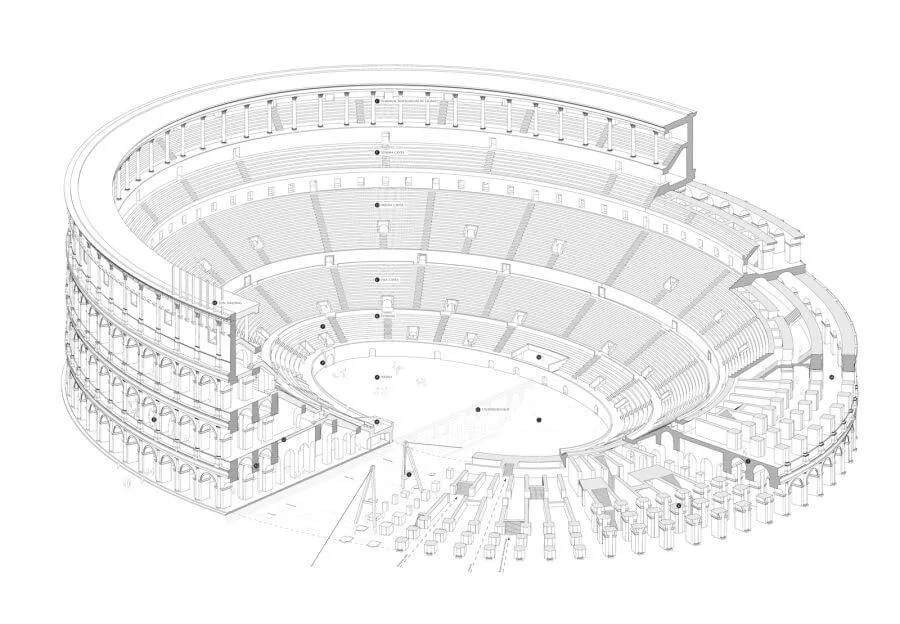
However, the Romans were not satisfied with this. During or after the opening of the Colosseum, another floor was added to the edge of the stone amphitheater: a wooden gallery (maenianum secundum in legneis) placed in the space between the roof and the walls. This was essentially a fourth floor consisting of a wooden grandstand structure built at the top and was clearly reserved for women (except the Vestal Virgins) and slaves, i.e., the lowest classes. Some sources suggest that this floor was only a standing area or had very steep and cramped seating. The Roman satirist Juvenal mockingly describes how women and the poor were pushed to the highest places, far from the events in the arena. This arrangement was introduced by Augustus following some scandals related to the mixed seating arrangement in previous venues. From there, you could see the show panoramically, literally on the beams, but you could also receive a clear message: you are as far away from imperial power and the splendor below as possible. Above, there were only the high velarium pillars of the Colosseum (and the sky). This extreme stratification was not just tradition; it was law. In 5 AD, Augustus reaffirmed the seating rules of the Republican era and added new ones, ensuring that almost every category of person had a specific place in the arenas and theaters. Senators occupied the front row orchestra seats, equites the next block, married people sat separately from singles, boys sat in a section reserved for them next to their teachers, soldiers sat in blocks reserved for them, and women (again, except for the Vestal Virgins) were sent to the top tier or completely barred from certain events. The architects of the Colosseum strictly enforced these rules, encoding social order in brick and marble. Above each arched entrance, numbers corresponding to these sections (now faintly visible and recently discovered with red paint) ensured that different social groups entered through different vomitoria and never mixed with each other. A wealthy citizen’s pottery ticket would read, “Entrance XVI, Seat 32, Grade V.” This did not indicate a random seat but rather the area appropriate to one’s class. Similarly, a poor laborer or foreigner would be directed to the upper seats and sit shoulder to shoulder only with those of similar class or origin. In this way, the amphitheater experience became a comfortable one for the elite and an orderly one for the authorities. The risk of finding a plebeian sitting in a senator’s seat or (God forbid) respectable women sitting next to noisy men was very low. Order was comfort; and in this context, comfort was a form of obedience.
Roman commentators were well aware of this mechanism of social control. The satirist Juvenal said that the Roman people traded their political freedoms for “bread and circuses,” meaning cheap grain and exciting games, and were happy to surrender their power in exchange. The seating plan of the Colosseum was an architectural reflection of this bargain. The people got their circuses, yes, but on the rulers’ terms. It could even be said that the Colosseum taught the Romans their place. A citizen entering the amphitheater performed a step-by-step ritual of social approval: the painted number on your ticket matched the number on your belt; as you climbed the stairs to your level, you saw signs or slaves directing you to “horsemen this way, plebeians that way,” and so on; you sat down in a seat that was exactly appropriate for your status. If you were an influential senator, you would walk directly onto the cool marble of the podium, perhaps waving to acquaintances on the other side of the arena. If you were a poor farmer from the countryside, you might be sitting in the wooden gallery, looking down at the clashing figures below under the sun. The architecture reinforced the social hierarchy as something natural—it literally fixed it in place for every performance. Even the levels of comfort were different: the podium had armrests and wide legroom; the upper tiers were crowded, and there was probably no shade in the areas where the canopy didn’t reach. The amphitheater, in a very real sense, reflected the stratification of Roman society in daily life by offering luxurious seats for the powerful and harsher bleachers for the less fortunate.
Interestingly, this classification was not merely a matter of honor, but also related to crowd management and security. High-ranking individuals (such as the emperor and senators) sat in the areas closest to the exits and protected pathways (the emperor even had a private tunnel leading directly to his own box), while the most volatile or marginal groups were kept as far away as possible from the events (and from high-ranking individuals). This was a clever method of preventing problems: if a riot broke out in the cheaper seats, those involved could be physically isolated in the upper sections. Furthermore, the division of the vomitoria into classes meant that each section of the crowd was semi-enclosed, reducing the risk of a unified mob mentality forming. Though it may sound harsh, the seating arrangement of the Colosseum was as much about control as it was about the viewing experience. The leaders of ancient Rome knew that a well-fed and entertained crowd was easier to manage (hence panem et circenses). However, even if they were satisfied, the crowds were reminded that those socially superior to them sat either above or below them. In this sense, the Colosseum was a microcosm of the empire’s social order: tier upon tier of stands rose up to the summit, where the emperor looked down like a god of the arena.
For modern visitors, the ruined cavea of the Colosseum still whispers of this arrangement. Remnants of the podium’s marble, the names of 5th-century senators carved into the stone seats, and the steps that once led different groups to their designated areas can still be seen. The shadow of discrimination is still felt in the layout itself. This is a powerful reminder that architecture can encode ideology. In the case of the Colosseum, the ideology was that Rome’s social hierarchy was as immutable a part of the natural order as the brick and mortar of the amphitheater. As spectators sat in their assigned seats, eating their free bread and watching bloodshed for entertainment, they were also learning a lesson: the emperor cares about you as long as you obey the rules. In the words of a modern scholar, the Flavian Amphitheater did not merely house the Romans; it “educated” them. Comfort and spectacle were contingent on accepting the rules. There was a small print clause to “bread and circuses”: enjoy the show from your own seat. And indeed, this social contract remained valid for centuries. Even long after the political stability of the empire had been shaken, the Colosseum’s vomitoria continued to drain regular crowds out. There is a lesson here: when people are well fed and entertained in a carefully constructed environment, they may not notice when their freedom slips away. The Colosseum is a concrete example demonstrating that architecture can passify and stratify society (in the literal sense) – a beautiful and terrifying machine for social engineering.
Which environmental systems enabled mass demonstrations to survive?
On a sweltering summer day in ancient Rome, 50,000 spectators crammed shoulder to shoulder under the merciless sun would have quickly become restless, even ill, had it not been for the Colosseum’s ingeniously designed climate control measures. Lacking modern HVAC systems, the Romans turned to a combination of smart engineering and human power to keep the crowd comfortable. The most striking device was the velarium, a massive retractable canopy stretched over the amphitheater like a fabric canopy. Sailors from the imperial fleet, specially assigned from the Misenum fleet, climbed the wooden poles and scaffolding along the amphitheater’s edges to open these canvas awnings. Dozens of ropes attached to the ground or outer edges allowed the crew to pull the velarium into place panel by panel. When fully extended, the canopy formed a huge canvas ring with an open center, casting wide strips of shade over the seats below. In ancient sources, this structure is compared to a large sail—a fitting analogy, as the velarium was essentially a sail turned upside down. The effect of the velarium was twofold: first, it protected a large portion of the audience (approximately one-third of the audience at any given time) from direct sunlight, preventing sunstroke and sunburn. Second, and more ingeniously, it acted as a giant air diffuser, creating a slight vacuum effect that drew cooler air from outside into the amphitheater. Essentially, the velarium transformed the Colosseum into a giant chimney or air scoop. As hot air rose beneath the canopy, it drew in the breeze flowing through the open arches and corridors below, continuously ventilating the seating areas with a steady airflow. Modern analyses of the amphitheater’s design have revealed this passive cooling mechanism: the Romans knew that a closed stadium with openings at the bottom would allow air to flow upward. This was truly impressive stadium climate control on a massive scale, all achieved using wood, canvas, and rope.
Of course, the velarium was not a perfect system. It could not be used in strong winds or storms (a sudden gust could tear the canvas or knock over the mast). On bad weather days, spectators had to wait out the storm or take shelter in the galleries. However, on clear days, the tent system provided great comfort. Pliny the Elder mentions the pleasant shade provided by tents painted in bright colors and even perfumed in other venues. At the Colosseum, we know from the historian Cassius Dio that sailors used ropes to open the massive velum, which was an impressive sight in itself. To enhance comfort further, the Romans sometimes used a type of ancient misting system. Sprinklers or attendants would spray scented water mist (sparsus) into the air, especially on the hottest days. One source describes how water mixed with saffron would fall like a fine rain, cooling and perfuming the amphitheater. With the combination of the cooling mist and the partial shade of the velarium, you can imagine that the afternoons when bloody sports took place became physically a bit more bearable.
Another environmental problem was cleanliness. After a day of competitions, the arena floor would be covered in blood, internal organs, and other unspeakable things. The Colosseum solved this problem with a sand floor and drainage system. The Latin word harena (meaning “sand”), from which the word “arena” derives, also refers to the purpose of this system: a disposable carpet used to absorb blood and other fluids, which could be raked clean or replaced between events. Beneath the sand were drainage channels that carried away excess blood when the sand was washed. The Roman engineers, masters of water management, built the Colosseum on the site of a dried-up lake and constructed a detailed drainage system around and beneath it. Four main channels extended from the center of the arena to the sewer network. It is believed that these were used to drain rainwater or cleaning water and, perhaps, to supply water when necessary (for rare sea battles or to wash the arena after particularly bloody performances). Morbid as it may be, the Colosseum was designed to be effectively “cleaned” after mass killings. The combination of absorbent sand and drainage allowed the arena to be prepared for the next fight at an astonishing speed. According to modern calculations, when all four main drains were flowing, the arena could be completely filled with water or drained in just a few hours. Similarly, contemporary observers noted that fresh sand was regularly spread to cover bloodstains (sometimes pre-dyed red to hide the blood—an early trick of set decoration). Beneath the stands, toilets (public restrooms) and facilities for accessing water were likely present. Evidence of public restrooms and fountains for spectators has been found in other Roman amphitheaters. Given its importance as the most significant venue, it is reasonable to assume that the Colosseum’s arched galleries were well-equipped with such amenities (the Regionary Catalog mentions fountains in the Colosseum). All of this made the experience survivable and even routine for the tens of thousands of people who spent their entire day there. The entire infrastructure of the building was designed not only to accommodate people but also to manage the byproducts of human (and animal) activity. Under the vaulted corridors beneath the seating areas, there were likely fountains where spectators could refresh themselves, and the placement of vomitoria ensured that those who needed to exit could quickly reach street level.
Structurally, the materials used in the Colosseum also played a role in environmental comfort and durability. The exterior facade, consisting of open arches, was not only aesthetically pleasing but also reduced weight and allowed air to circulate. The use of lighter tuff stone and brick (rather than solid concrete) in the cavea walls allowed the structure to “breathe” and sped up construction. Iron clamps weighing 300 tons held large blocks together without the need for cumbersome support walls, creating circulation areas that allowed air to flow. The design also cleverly incorporated vomitoria exits on each seating level to facilitate crowd movement, ventilation, and lighting. Today, anyone standing in the Colosseum’s high corridors can feel the crosswinds coming through the open arches—the Romans had created a massive wind tunnel surrounding the seats.
Modern sürdürülebilirlik terminolojisinde, Kolezyum’un pasif soğutma ve havalandırma, etkili gün ışığı kullanımı ve yerel kaynaklı malzemeler kullandığını söyleyebiliriz. Traverten taşı yakındaki Tivoli’den getirilmişti; betonu ise su altında bile sertleşen kireç ve volkanik kül (pozzolana) karışımından oluşuyordu. Bu, hızlı inşaat ve dayanıklı tonozlar sağlayan, o dönemin en ileri teknolojisiydi. Bu tonozlar (oturma alanlarının ve koridorların zeminlerini oluşturan), ince ama sağlam olacak şekilde tasarlanarak malzeme kullanımı ve ağırlığı azaltılmıştı. Aslında tüm yapı, verimlilik açısından bir harikadır: bugün elektrik ve makinelerle elde ettiğimiz şeyi, yerçekimi ve akıllı tasarımla başarmıştır. Velarium, esasen devasa bir gerilebilir çatıdır (bazı modern stadyumların kumaş çatılar gibi) ancak insanlar ve halatlarla çalıştırılır. Kase şekli, sadece görüşü değil, akustiği de en üst düzeye çıkarmıştır (yarı kapalı tente, seslerin ve anonsların daha iyi duyulmasını sağlamıştır). Günün maçları bittiğinde, kalabalığın rahat etmesini sağlayan aynı tasarım, onların akşam havasına hızla dağılmasını sağlayarak, tıkanıklık, sıcaklık ve stresin artmasını önlemiştir. Bu özellikleriyle Kolezyum, çağdaş stadyum tasarımının birçok ilkesini öncüler. Günümüz mimarları hala gölge yaratmak (genellikle yüksek teknolojili çatılarla), rüzgar akışını yönetmek (genellikle hesaplamalı akışkanlar dinamiği ile) ve hızlı çıkış sağlamak (yangın yönetmeliklerine ve kalabalık güvenliğine uygun olarak) için çaba sarf ediyorlar. Flavius Amfitiyatrosu ise tüm bunları kaba kuvvet mühendisliği ve zarif sadeliğin bir karışımıyla başarmıştı. Pliny the Elder bir keresinde, “Nulla umbra in hoc theatro” – “bu tiyatroda gölge yok” yazarak, başka bir mekanın güneşe göre konumunu övmüştür. Ancak Kolezyum, ihtiyaç duyulduğunda kendi gölgesini yaratıyordu.
One particularly striking aspect is how the engineering of the Colosseum intersected with show logistics. Consider, for example, the meridiani, the midday breaks during which criminals were executed. After these horrific scenes, crews had to quickly clean the arena for the afternoon gladiator fights. Rinsing with liquid lime (to disinfect the blood), fresh sand, and possibly water from aqueducts through drainage systems made a relatively quick turnaround possible. This suggests a level of operational efficiency integrated into the architecture. The drains were likely used not only for rare flooding but also for daily cleanup of blood and debris. Even waste management (food scraps, etc.) from the crowd relied on the outflow and periodic washing of the stone terraces. Despite the Colosseum’s centuries of use, the absence of any recorded cases of disease or collapse demonstrates the effectiveness of its ventilation, drainage, and structural integrity.
The Colosseum’s environmental systems, such as shadow, air, water, and waste management, played a crucial role in making horrific spectacles acceptable as mass entertainment. Spectators could focus on the fights and dramas without being affected by heat, odors, or discomfort (at least beyond what was expected). In a broader sense, this comfort was part of the social contract: the Roman state did not merely provide the spectacle but also ensured a safe and tolerable environment for its viewing. In modern stadium design, there is often talk of the “fan experience”: good views, comfortable seats, climate control. The Colosseum offered a fan experience two thousand years ago: every seat had a view, most seats were shaded, everyone had access to an exit, and they could probably get a cool drink from a fountain. There were even food and drink vendors roaming the stands—ancient writers mention snacks like dates, pastries, and wine. So, the next time you sit in a well-designed stadium to watch a game, think about those Roman engineers. They achieved an extraordinary sustainable design using nothing but physics and human strength. There were no electric fans or giant screens—just the Mediterranean breeze, fluttering canvases, and the cool stones of a well-built amphitheater. The Colosseum demonstrates that even in a place set aside for death, the living were cared for with remarkable attention to detail. It is ironic that the design that kept the audience alive and happy was also what ensured the smooth continuation of the deadly spectacle. Rome knew that to keep the crowd coming back to watch the bloody shows, they had to ensure their comfort and enjoyment.
Why does the theater of suffering still draw us in?
Two thousand years after the Colosseum’s opening games, crowds still flock to its ancient skeleton—not to watch the slaughter, but to marvel at the building itself. With the blood long since dried, what draws people to this arena of suffering? Part of the answer lies in the fact that the Colosseum invented a type of structure that is still highly significant today. Modern sports stadiums, concert halls, and even e-sports venues reflect the Colosseum’s design: a central performance area surrounded by an oval or circular seating area, tiered seats, multiple entrances, and various amenities around the perimeter. In fact, the Colosseum can be seen as the prototype for modern stadiums. Architects openly cite the Colosseum as an inspiration; one architect stated, “The Colosseum, built in 80 AD, is still the ancestor of all modern stadiums.” Its influence can be seen in everything from the layout of the Los Angeles Coliseum (which takes its name from here) to the design of modern football stadiums, with their vomitoria and numbered gates. The basic principle—providing everyone with a good view and allowing them to exit quickly—is universal. We find the Colosseum structurally familiar because we keep recreating it for our own spectacles (fortunately, usually non-lethal ones). Whether it’s a bullfighting arena in Spain, a baseball field in America, or a sumo arena in Japan, the Colosseum’s DNA persists. This continuity makes the ruins compelling: visitors can stand inside and easily imagine themselves in a similar space today, minus the togas. It is a bridge that connects our experience of mass entertainment to that of the ancient Romans, spanning time. In those curved rows of seats and wide walkways, we sense a design that is still functioning. An ancient spectator could enter a modern stadium and intuitively understand it—and vice versa.
But there is more to captivate us. The Colosseum’s charm also lies in the aura created by historical drama and the passage of time. As a ruin, it is incredibly picturesque and evocative. Over the centuries, it has served many purposes: a fortress, a quarry, a temple, a symbol. In the Middle Ages, the Romans built houses in its arched galleries, and in the 12th century, the Frangipane family transformed it into their private castle. Later, it was systematically plundered for travertine and metal to build new palaces, and traces of iron shackles torn from the blocks are still visible. During the Renaissance, the Colosseum became a romantic backdrop for ruins. Artists drew it, poets saw it as a memento mori. It became a kind of unique botanical garden: over 300 plant species took root among its stones (some brought by animals kept there from distant lands), which inspired 18th-century botanists to study its vegetation with scientific enthusiasm. Thus, the Colosseum became a palimpsest of history, with layers of human experience accumulated in its stones. When we visit it today, we do not see merely an arena; we see a medieval workshop (where blacksmiths and shoemakers once worked beneath the vaults), a Christian sanctuary (Pope Benedict XIV consecrated it for the martyrs said to have died here in 1749), a romantic ruin (a source of inspiration for Byron and Dickens), and a modern symbol of heritage (a protected and beloved structure listed on the UNESCO World Heritage List since 1980). Few structures have witnessed such profound transformations. This rich tapestry of meanings envelops the Colosseum in an eternal mystery. The Colosseum embodies Rome’s history, from imperial splendor to medieval decline and its rebirth as a global tourist destination.
Even in its ruined state, the Colosseum continues to “perform.” It has become a stage for reflection on ethics and human nature. The fact that a place once used to desensitize people to violence is now presented as a monument calling for peace is a profound irony. For example, when a death sentence is commuted or a court abolishes the death penalty, the Colosseum is illuminated with golden light—a modern ritual that reimagines the amphitheater as a symbol of the value of life. Its infrastructure, once a mechanism of death, is now an exhibition space that informs visitors about engineering rather than terrifying them. Italian authorities even organize cultural events at the Colosseum (carefully managed to prevent damage): In recent years, part of the arena was temporarily set up for a production of Oedipus Rex, and plans are underway to construct a new lightweight floor to accommodate further events while protecting the underground remains. This reversible floor project, scheduled for completion in the mid-2020s, will allow visitors to stand at arena level and imagine the space as it once was, or occasionally witness concerts or reenactments in this massive space. In this way, the Colosseum is finding a second life as a place of education and thought rather than violence. Part of what draws us here is that it is a place of paradox: the beauty of its arches contrasts with the savagery of its purpose; its size overshadows the horror of what happened in its sands. This tension provokes thought. Tourists walk around in awe but also with a certain seriousness, contemplating the fragility of life and the strangeness of people’s entertainment preferences.
The amphitheater’s durability is another factor. Despite earthquakes (a 14th-century earthquake destroyed much of the southern side), stone thieves, and pollution, it has managed to remain standing for nearly two thousand years. Approximately one-third of its surroundings are still intact, and its main features are complete. Standing beneath the remaining arches as morning light hits the travertine, one instinctively feels the presence of the ancient world. If you listen carefully, you can almost hear the murmur of the crowd. The Colosseum connects us to the ancient world not as an abstract concept but as a physical space we can walk through. We climb the same steps (now restored) as the Roman spectators. Looking down into the Hypogeum, we imagine the mechanism and fear of those about to emerge from it. In a world where much of the ancient past survives only in texts and fragments, the Colosseum is a complete sensory environment—yes, partly a ruin, but a ruin that encourages us to complete it by sparking our imagination. UNESCO and Italy are investing in the preservation of the Colosseum not only for its past but also because it continues to educate and warn. As noted in UNESCO’s records, the Colosseum (as part of the Historic Centre of Rome) has an exceptional universal value in terms of human creativity and civilization. Every year, millions of people (7.6 million in 2019 alone, a record for any archaeological site) come here to be part of this heritage, to grasp its magnitude, and to understand its meaning.
The Colosseum is appealing because it forces us to confront our own nature. There is a frequently quoted saying: “Rome found its most enduring monument in the Colosseum, but also its most disturbing.” The Colosseum is a place that fascinates us because we are disturbed by the fact that people could enjoy such cruel entertainment as sport. The arena asks visitors this question: What would you have done if you had been sitting in these seats? Would you have cheered? This is an uncomfortable question, and that is why it is important. By studying the Colosseum, we not only marvel at Roman engineering, but also hold up a mirror to the phenomenon of mass entertainment. Today, we consider ourselves more civilized—our stadium spectacles typically involve only fake violence or competitive sports bound by strict rules. Yet, discussions persist about the violence in the media, the desire for bloodshed in contact sports, and the thin line between sport and harm. The Colosseum painfully reminds us how easily entertainment can devolve into brutality when a society’s moral values are shaken. As some have said, it serves as an “ethical mirror.” This is an important reason why the Colosseum has retained its place in our cultural consciousness. The amphitheater ruins were partially preserved because they were used by Christian thinkers in later periods as a cautionary example of pagan decline and martyrdom. In modern times, it has become a backdrop for dialogues on human rights (e.g., enlightenment demonstrations against the death penalty). The Colosseum reminds us that magnificent architecture can host horrific events and that technical perfection does not equate to moral perfection. This dichotomy may be the Colosseum’s most important lesson. As an architectural historian has strikingly noted: The same vaults and corridors that were efficiently used to entertain 50,000 people also facilitated the killing of thousands of gladiators and animals with the same efficiency. The design we praise for its ingenuity served a policy we despise for its inhumanity. Accepting this dissonance allows us to understand that the Colosseum is more than just an ancient stadium; it is a monument that compels us to reflect on progress and ethics.
Today, we are fascinated by the Colosseum because of its timeless design, historical layers, and symbolic power. As architects and engineers, we are amazed by this structure, wondering how it could have been so well designed in the 1st century and remain so perfect that it is still used as a model today. As historians, it intrigues us; every stone has a story, from emperors to artisans, from looters to conservators. And as humans, it challenges us—while celebrating its beauty, it never lets us forget the cruelty with which it was built. In a way, the Colosseum has taken on a new role: instead of uniting an empire through bloody sports, it unites the world through reflection on history. In the heart of Rome, open to the sky, partially ruined but completely iconic, it stands and does what it has always done: bring people together. The difference is that we now gather around it in peace, armed with cameras instead of swords, our awe balanced by empathy rather than a thirst for blood. Perhaps that is why it will always draw us in: it shows us how far we have come and pleads with us not to regress. As long as arenas exist and crowds cheer, the Colosseum will retain its significance—a architectural marvel and a moral warning. Within the enduring shell of this painful theater, we find not only a connection to the past but also a reflection of ourselves.
Ethical Note: Rediscovering a world-famous structure such as the Colosseum means confronting a disturbing past. This amphitheater is a masterpiece of architecture that was specifically designed for mass entertainment and killing. We can admire the engineering and beauty of the Colosseum—and we should, because it has influenced architecture for two thousand years—but this admiration must be balanced with an understanding of its original use. Examining its logistics and elegance allows us to better judge the society that built it. The Romans achieved a kind of perfection in stadium design, but they applied it to the most brutal forms of human entertainment. The same elegant corridors that efficiently directed a family to their seats also efficiently led people and animals to slaughter. This duality is the essence of the lesson the Colosseum teaches us. As we design our own arenas and enjoy our own spectacles, the Colosseum stands as a silent witness, urging us to reflect on the values these spectacles represent. The ruins of the Colosseum are not only an archaeological treasure, but also a lasting moral mirror. In them, we see humanity’s astonishing ability to build and its capacity to destroy.
Discover more from Dök Architecture
Subscribe to get the latest posts sent to your email.