



Nearly 800 architects and designers told Chaos and Architizer that they now weave machine‑assisted tools into daily practice a shift that already reshapes how space gets imagined and built.
The transformation moves beyond novelty. Firms report that generative systems speed project timelines and free time for more probing design decisions. This change alters workflows and invites fresh questions about craft, ethics, and public value.
Viewed globally, the profession is adapting methods once tied to hand sketches and legacy software. The result is not only faster delivery but a deeper exploration of form, structure, and program.
This section frames the evidence, the practical effects on studios, and what the profession might learn as it rethinks practice and purpose in the built world.
Key Takeaways
- Chaos and Architizer surveyed nearly 800 practitioners integrating machine tools into design workflows.
- Generative systems are accelerating project timelines and changing daily practice.
- Time saved allows architects to explore more complex spatial ideas and structural forms.
- The shift signals a global rethinking of how the built environment is conceived.
- Adoption raises questions about craft, ethics, and long-term societal impact.
The Evolution of Latest Updates in AI for Architecture
In every era, the tools at hand have rewritten what architects imagine and what they can build.
Compasses, drawing boards, and computers each redefined craft and method. Today a new class of systems acts as semi‑autonomous partners, proposing forms and testing performance against programmatic goals.
The physical context of this shift is visible across the Greater Bay Area, where data centers and infrastructure alter the built world and shape local development patterns.
- Historical instruments have guided practice and made new design grammars possible.
- Contemporary systems suggest solutions but require strict project management and oversight.
- Efficiency gains prompt a rethinking of performance, quality, and professional responsibility.
- Firms now integrate risk management to guard data and meet institutional requirements.
The challenge remains balancing rapid technological development with rigorous management and ethical practice. This balance will shape how the profession measures success today and beyond.
Integrating Intelligent Tools into Daily Design Workflows
Design teams increasingly treat computational tools as collaborators that test performance early and often. This practical turn shifts conversation from spectacle toward measurable gains in project delivery and design quality.
Practical Application in Firms
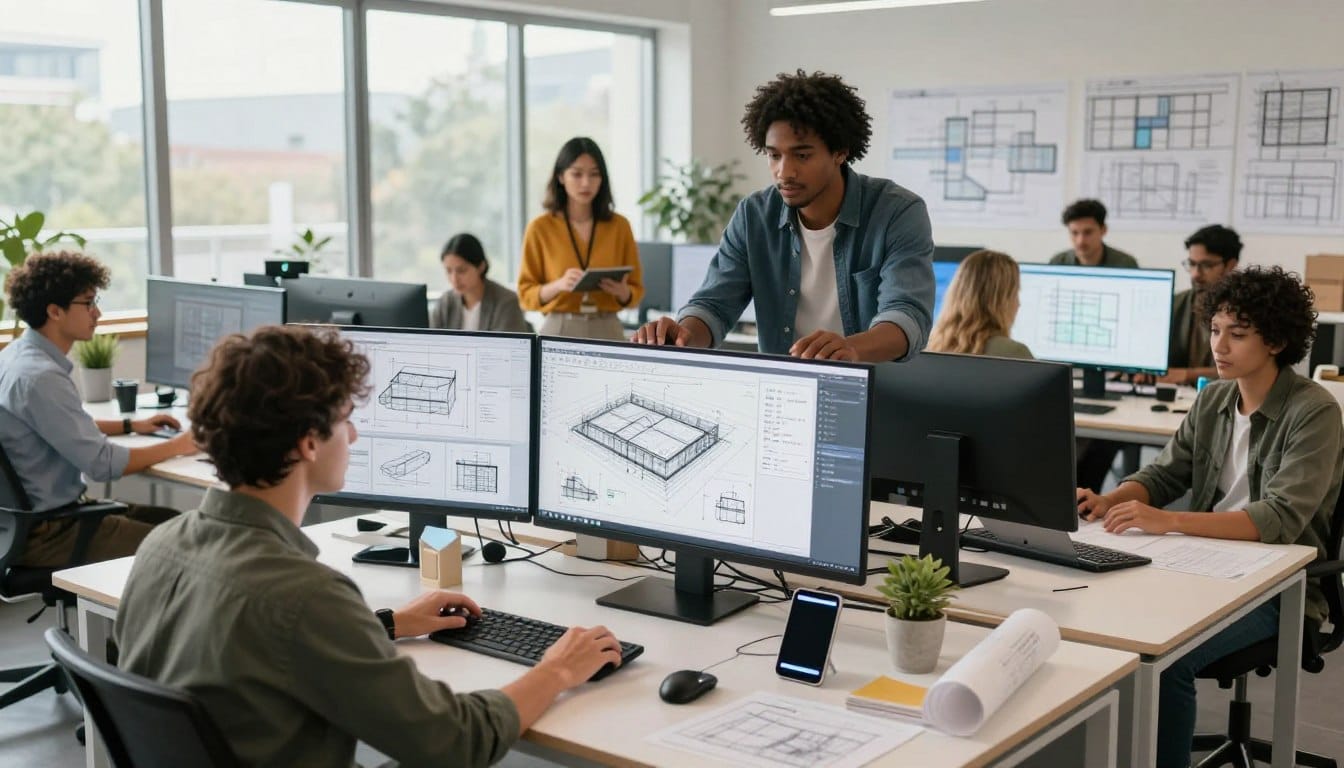
At practice level, studios use models to simulate environmental conditions and to resolve tricky junctions in assemblies. That use reduces errors and speeds documentation of complex work.
The Japan Pavilion at the 2025 Venice Biennale, curated by Jun Aoki, frames this change through the “in-between” a study of how machine intelligence asserts autonomy within design processes.
The Shift from Hype to Utility
Firms now prioritize systems that deliver measurable efficiency and performance gains. The emphasis is on components that enhance the ability to coordinate structure, envelope, and program across the whole project team.
- Practical systems resolve construction junctions and reduce human error.
- Digital models simulate climate and use to inform early design moves.
- Refined workflows turn experimental innovation into repeatable advantage.
Overcoming the Bottleneck of Unstructured Data
When critical content lives scattered across formats and silos, software cannot reason; projects stall and costs rise. IDC found roughly 90% of business information is unstructured, which creates a clear challenge for firms that want reliable outputs from complex systems.
Modular Architecture as a Strategic Advantage
Modular design lets teams treat models and services as interchangeable components. Aaron Levie of Box argues this approach reduces vendor lock‑in and speeds adoption of better model offerings.
- Normalize content across repositories so services retrieve authoritative information.
- Build a federated content layer to map documents and media with permission-aware controls.
- Invest in data organization up front to cut long‑term project cost and improve efficiency.
- Use modular systems to swap models and software without disrupting governance or research workflows.
Such an approach transforms how firms handle documentation and media. It makes services trustworthy, lowers risks, and preserves control over proprietary design information as the world of digital infrastructure changes.
Redefining Architectural Authorship in a Collaborative Era
The role of the architect has begun to shift from solitary author to coordinator of hybrid, networked authorship.
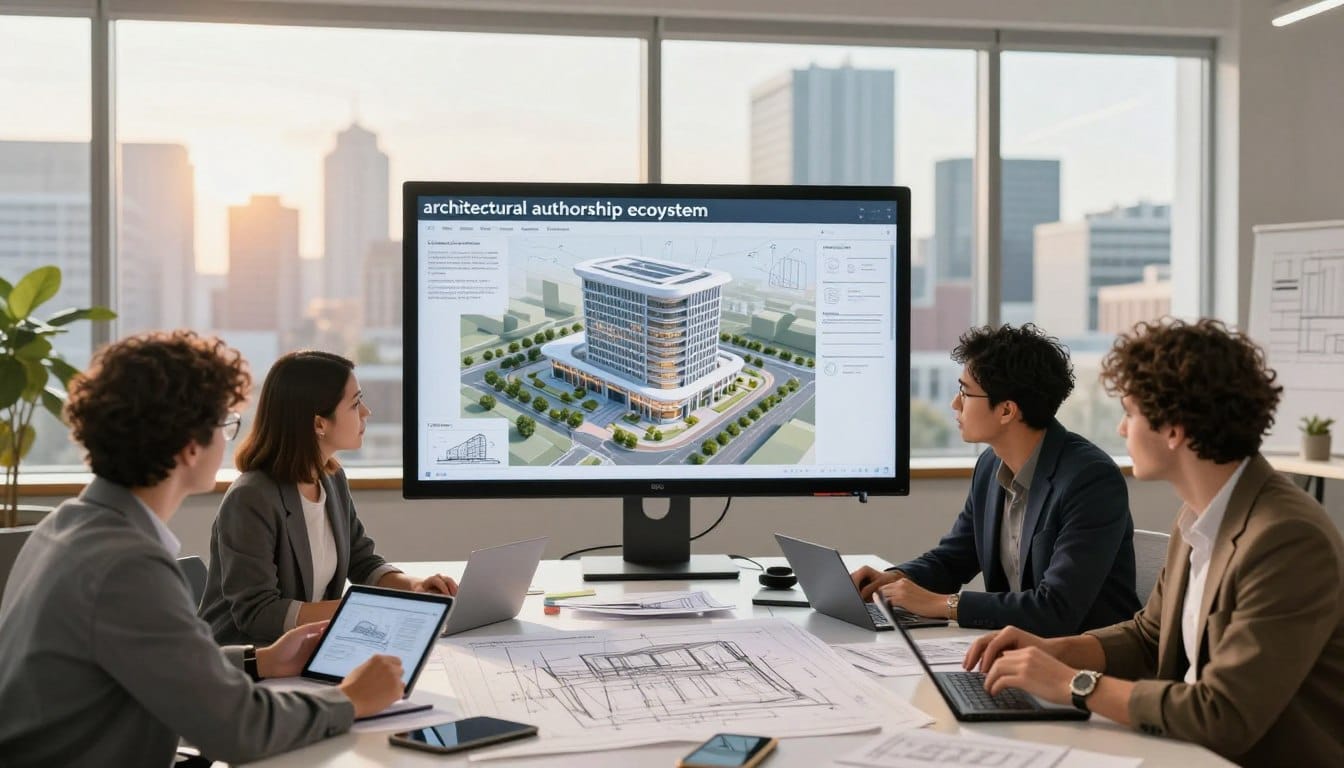
Exhibitions such as “Architecture of Possibility: Zaha Hadid Architects” at MOCAUP Shenzhen show how a studio expands its digital ecosystem and blends virtual environments with practice.
This year, generative software and distributed teams have made the authorship question urgent. Artificial intelligence now acts as a semi-autonomous agent that often returns outcomes beyond initial human expectation.
Project management must now balance human intelligence and machine-generated content. That requires new protocols for ownership, review, and ethical oversight.
- Distributed teams redistribute credit and responsibility across contributors.
- Systems produce content that needs human curation to fit programmatic goals.
- Workflows must record provenance so authorship remains traceable.
| Aspect | Traditional Model | Collaborative Model |
|---|---|---|
| Author | Single lead architect | Team + computational agents |
| Content Origin | Human drafts and sketches | Human + generated outputs |
| Management | Design manager | Integrated project management |
| Practice Outcome | Authored object | Networked, repeatable ecosystem |
Reaching the Limits of Transformer-Based Models
Across research labs and conferences, a quiet consensus has emerged: raw scaling of transformer layers no longer buys proportional reasoning gains. Adeia’s analysis and discussions at NeurIPS 2025 show performance curves flattening as energy and cost climb.
The Scaling Law Plateau
Empirical studies indicate a scaling law plateau where extra compute yields small returns in accuracy and reasoning. This pattern raises questions about the long-term viability of present models for complex project work.
Hardware and Energy Constraints
Energy budgets and hardware throughput now limit how systems train and serve large models. Firms face a challenge: invest in new infrastructure or shift approach to keep costs and environmental impacts manageable.
| Concern | Current Effect | Forward Response |
|---|---|---|
| Scaling limits | Diminishing accuracy per compute | Hybrid symbolic‑neural architectures |
| Energy & hardware | Rising cost and emissions | Hardware‑algorithm co‑design |
| Spatial reasoning | Poor handling of physical data | New reasoning models and components |
Researchers now explore architectures that reason about physical data with greater efficiency. Investment in research and infrastructure aims to build an ecosystem where intelligence and design meet lower cost and higher capability.
Emerging Paradigms in Computational Design
Computational design is shifting from pattern generation toward models that anchor reasoning in physics and sensor streams.
New systems now pair neuromorphic hardware with physics‑based foundation models. They ingest measured data from sensors and digital twins to predict performance and environmental response.
By treating multimodal input as native content, these approaches make design workflows causal and interactive. Architects can test how materials, light, and wind interact across a project at early stages.
Such paradigms create richer world models that reason about context and causality. That reasoning lets teams represent architectural knowledge and compare metrics like energy, comfort, and lifecycle cost.
| Approach | Primary Data | Reasoning | Typical Benefit |
|---|---|---|---|
| Physics‑based foundation models | Sensor streams, simulations | Causal physical reasoning | Higher predictive performance |
| Neuromorphic systems | Real‑time telemetry | Event‑driven reasoning | Low‑latency interaction |
| Multimodal software stacks | Images, BIM, sensor logs | Cross‑modal inference | Richer design insight |
Cultivating Living Materials through Digital Fabrication
Practices that blend living matter with robotic control ask architects to think of buildings as ecosystems, not objects. The Growing Matter(s) Pavilion by Henning Larsen Architects shows how mycelium and automated deposition can produce forms that continue to change after fabrication.
Merging Biological Intelligence with Robotics
This approach treats growth and decay as parameters that shape the final geometry. Robots seed and guide biological media so structures can act as agents of active repair across the built world.
Integrating mycelium into 3D printing cuts the cost of complex ornamentation. It also increases the ecological capacity of a project and reduces embodied waste.
The method alters design practice: teams must model biological timelines as part of context and construction. Living structures offer new ways to pair digital precision with biological adaptability. As fabrication media mature, the logic of the living becomes a tool for sustainable design and ongoing maintenance of work.
Conclusion
What matters today is whether systems help architects convert information into reliable project outcomes. The rapid evolution of artificial intelligence has shifted the profession from spectacle to measurable utility, altering workflows and the allocation of time across teams.
Success will hinge on sound data management, resilient infrastructure, and models that reason about construction, cost, and performance. Innovation now means building systems that support content provenance, project management, and long‑term efficiency.
By embracing these tools with clear governance and ethical care, the field can retain craft while meeting a more connected world. The future of architecture depends on the profession’s ability to guide technology toward public value and durable design.
FAQ
What practical gains do architects see when adopting intelligent design tools today?
How has the role of authorship in architecture changed with collaborative AI systems?
Why are unstructured data a bottleneck, and how can practices overcome it?
What is meant by modular architecture as a strategic advantage?
data ingestion, geometry engines, simulation modules so teams can upgrade parts without overhaul. This reduces vendor lock-in, accelerates testing of new models, and supports phased investment.Are transformer-based models still the best option for design reasoning?
What constraints on hardware and energy should firms anticipate when scaling models?
How can smaller practices access advanced computational design capabilities without excessive cost?
What emerging paradigms in computational design are worth watching?
How realistic is the prospect of integrating living materials in building fabrication?
biohybrids, cultured materials, and responsive membranes `but scaling requires advances in durability, regulatory clarity, and supply chains. Digital fabrication acts as the bridge, enabling precise deposition and hybrid robotic-biological workflows.What ethical and social risks arise when deploying intelligent systems in architecture?
How should firms measure return on investment for AI-enabled projects?
time savings, reduced change orders, energy performance with qualitative indicators such as design quality, client satisfaction, and team learning. Pilot projects with clear KPIs provide the best evidence for broader investment.