
Wood has moved from folklore to silhouettes, from huts and temples to towers reshaping city profiles. The appeal of mass timber is both material and cultural, promising bold openness and heights alongside speed, warmth, and lower carbon emissions. Projects like the 25-story Ascent in Milwaukee demonstrate that wood is no longer a niche material but a structural language for dense cities. The result is not nostalgia but a contemporary construction system with its own rules, standards, and beauty.

The Evolution and Rise of Wood in Contemporary Architecture
The resurgence of wood follows a shift in priorities from pure performance to performance and climate factors. Cities and customers are demanding buildings that can be constructed humanely and quickly while reducing carbon emissions. This places engineered wood at the center of policy and practice. Large-scale plans like Stockholm Wood City demonstrate that the market is no longer in the experimental phase but has entered the scaling phase. Height records moving from Mjøstårnet to Ascent reflect a competitive, evidence-based field rather than an innovation race.
Historical Heritage: From Local Architectural Styles to Monumental Wooden Structures
The reliability of wood dates back to ancient times and has been proven in temples and halls that have stood for over a thousand years. The Hōryū-ji temple in Nara houses some of the world’s oldest wooden buildings, making wood’s durability a cultural testament. Today’s mass timber towers transfer this legacy to urban infrastructure, where warmth and sensitivity meet rules and logistics. Here, history is not a museum reference, but a performance dataset that modern design builds upon.
Technological Advances: Engineered Wood, CLT, and Glulam
Standardized cross-laminated timber panels, compliant with the ANSI/APA PRG-320 standard, have been transformed into rigid, plate-like panels with two-way stiffness, serving as flooring, walls, and roofs. Glulam, defined and tested for decades, provides long, precise beams and columns with a high strength-to-weight ratio and impressive geometry. Together, hybrid frames enable rapid prefabrication, clean construction sites, and exposed surfaces that also serve the function of creating structure and space. They do not replace steel and concrete in every case; rather, they are complementary tools with different structural behaviors and standards.
Sustainability and Carbon Sequestration in Wooden Structures
Wood stores biogenic carbon throughout its service life and can replace higher-carbon materials, but calculations must be rigorous and life-cycle based. While the IPCC guidelines treat harvested wood products as a carbon sink using defined methods, recent research warns that assumptions about storage, decay, and land use can affect the results. The conclusion is clear in principle and requires careful application: use certified sourcing, design for longevity, and measure using transparent LCA methods. Well-designed wood buildings reduce concrete emissions and keep options open at the end of their life, but calculations must be defensible.
Regulatory Changes for Wooden Buildings and Developments in Fire Safety
The 2021 International Building Code established three high-rise wood categories—IV-A, IV-B, and IV-C—enabling buildings up to 18 stories tall with specific height, area, and protection limits. IV-A requires the complete encapsulation of solid wood elements to achieve a three-hour primary frame rating, while IV-B and IV-C permit calibrated exposure under defined conditions. Full-scale tests conducted by ICC partners, NIST, and NFPA demonstrate performance consistent with predictable charring, delayed intervention with gypsum protection, and modern fire strategies. The codes are not permissive for wood; they are a conservative framework built on testing and redundancy.
2. A Definition of a “Masterpiece” in Wooden Architecture
A masterpiece made of wood is more than just its height or innovation. It strikes a balance between the structure’s solidity, the clarity of its form, and its harmony with the space, which inspires confidence and care. Award frames reflect this balance by demanding design excellence, suitability for purpose, context, and sustainability. In wood, this balance must also demonstrate honest construction, delicate details, and measurable performance over time.
Criteria: Structural Innovation, Aesthetic Integrity, Contextual Harmony
Structural innovation is legible and testable, not a spectacle. Ascent and Mjøstårnet have proven this ambition by developing this type with validated high-rise timber systems that publish height, materials, and methods. Aesthetic integrity means that form, connections, and openings can be clearly understood when viewed in daylight and up close. Contextual harmony links the program and mass to the local climate, craftsmanship, and culture. This can be seen in civil wood projects such as Sara Kulturhus, which incorporates public use into the regional wood tradition.


Materials and Labor: Details, Carpentry, Finishing Touches
Craftsmanship is evident in the connections. Reference standards for glulam and log wood connections regulate shrinkage, moisture, tolerance, and fire protection, because uncontrolled craftsmanship fails during service. Sample projects incorporate carpentry work as part of the architecture. Tamedia’s open timber frame with interlocking elements that eliminate visible steel is one such example. The coatings protect the fibers from UV rays and abrasion while preserving the readability of the grain, ensuring the surface and structure remain harmonious over time.


Spatial Experience: Light, Texture, Acoustics
Beautiful wooden buildings exhibit a harmonious appearance even before they are measured. Light caresses the wood’s grain and corners, creating depth, while texture balances scale and touch in lobbies, halls, and rooms. Acoustics must be handled with the same care, as CLT and other mass timber systems have specific workarounds that require layered assemblies and tested details to meet privacy and reverberation targets. When sight, sound, and surface are in harmony, the space gives a quiet, warm, and sensitive impression.
Longevity and Adaptability: Durability Over Time
Wooden masterpieces are designed for change. The design, which is suitable for dismantling, guides the connection elements, grids, and layers, enabling future work to be carried out with minimal waste and clear sequencing. Long-lasting performance also depends on realistic hybrid systems, such as Mjøstårnet’s selective use of concrete panels for comfort and acoustics within a completely wooden frame. Durable details, easy-to-maintain surfaces, and an adaptable plan give wood architecture a second and third life without losing its character.
A Wooden Architectural Masterpiece That Was a Turning Point
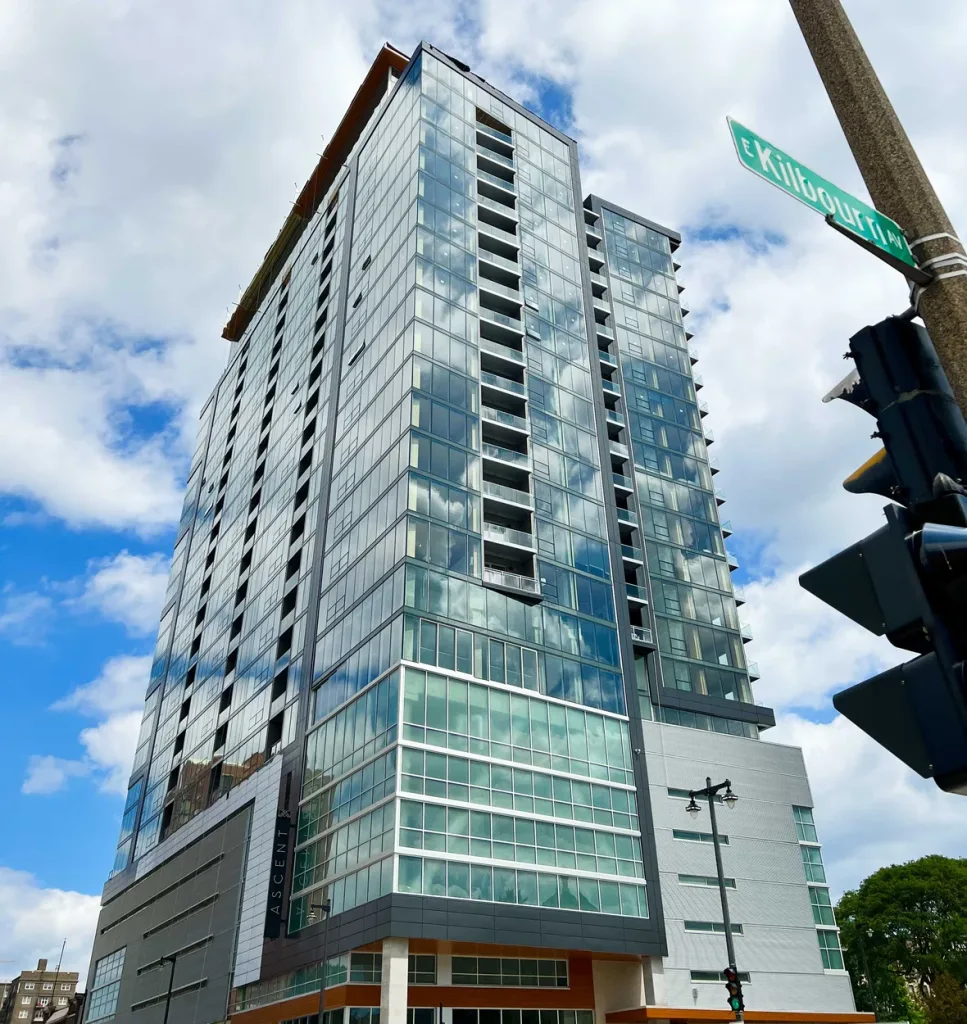
The Ascent in Milwaukee serves as a clear reference point for large-scale timber structures in an urban setting. This building combines ambition with evidence through a mixed-use system that spans 25 stories, 284 feet, and reassures both officials and investors. The building’s podium and tower composition carries wood into the silhouette while keeping the cores and parking in concrete where they are most effective. This structure is not a material experiment but reads as contemporary urban housing with a warm structural interior.
Project Introduction and Key Information (Location, Size, Architect)
Located in downtown Milwaukee, Ascent is a 25-story residential tower with 259 units, built on a six-story podium, spanning 493,000 square feet. Designed by Korb + Associates and with structural engineering by Thornton Tomasetti, this building was recognized by CTBUH and other organizations as the world’s tallest mass timber hybrid building upon completion. The tower consists of a 19-story solid wood structure on a tensioned concrete base, with social facilities on the top floor. These features make the tower both a record holder and a fully functional part of the city.


Design Rationale and Conceptual Vision
The concept is quite simple: expressing the structure as a space, revealing wood in areas that enrich daily life, and using hybrid systems in areas that require performance. Approximately half of the wood is left visible to create a biophilic effect, achieving harmony between the building’s structural reality and health and identity. The US Forest Service Wood Innovation Grant, by supporting testing and knowledge sharing, demonstrated that the project’s goal was not a single solution but the development of a type. The result is a calm and sensitive interior wrapped in a contemporary façade that protects wood and presents a confident urban image.
Structural Systems and Load Paths in Wood
Gravity loads are transferred to a grid consisting of CLT floor panels and unidirectionally glued laminated beams, then to the concrete podium and foundations. Lateral loads are resolved by full-height reinforced concrete cores, with CLT acting as a diaphragm to transfer forces to the cores. This combination was chosen for its stiffness, code clarity, and construction logic, and has been validated through project-specific testing and peer reviews. In short, while the wood frame construction handles the timber room construction and a large portion of the opening, the concrete handles the parking, cores, and system anchoring work.
Material Selection, Finishing, and Detailing Strategies
The mass timber package was sourced from established Austrian suppliers: glulam produced by Wiehag and CLT produced by KLH provided tight tolerances and fast installation. Approximately 50% of the interior wood remains exposed, while connections and selected elements are protected or encapsulated to meet fire resistance standards proven in tests conducted at the Forest Products Laboratory. Prefabrication using pre-drilled elements and a coordinated digital model kept site work clean and fast, supporting quality at the connection points where craftsmanship and performance converge. Surfaces were kept minimal to highlight the architectural character’s veins, light, and proportions.
Performance and Challenges in Real-World Use
Thermal Behavior, Insulation, and Moisture Control
Wood provides better thermal insulation than steel or concrete, but its mass still requires an appropriate thermal envelope: continuous insulation to eliminate thermal bridges, a rain screen for drainage, and a vapor strategy to allow joints to dry. Current regulations increasingly mandate or encourage continuous insulation that reduces thermal bridging at edges, balconies, and connection elements. Hygrothermal studies conducted on CLT show that temperature and moisture move together across the panel; detailing must keep dew points away from sensitive layers. Field observations in buildings such as Peavy Hall confirm that wet wood can dry if large amounts of water are diverted and drying pathways are real, particularly at interfaces beneath cladding and membranes. Design according to the “4 Ds” of deflection, drainage, drying, and durable materials, then validate with climate-appropriate modeling and on-site moisture management.
Acoustic Performance and Vibration Control
Bare CLT floors are acoustically very “direct”; they require additional mass, flexible layers, and careful side control to meet multi-family or lodging objectives. Tested assemblies typically pair wood panels with coverings and separators, and recent multi-building studies map which connection paths cause the most sound leakage, allowing details to block them. Vibration creates a different comfort threshold: The response caused by walking typically dictates panel thickness, spacing, and cladding choices, and designers now use system-level guidelines and on-site measurements to fine-tune performance. This model is consistent in case studies: Increase stiffness and damping where people move, separate coverings, and document results with tested installations rather than assumptions.
Maintenance, Durability, and Aging of Wooden Elements
Outdoor wood deteriorates due to UV rays and water: the fibers photodegrade, the surfaces crack, and when left unprotected, the surfaces chalk, all of which increase the maintenance burden. Durability starts with species and exposure class, then coatings and protective treatments are added where the risk is higher; standards such as EN 350 classify natural resistance, while manuals summarize coating life and recoating cycles. Routine inspections are more important than heroic actions: ensure free drainage at edges, protect end grains, reseal cracks before water ingress, and plan cleaning and recoating according to orientation and climate. For solid wood used indoors, the main factor determining service life is protection from frequent moisture and leaks, not pressure fatigue. Good detailing makes maintenance predictable; poor detailing makes maintenance constant.
Renewal, Repair, and Life Cycle Flexibility
If you are planning changes, wood is a good choice: reversible screws and plate connections, accessible joints, and modular grids allow for disassembly, replacement, and reuse. Research and case studies on “design for disassembly” show how connection options determine whether elements can be pulled apart, re-rated, and reused rather than scrapped. In vertical extensions of existing buildings, mass timber is increasingly being used due to its lightness and speed, provided the existing frame and fire strategy are reassessed; documented projects and feasibility studies summarize the structural and code steps. When damage occurs, standards and technical notes explain how elements should be assessed and repaired, including localized epoxy plus mechanical repairs under post-fire planing, reinforcement, or engineering review. End-of-life studies emphasize reuse first, followed by recycling or energy recovery, and LCAs demand clearer, time-sensitive carbon accounting to maintain the credibility of claims.
Broader Meanings and Future Directions
Mass timber is shifting from individual buildings to region-scale strategies and linking climate goals to faster and cleaner construction. Stockholm’s plan demonstrates how an entire neighborhood can be organized around timber supply chains, rapid assembly, and measurable carbon reductions. High hybrids point to a pragmatic future where wood is combined with steel or concrete to meet height, strength, and regulatory requirements. Education and robotics are bridging the gap between ambition and repeatable delivery.


Wooden Visions at the Urban Scale: Wooden Cities and Tall Wooden Towers
Stockholm Wood City is expanding this concept to a 250,000 m² area, incorporating 2,000 residential units and 7,000 workspaces, thereby advancing log construction from a pilot project to a policy phase and commencing delivery in the near term. The project’s standout features are not just carbon reduction, but also speed, calmer construction sites, and a quieter city during construction. In parallel, high-rise timber construction records and proposals continue to advance. Commercial hybrids like Ascent and Atlassian Central, certified by CTBUH, utilize timber in high-rise systems. Urban design is learning to approach timber both as a material and a strategy.


Interdisciplinary Trends: Digital Design, Robotics, and Wood Manufacturing
Robotic prefabrication eliminates tolerances that were previously dependent on manual labor by transforming irregular wooden frames into precise, repeatable modules. ETH Zurich’s Spatial Timber Assemblies and DFAB House demonstrate the entire process from model to robot to building, with just-in-time cutting, placement, and quality control. This is applied DfMA, where design, structural logic, and toolpaths are created together. The result is more geometry per hour, fewer errors, and factories that learn from data.


Hybrid Materials and Composite Strategies (Wood + Steel/Concrete)
Composite wood-concrete floors extend spans, stiffen vibration response, and increase acoustic mass by using moisture- and construction-sequence-adjusted shear connectors and coverings. Guides now codify these assemblies, transforming one-off details into standard practice. At the tower scale, many leading designs are hybrid: wood floors and columns work with concrete cores or steel exoskeletons to meet deflection, fire, and egress requirements. Hybridity is not a compromise; it is the engineering that enables wood to reach the urban scale.
Training Architects and Shaping the New Generation of Wood Design
The ecosystem is rapidly maturing: Updated Log Design Guides guide teams from the concept stage to the detailing stage, while TDI and UBC organize focused courses, tours, and micro-certifications that train practitioners in months rather than years. The World Timber Engineering Conference brings together research and applications, and Eurocode 5 updates point to evolving design rules for strength and diaphragm behavior. The result is simple: Training is no longer an obstacle, but a factor accelerating scaling.