

Architectural Mycelium
What is a misel and how does it grow?
Mycelium is the branched, root-like network of fungal hyphae that colonizes plant material and binds loose fibers into a cohesive mass. In a mold filled with agricultural waste such as hemp stalks or straw, the hyphae digest lignocellulose and bind the particles together into a lightweight, porous composite. Once the desired shape is achieved, the piece is dried or heat-treated to halt growth and stabilize the material, then density and strength are adjusted through compression steps. This process yields panels or blocks produced with low toxicity, recyclability, and minimal energy consumption.


The evolution of biomaterials in contemporary architecture
Biomaterials have evolved from local traditions toward climate-focused innovation. Mushrooms, wood, straw, fungus, and hemp stand out as serious low-carbon options. This field is shifting from extraction and combustion toward cultivation and harvesting. Thus, buildings can be grown, used, and then safely returned to biological cycles. Recent design reports highlight the rise of mycelium alongside other bio-based systems, driven by the need to decarbonize the construction sector and reform certification regimes that favor non-degradable petro-materials. This cultural shift positions mycelium as part of a broader material ecology rather than a niche experiment.
Why are architects turning to mushroom-based materials?
Mycelium composites transform waste into components with useful performance characteristics: low thermal conductivity for insulation, acoustic absorption, and suitable fire behavior due to charring. Life cycle studies indicate that when energy inputs are controlled and material selection is aligned with carbon budgets, there is potential for very low or even net negative carbon emissions. Prototypes such as The Living’s Hy-Fi have brought laboratory characteristics to a public testing environment, demonstrating form freedom and compostability at an architectural scale. These characteristics make mycelium attractive for partitions, interior panels, and temporary structures where circularity and lightness are important.
Overview of the potential and current limitations of miselin
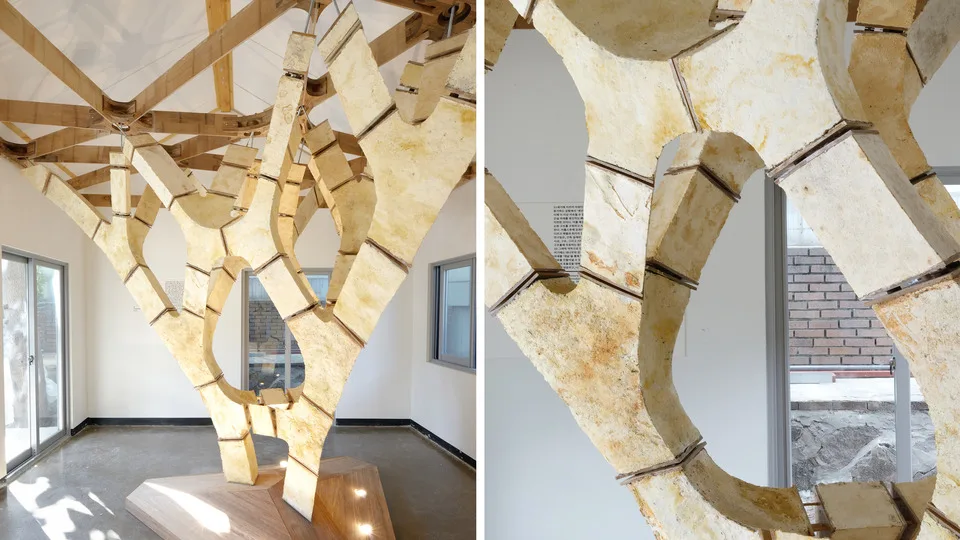
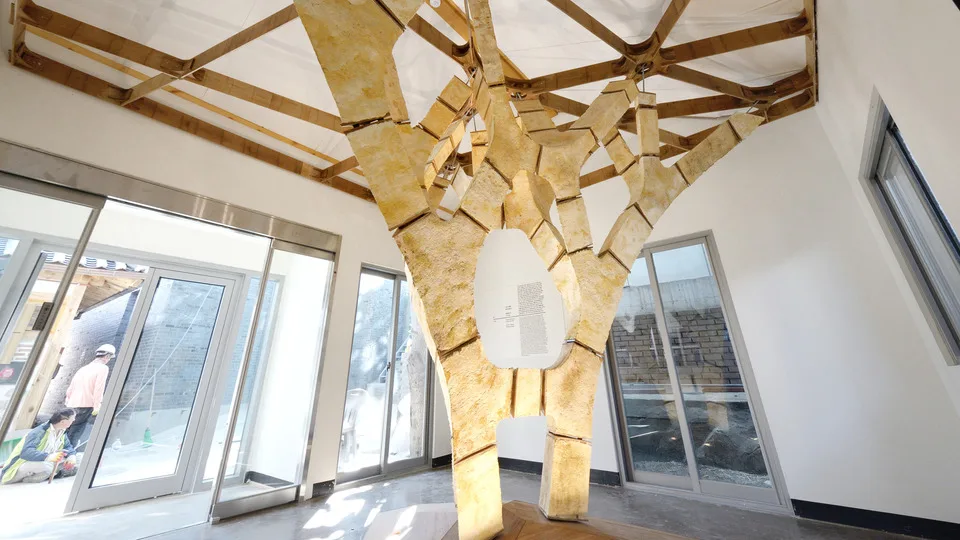
Technically, mycelium boards can achieve insulation values comparable to traditional foams, with reported thermal conductivities in the range of approximately 0.04–0.06 W·m⁻¹·K⁻¹, and exhibit low heat release rates in fire due to protective char formation. However, structurally, their compressive strength falls far below that of a fired wall, limiting primary load-bearing applications to specialized compressed geometries or hybrid systems. Durability is a key concern: The same biology that enables compostability also means that unprotected composites can degrade or mold within months when exposed to high moisture or soil contact, necessitating coatings, densification, and careful detailing. Even so, constructed experiments like Hy-Fi and research studies like MycoTree show a reasonable path for internal components, temporary works, and circular assemblies as codes and production methods mature.
Material Properties and Structural Potential
Physical and mechanical properties of mycelium composites
Mycelium composites behave like bio-foams: fungal hyphae weave plant fibers into a porous solid material, and the density of this solid material can range from lightweight to particleboard-like values, varying between ~25 and ~950 kg/m³ depending on the substrate and processing. Strength is in the kPa to low MPa range and increases with densification and fiber orientation, allowing designers to engineer stiffness and fracture modes similar to engineered wood or foam cores. The material’s behavior is determined by a two-phase particulate composite, as it is in reality, so particle size, anisotropy, and packing determine the elastic response and ultimate strength. Unless the surface is protected, weather conditions and humidity degrade performance, framing mycelium panels as systems that require coating, detailing, and controlled exposure to deliver on their promise.
Heat, sound, and fire resistance performance
Thermally, mycelium boards typically fall within the range of 0.03–0.07 W/m·K, which is comparable to commonly used insulation materials. However, the literature indicates a wider range of 0.025–0.105 W/m·K, depending on tension, substrate, density, and test method. Acoustically, they behave like open-cell absorbers, and their normal incidence absorption coefficients often peak around 0.8–0.9 in the mid-band, making them natural candidates for interior noise control. In fire, cone calorimetry conducted on mycelium-brass shell panels shows significantly lower peak heat release rates and smoke compared to XPS (PHRR ≈ 133 vs. 536 kW/m² under 50 kW/m² light intensity) due to char formation and mineral content in some substrates. Taken together, the profile insulation class thermal performance, room-friendly acoustics, and careful formulation are rewarded with a relatively quiet fire signature.
Sustainability features: concrete carbon, biodegradability, and circular economy
LCAs demonstrate that impacts from cradle to gate are remarkably low: In a study compliant with EN 15804+A2, it is stated that the lightweight hemp-based mycelium composite has ~0.367 kg CO₂e per kilogram, with electricity supply and substrate cultivation being the most significant problematic areas. As the raw material is an agricultural or forestry by-product and the binder is cultivated, the material can store biogenic carbon during use and adapt to circular flows that locally evaluate waste. Biodegradability is a characteristic at the end of its life, but it must be balanced with responsible methods that ensure durability and prevent uncontrolled decay throughout its service life. Scenario studies conducted at the city scale show that when produced with clean energy and widely used, mycelium insulation can transform building stocks into meaningful carbon sinks rather than just a burden.
Challenges and limitations: scale, certification, durability
Scaling from gallery pieces to code-compliant products depends on standardization: variability between types, sublayers, and growth cycles complicates predictable performance and slows certification. Recent compliance studies show progress in bending, thermal, and fire response criteria, but long-term moisture response and mold resistance remain obstacles, and some mycelium fiber boards still fail to meet traditional EN thresholds without additional processing. Weathering tests document power loss in unprotected panels over weeks in hot and humid environments, highlighting the necessity of coatings, barriers, and careful placement in installations. Policy reviews echo the same theme: without harmonized testing methods and product standards, the market adoption will remain a niche area despite strong sustainability foundations.
Design Considerations for Architects
Architectural programming and integrating mycelium materials into the summary
Start with areas where the strengths of bio-composite already meet requirements: interior partitions, acoustic cladding, and temporary or removable elements that benefit from lightness, open porosity, and low carbon emissions. Hy-Fi’s compostable brick tower and recently factory-produced mycelium wall and ceiling panels demonstrate realistic entry points for exhibition, furnishing, and affordable housing pilot projects. Aim to align with full life-cycle carbon accounting and circular flows, so components can be returned to biology or remanufactured rather than sent to landfill. Since moisture sensitivity is a design constraint rather than an afterthought, establish controlled moisture zones and clear protection strategies.


Form creation, mold design, and biomimetic geometry with mycelium
Design the geometry to perform structural tasks your material cannot handle: compression-focused forms and cable logic ensure safe operation of composites that are weak in tension. MycoTree’s growing nodes and bamboo supports demonstrate how 3D-printed static and digitally manufactured molds transform a fragile material into a robust branched framework. For continuity without joints, the woven permanent mold enables paste-based growth of monolithic shells with enhanced post-processing hardness. Since growth conditions and substrate grading directly shape mechanical behavior, consider the mold as a micro-ecology that directs density, fiber orientation, and surface quality.
Construction logistics: growth, final processing, assembly, and maintenance
The delivery chain is biological and then architectural: pasteurize or sterilize the substrate, inoculate it, grow it to the target density, then deactivate it by drying or heat, and finally cut and press it according to specifications. The final process is not cosmetic; as research has shown, thermal treatment and hot pressing increase stability and reduce heat release, determining moisture response and fire behavior. Plan assemblies as replaceable cassettes with rear ventilation, drip trays, and covers, and keep biocomposites away from large amounts of water, as mycelium fiber boards can absorb significant moisture without barriers. Maintenance is similar to wood maintenance: control exposure, seal edges, monitor joints, and design for easy replacement of contaminated or damaged panels.
Regulatory, life cycle, and end-of-life strategies for mycelium-based buildings
Compliance through existing frameworks: Fire response is classified according to the EN 13501-1 standard, and early guidelines on mycelium insulation indicate target classes as official certifications mature. Document impacts with LCA compliant with EN 15804. Recent research reports low cradle-to-gate CO₂e values and highlights electricity and substrate cultivation as key points for decarbonization. Considering that coatings and hybrids may limit compostability, design waste from day one by following circular playbooks that prioritize disassembly and material cycles at the highest value. At end-of-life, national fire codes evaluate systems rather than materials alone, so test the entire structure and specify recoverable fasteners to ensure reuse or safe biological degradation at the end of its service life.