


Operational Workflow and Spatial Efficiency
In efficient restaurant layouts, circulation for staff should be parallel but separate from guest traffic. As one architect noted, “efficient circulation paths for customers and staff are essential to keep people and food moving efficiently”. A common strategy is to direct the flow of staff against the flow of guests, with one-way aisles that minimize face-to-face transitions.
- Corridor Width: Main service corridors should be wide enough for staff and equipment. Guidelines recommend at least 900 mm (≈36″) for a single waiter path, widening to 1050-1350 mm when cars or multiple servers pass by. (In practice, many designers use 1.2-1.5 m for high-traffic back-of-office corridors). Sufficient width reduces collisions and allows passage even during peak load.
- Zoning and Adjacency: To shorten routes, the back of house should be zoned according to its functions. Cluster storage/receiving areas near the kitchen entrance; place prep stations near the cooking area; and place dishwashing/cleaning areas where dirty plate traffic can easily exit the dining area. Good design places cleaning (dishwashing) zones away from food preparation zones to avoid cross-contamination, but with direct access to waste disposal and the kitchen. In short, each zone (prep, cooking, serving, cleaning) is adjacent to related tasks and feeds into service corridors, minimizing zig-zag movement.
- Peak Load Planning: Designers should analyze peak periods (“peak hours”) and make sure that hallways can handle simultaneous tasks (two cooks carrying trays, servers returning used plates, cleaning staff with carts). This may mean providing double sinks or workstations near serving windows and extra aisle space. Many fast-casual chains (Chipotle, Popeyes, McDonalds) use a linear “assembly line” kitchen layout so that multiple staff members can work sequentially on a common path in line with the continuous flow of customers. Fast-casual designers also take customer queues into account by placing self-service stations (drinks, condiments) separate from seated diners after the ordering line to prevent queues from spilling into the food aisles.

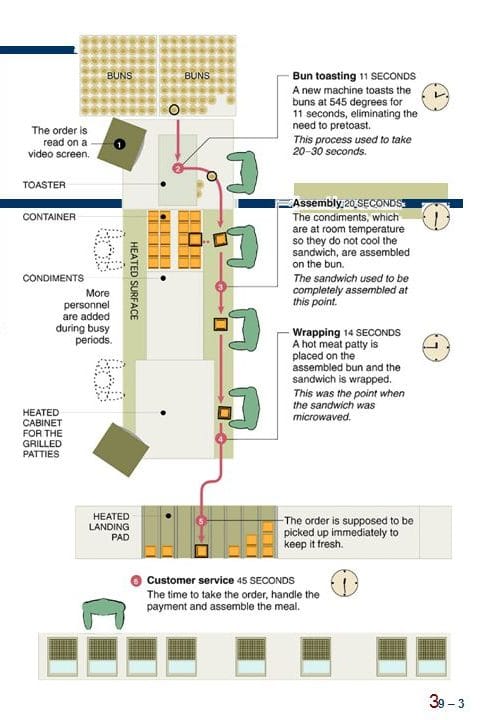
- Human Factor: Walkways should allow easy push-pull movement (avoid tight turns) and access distances should be ergonomic. Lighting and sight lines in corridors help staff to quickly see target desks or stations. Signage or color coding can guide staff through complex areas. Overall, a simplified, almost loop-like circulation (often U-shaped) for staff and a minimum of dead ends ensures the smoothest workflow.
Health, Safety and Code Compliance
All service corridors must comply with building, fire and health regulations. Key requirements include:
- Exit and Fire Safety: Life safety regulations (e.g. NFPA 101/IBC) require at least two independent exits and prohibit the use of the kitchen or storage room as an escape route. Corridors used for egress must be completely unobstructed. Exit corridors must have minimum clear widths (typically 36″ or more) for evacuating customers and staff and be accessible for people with disabilities. Exit routes should be organized so that one hazard (fire in the kitchen) does not block all exits. Any fire-rated separation (a 1-hour wall between the kitchen and dining area in a meeting space) must have self-closing doors in the service corridor. Emergency lighting and exit signs should clearly mark all routes and panic hardware on doors should never block hasty egress.
- Accessibility (ADA): Common areas and staff corridors must allow wheelchair access. This means a minimum clear width of 915 mm (36″) in corridors and a minimum clear opening of 815 mm (32″) at doorways. Floor surfaces must be smooth, slip-resistant and free from sudden changes in level. Ramps or elevators are required if personnel paths change level. In practice, many design guidelines adopt a 1200 mm (48 in.) clear aisle for high-traffic corridors to overcome these requirements and improve maneuverability.
- Access to Ventilation and Utilities: Commercial kitchens require significant HVAC and oil exhaust equipment. Corridors must allow maintenance access to these systems without dismantling structures. In particular, NFPA 96 mandates that exhaust ducts include access panels for intermittent cleaning so that grease cannot accumulate unchecked. Hoods and fans must also have service clearances per mechanical codes (typically ~24″ around devices). For hard-to-reach mechanical shafts, it is wise to plan locked maintenance corridors or hinged panels (so that installers and contractors can open them for inspection without disrupting operations).
- Fire Extinguishing: All cooking lines should be equipped with approved fire extinguishing systems. The layout should provide unobstructed access to pull stations and extinguishers. Special care should be taken where flammable substances are stored; alcohol or gas cylinders should usually be in a ventilated compartment separate from the main corridor. The corridor itself should not be used for the storage of flammable substances.
- Hygiene and Sanitation: Health rules require the use of durable and cleanable surfaces in NCD corridors. Kitchen and dishwashing area floors should be smooth, non-absorbent and easily cleanable. Many regulations (California Retail Food Code) require floors to be recessed into walls (minimum 3/8″ radius up to ~100mm) to eliminate joints. Walls in prep and dishwashing areas should likewise be tiled, FRP or painted with washable epoxy. Planning should include floor drains with glycol or waterless traps where necessary (usually in dishwashing and mopping areas) and adequate lighting for inspections. All food zones should have easy access to handwashing sinks at entry points to prep/cooking areas. In short, corridors and service areas should use industrial-grade floor and wall materials that can withstand constant cleaning without harboring mold or grease.
- Utilities and Maintenance: Corridors often house utility lines (gas lines, power lines). Design open spaces for maintenance: A duct or service corridor for electrical panels/valves, separate from main traffic routes where possible. All junction boxes and valves should be labeled and located in illuminated, accessible locations. Consider future code inspections: Leave removable panels at convenient heights for HVAC ducts and plumbing closures.
Integration with the Home Front and Guest Experience
Well-designed service corridors should be virtually invisible to diners. Strategies include:
- Acoustic Separation: Use sound-absorbing finishes and barriers to prevent kitchen noise from invading the dining room. Designers often create “acoustic zones” in hallways adjacent to dining with heavy curtains, ceiling baffles or acoustic panels. For example, Ever Restaurant (Chicago) treated the entrance hallway as a sound buffer: hand-laid plaster walls and custom ceiling baffles “mute” traffic noise as guests approach the dining room. More simply, mechanical rooms and dishwashers should be in acoustically insulated cabinets or silenced with acoustic sealant on doors. To reduce sound transmission, separate corridors with absorbent curtains or filled niches. The aim is that noise and sounds from backstage are not carried into the dining environment.

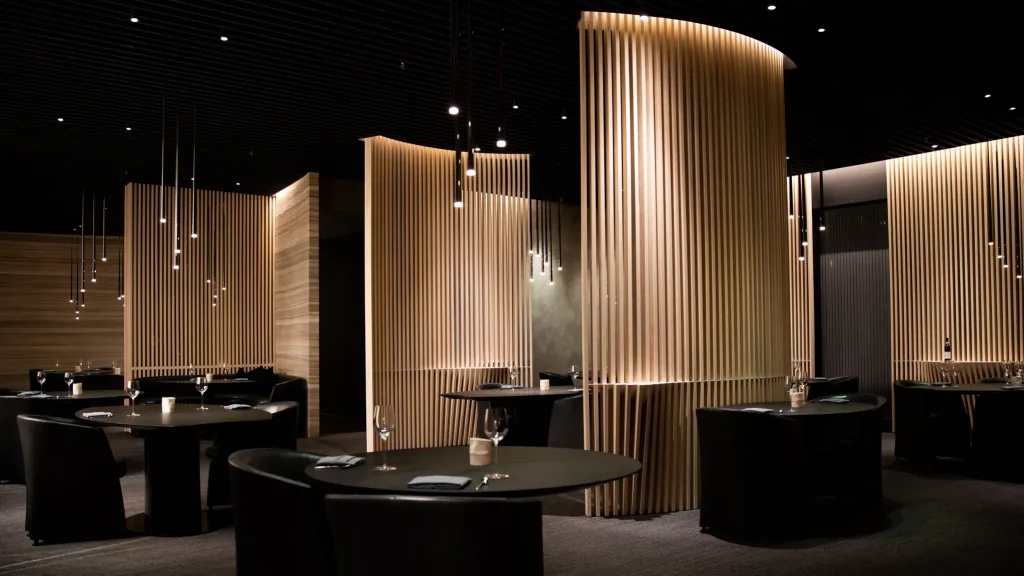
- Visual Screening and Design Continuity: Hide staff traffic and storage behind tasteful finishes. Corridors and doors used by staff should match the design language of the restaurant. Common techniques include recessed wood-paneled doors or wall partitions that hide access points. In one layout, the kitchen pass-through countertop is protected by a low partition wall, creating a private space for staff and hiding stacks of plates. Where a door is needed, it can be framed so that when closed it appears as just another panel or notice board. Carefully chosen color or material changes can be used at transitions between zones (kitchen to service corridor) so that staff know they are leaving a prep zone, but diners only see consistent decor.
- Flow Separation: Wherever possible, separate guest paths from service paths. Separate rear entrances for deliveries from dining room entrances and use a screened vestibule at entry points. As one design example notes, an entryway can “create an acoustic and thermal barrier” between the noisy kitchen/back of house and the quiet dining room. Servers or runner stations often act as buffers – customers are escorted from the entrance to the dining area without seeing the service corridors. In large designs, the front and back stairs/elevators should be opposite each other so that servers and servers are never in customers’ line of sight. In short, hide or direct all service traffic away from tables so that diners neither see nor hear them.
- Protecting the Experience: Ultimately, the guest experience dictates hallway design details. Fine-dining restaurants often emphasize décor continuity: the same stone or wood used in the dining room can cover the ceiling of a hidden hallway, making a food cart magically disappear beyond the threshold. Some high-end venues even use differences in scent or lighting at service entrances to psychologically “cleanse” the transition from work to leisure. (A well-known example: Noma 2.0 in Copenhagen deliberately “dissolves the idea of the traditional restaurant” by placing chefs in the center and allowing guests to observe preparation. Here, the open layout is a design feature in itself – but even Noma uses zoning to keep moving carts on the perimeter of the dining area). As with all design elements, the cladding of the doors and walls leading to the serving areas should be “felt” as part of the story, not an afterthought.


Example – Fast Casual (Chipotle style): In fast-casual chains, the kitchen is usually open but linear. Customers move along a service line (food “conveyor”) while staff work behind a long counter. Designers keep the aisle behind the counter straight and uncluttered so that staff can easily walk back and forth. Beverage stations and dispensers are placed at the end of the line, well away from seating, so that waiting guests don’t block staff or tables. Chipotle’s model inspired many of these choices: by placing self-service drinks at the end of the line, the designers allow guests to queue without blocking diners.


Example – Fine Dining (Ever Restaurant): At Ever in Chicago, acoustics and aesthetics are aligned in the service design. Guests enter a light foyer and follow a corridor lined with bespoke acoustic plaster and wood paneling. The corridor itself creates a sensory transition, “muting” sound as it moves towards the dining room. Hidden doors in the corridor provide direct access to staff without breaking visual continuity. This illustrates how even ancillary spaces can be shaped to enhance the dining drama.
Every restaurant’s solution is different, but the overall goal is universal: staff must move efficiently, safely and largely out of sight of guests. By applying circulation analysis, ergonomic planning and the above rules, architects can design back-of-house corridors that meet operational needs without compromising the dining experience.